

223
6.4
Determination of Consumption Rates and Benthic Fluxes
6.4
Determination of Consumption
Rates and Benthic Fluxes
6.4.1
Fluxes and Concentration Profiles
Determined by In Situ Devices
One reason for determining changes of oxidant
concentrations or consumption / production rates
in the pore water fraction of a sediment is to
quantify the underlying respiration processes and
to define the reactive horizons. Until today,
however, there is no method to determine oxic
respiration directly. Total oxic respiration has to
be calculated from the difference between the
oxygen demand of the sediment and the amount of
oxygen consumed by oxidation of reduced species
(see above). There are two main methods to
determine diffusive or total oxygen uptake rates in
deep-sea sediments. These are (1) the application
of microelectrodes and optodes to obtain one- or
even two-dimensional (planar optodes) depth
profiles and (2) benthic chambers to reveal total
areal uptake rates (cf. Section 12.2). Clark-type
microelectrodes as they are commonly in use since
more than two decades (e.g. Revsbech et al. 1980;
Revsbech and Jørgensen 1986; Revsbech 1989;
Gundersen and Jørgensen 1990) and the more
recently invented optodes (Klimant et al. 1995)
have become a driving force in performing
measurements of oxygen consumption and
penetration depths in any kind of soft sediment.
Since a couple of years the two-dimensional
oxygen distribution can be determined by socalled planar optodes (Glud et al. 1996) showing
an excellent correlation with measurements
performed with microelectrodes. For the general
principles of microelectrodes and optodes and
their application in the deep sea we refer to the
description in Section 3.5 and the references
above.
Within the past two decades benthic lander
systems have been increasingly applied in the
deep-sea (e.g. Berelson et al. 1987; Jahnke et al.
1997; Reimers et al. 1992; Wenzhöfer et al., 2001a)
to avoid artefacts resulting from sediment
recovery (see discussion below). Some results
obtained by these devices have already been
shown in Chapter 3. The microelectrodes or
optodes provide information on the oxygen
penetration depth and its depth-dependent
distribution, whereas the benthic chambers
measure total fluxes across the sediment water
interface. There is generally good agreement of
fluxes obtained by both methods (Jahnke et al.
1990; Fig. 12.10), but total fluxes might exceed
calculated diffusive fluxes from oxygen profiles.
While diffusive transport of pore water is the
dominant process in the large area of the
oligotrophic oceans where the input of degradable
organic matter to the sea-floor is low (Sayles and
Martin 1995), this is not the case adjacent to
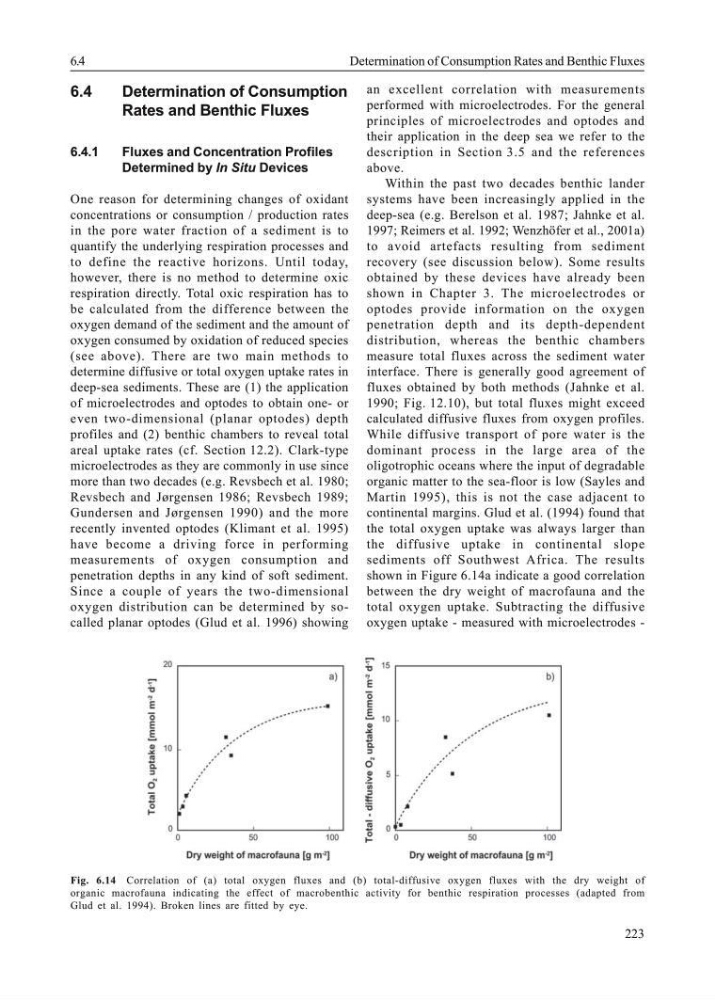
continental margins. Glud et al. (1994) found that
the total oxygen uptake was always larger than
the diffusive uptake in continental slope
sediments off Southwest Africa. The results
shown in Figure 6.14a indicate a good correlation
between the dry weight of macrofauna and the
total oxygen uptake. Subtracting the diffusive
oxygen uptake - measured with microelectrodes -
Fig. 6.14 Correlation of (a) total oxygen fluxes and (b) total-diffusive oxygen fluxes with the dry weight of
organic macrofauna indicating the effect of macrobenthic activity for benthic respiration processes (adapted from
Glud et al. 1994). Broken lines are fitted by eye.
6.4
Determination of Consumption Rates and Benthic Fluxes
6.4
Determination of Consumption
Rates and Benthic Fluxes
6.4.1
Fluxes and Concentration Profiles
Determined by In Situ Devices
One reason for determining changes of oxidant
concentrations or consumption / production rates
in the pore water fraction of a sediment is to
quantify the underlying respiration processes and
to define the reactive horizons. Until today,
however, there is no method to determine oxic
respiration directly. Total oxic respiration has to
be calculated from the difference between the
oxygen demand of the sediment and the amount of
oxygen consumed by oxidation of reduced species
(see above). There are two main methods to
determine diffusive or total oxygen uptake rates in
deep-sea sediments. These are (1) the application
of microelectrodes and optodes to obtain one- or
even two-dimensional (planar optodes) depth
profiles and (2) benthic chambers to reveal total
areal uptake rates (cf. Section 12.2). Clark-type
microelectrodes as they are commonly in use since
more than two decades (e.g. Revsbech et al. 1980;
Revsbech and Jørgensen 1986; Revsbech 1989;
Gundersen and Jørgensen 1990) and the more
recently invented optodes (Klimant et al. 1995)
have become a driving force in performing
measurements of oxygen consumption and
penetration depths in any kind of soft sediment.
Since a couple of years the two-dimensional
oxygen distribution can be determined by socalled planar optodes (Glud et al. 1996) showing
an excellent correlation with measurements
performed with microelectrodes. For the general
principles of microelectrodes and optodes and
their application in the deep sea we refer to the
description in Section 3.5 and the references
above.
Within the past two decades benthic lander
systems have been increasingly applied in the
deep-sea (e.g. Berelson et al. 1987; Jahnke et al.
1997; Reimers et al. 1992; Wenzhöfer et al., 2001a)
to avoid artefacts resulting from sediment
recovery (see discussion below). Some results
obtained by these devices have already been
shown in Chapter 3. The microelectrodes or
optodes provide information on the oxygen
penetration depth and its depth-dependent
distribution, whereas the benthic chambers
measure total fluxes across the sediment water
interface. There is generally good agreement of
fluxes obtained by both methods (Jahnke et al.
1990; Fig. 12.10), but total fluxes might exceed
calculated diffusive fluxes from oxygen profiles.
While diffusive transport of pore water is the
dominant process in the large area of the
oligotrophic oceans where the input of degradable
organic matter to the sea-floor is low (Sayles and
Martin 1995), this is not the case adjacent to
continental margins. Glud et al. (1994) found that
the total oxygen uptake was always larger than
the diffusive uptake in continental slope
sediments off Southwest Africa. The results
shown in Figure 6.14a indicate a good correlation
between the dry weight of macrofauna and the
total oxygen uptake. Subtracting the diffusive
oxygen uptake - measured with microelectrodes -
Fig. 6.14 Correlation of (a) total oxygen fluxes and (b) total-diffusive oxygen fluxes with the dry weight of
organic macrofauna indicating the effect of macrobenthic activity for benthic respiration processes (adapted from
Glud et al. 1994). Broken lines are fitted by eye.