

6
Benthic Cycling of Oxygen, Nitrogen and Phosphorus
218
known so far seem to belong to the Planctomycales (Strous et al. 1999) a group of bacteria,
which harbors relatively few isolated pure
cultures, but seems to be quite abundant in marine
environments. The process of anammox depends
on nitrite, which occurs as an intermediate product during nitrification and denitrification
(Fig. 6.9). Thus, anammox should not be seen as
an alternative process to denitrification, but rather
as a short cut in the nitrogen cycle, which still
depends on the production of nitrite from denitrification. During the oxidation of ammonia with
nitrite the highly toxic gas hydrazine (N 2 H 4 ) is
formed as an intermediate. To avoid a toxification
of the cells with hydrazine the oxidation of ammonia to dinitrogen is restricted to a special cell
compartment called anammoxosome. In the membrane of the anammoxosome a very unusual type
of lipids called ladderanes is found that seem to
be typical for anammox bacteria.
Rates of anaerobic ammonia oxidation in the
environment can be determined by anaerobic
incubation of samples with
15
N-labelled ammonia
and recording the formation of labeled dinitrogen
over time. For detection of anammox bacteria in
the environment the ladderane lipids can be used
as biomarkers for the detection of anammox
bacteria. As all anammox bacteria known so far are
phylogenetically closely related, it is also possible
to search for anammox bacteria with molecular
techniques such as fluorescent in situ hybridization. Although anammox bacteria were first
described from wastewater reactors they were now
also detected in various marine environments like
the Skagerrak (Thamdrup and Dalsgaard 2002), the
Black Sea (Kuypers et al. 2003), the Golfo Dulce
(Dalsgaard et al. 2003) and the Benguela upwelling
area (Kuypers et al. 2005). Thus, we have to
assume that a considerable part of the total bacterial production of dinitrogen is carried out by
anaerobic ammonia oxidation.
6.3.1.4 Nitrogen Isotopes in Marine Sediments
The stable isotope composition of sedimentary
organic matter has widely been used to describe
the state of the oceanic nitrogen cycle as it allows
conclusions on nitrogen sources and transformation processes (i.e. assimilation or denitrification),
which are subject to isotopic fractionation (i.e.
Francois et al. 1992; Altabet and Francois 1994;
Altabet et al. 1999; Thunell et al. 2004). We will
briefly discuss this issue because early diagenesis
plays a certain, but still somewhat unconstrained
role affecting the isotopic composition of organic
nitrogen compounds. Stable nitrogen isotope
ratios are usually expressed as
1000
1
tan
14
15
14
15
15
⋅
⎥
⎥
⎦
⎤
⎢
⎢
⎣
⎡
−
⎟
⎟
⎠
⎞
⎜
⎜
⎝
⎛
=
dard
s
sample
N
N
N
N
N
δ
(6.11)
where the standard, atmospheric nitrogen, has a
δ
15
N of 0‰.
Deep water nitrate seems to have a fairly
constant δ
15
N-level of about 5‰ (Sigman et al.
2000), which must be the result of almost balanced
inputs and losses. The major input of nitrate is via
nitrogen fixation – the ability of certain prokaryotes to transform dinitrogen to ammonia – which
is then incorporated into new biomass. Although
the controls are not completely understood, the
process is of utmost significance in ocean biogeochemistry, because it may enable certain levels of
primary productivity, even in nitrate-starved regions
of the surface ocean. Since nitrogen fixation is
considered to cause only little fractionation it
produces fixed nitrogen with about the same δ
15
N
as atmospheric nitrogen (i.e. Codispoti et al. 2001).
At present, we have to assume that the major
losses of nitrate are caused by denitrification in
the water column and the sediments. Due to the
preferential use of the light isotope in the course
of mineralization processes deep water nitrate
becomes more enriched in
15
N. In suboxic zones of
the water column the total nitrate pool is usually
not depleted considerably by denitrification,
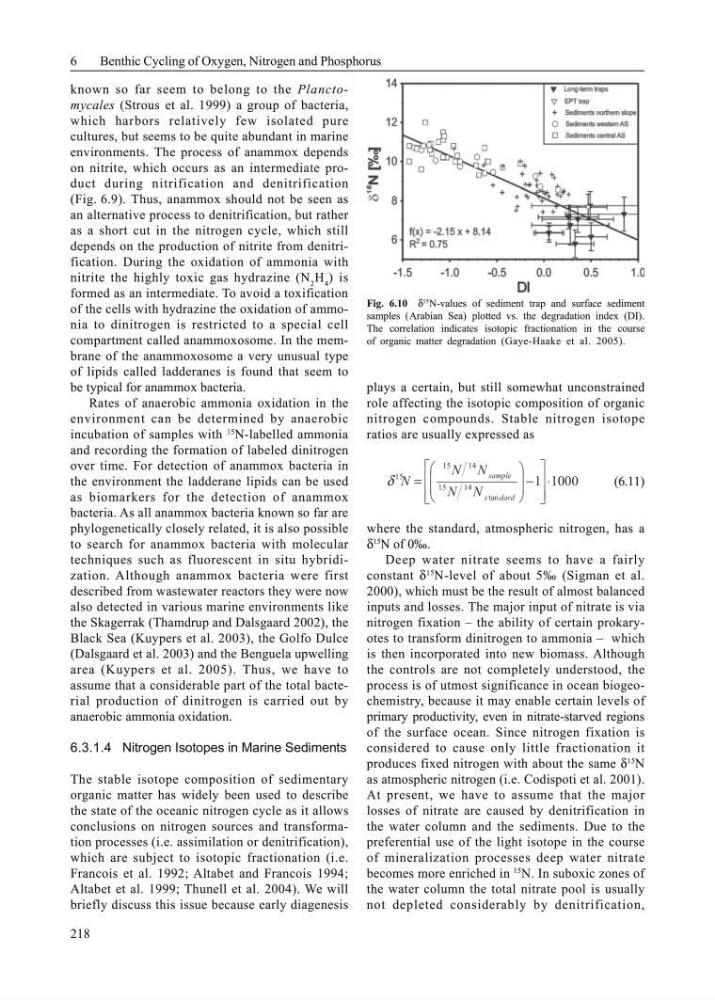
Fig. 6.10 δ
15 N-values of sediment trap and surface sediment
samples (Arabian Sea) plotted vs. the degradation index (DI).
The correlation indicates isotopic fractionation in the course
of organic matter degradation (Gaye-Haake et al. 2005).
Benthic Cycling of Oxygen, Nitrogen and Phosphorus
218
known so far seem to belong to the Planctomycales (Strous et al. 1999) a group of bacteria,
which harbors relatively few isolated pure
cultures, but seems to be quite abundant in marine
environments. The process of anammox depends
on nitrite, which occurs as an intermediate product during nitrification and denitrification
(Fig. 6.9). Thus, anammox should not be seen as
an alternative process to denitrification, but rather
as a short cut in the nitrogen cycle, which still
depends on the production of nitrite from denitrification. During the oxidation of ammonia with
nitrite the highly toxic gas hydrazine (N 2 H 4 ) is
formed as an intermediate. To avoid a toxification
of the cells with hydrazine the oxidation of ammonia to dinitrogen is restricted to a special cell
compartment called anammoxosome. In the membrane of the anammoxosome a very unusual type
of lipids called ladderanes is found that seem to
be typical for anammox bacteria.
Rates of anaerobic ammonia oxidation in the
environment can be determined by anaerobic
incubation of samples with
15
N-labelled ammonia
and recording the formation of labeled dinitrogen
over time. For detection of anammox bacteria in
the environment the ladderane lipids can be used
as biomarkers for the detection of anammox
bacteria. As all anammox bacteria known so far are
phylogenetically closely related, it is also possible
to search for anammox bacteria with molecular
techniques such as fluorescent in situ hybridization. Although anammox bacteria were first
described from wastewater reactors they were now
also detected in various marine environments like
the Skagerrak (Thamdrup and Dalsgaard 2002), the
Black Sea (Kuypers et al. 2003), the Golfo Dulce
(Dalsgaard et al. 2003) and the Benguela upwelling
area (Kuypers et al. 2005). Thus, we have to
assume that a considerable part of the total bacterial production of dinitrogen is carried out by
anaerobic ammonia oxidation.
6.3.1.4 Nitrogen Isotopes in Marine Sediments
The stable isotope composition of sedimentary
organic matter has widely been used to describe
the state of the oceanic nitrogen cycle as it allows
conclusions on nitrogen sources and transformation processes (i.e. assimilation or denitrification),
which are subject to isotopic fractionation (i.e.
Francois et al. 1992; Altabet and Francois 1994;
Altabet et al. 1999; Thunell et al. 2004). We will
briefly discuss this issue because early diagenesis
plays a certain, but still somewhat unconstrained
role affecting the isotopic composition of organic
nitrogen compounds. Stable nitrogen isotope
ratios are usually expressed as
1000
1
tan
14
15
14
15
15
⋅
⎥
⎥
⎦
⎤
⎢
⎢
⎣
⎡
−
⎟
⎟
⎠
⎞
⎜
⎜
⎝
⎛
=
dard
s
sample
N
N
N
N
N
δ
(6.11)
where the standard, atmospheric nitrogen, has a
δ
15
N of 0‰.
Deep water nitrate seems to have a fairly
constant δ
15
N-level of about 5‰ (Sigman et al.
2000), which must be the result of almost balanced
inputs and losses. The major input of nitrate is via
nitrogen fixation – the ability of certain prokaryotes to transform dinitrogen to ammonia – which
is then incorporated into new biomass. Although
the controls are not completely understood, the
process is of utmost significance in ocean biogeochemistry, because it may enable certain levels of
primary productivity, even in nitrate-starved regions
of the surface ocean. Since nitrogen fixation is
considered to cause only little fractionation it
produces fixed nitrogen with about the same δ
15
N
as atmospheric nitrogen (i.e. Codispoti et al. 2001).
At present, we have to assume that the major
losses of nitrate are caused by denitrification in
the water column and the sediments. Due to the
preferential use of the light isotope in the course
of mineralization processes deep water nitrate
becomes more enriched in
15
N. In suboxic zones of
the water column the total nitrate pool is usually
not depleted considerably by denitrification,
Fig. 6.10 δ
15 N-values of sediment trap and surface sediment
samples (Arabian Sea) plotted vs. the degradation index (DI).
The correlation indicates isotopic fractionation in the course
of organic matter degradation (Gaye-Haake et al. 2005).