

217
(1992) calculated for rapidly accumulating sediments on the continental margin off California that
aerobic respiration is the major pathway of organic matter oxidation and more than 90% of the
oxygen flux into the sediments is used for organic
carbon oxidation. Since respiration by anoxic
processes is estimated to exceed 30% of the total
mineralization in the sediment this indicates an
incomplete reoxidation cycle. Results of Canfield
et al. (1993 a,b) and Wenzhöfer et al. (2002) from
continental shelf sediments of the Baltic Sea
indicate that oxygen consumption by reoxidation
processes is quantitatively more important than
aerobic respiration. In these environments sulfate
reduction seems to be the dominant respiration
process (Wenzhöfer et al. 2002; Thamdrup et al.
1994), although metal oxides can also play a
significant role in particular cases. Canfield et al.
(1993 a,b) have shown that the importance of
metal oxides in the diagenetic sequence is
strongly dependent on bioturbation activity.
Mineralization rates simply derived from pore
water gradients might underestimate the true rates
by one order of magnitude (Haese 1997). Such
complex interactions between different pathways
of organic matter decomposition and redox reactions are restricted to coastal marine environments
and highly accumulating upwelling regions. In
oligotrophic regions of the deep sea, 100 to 1,000times more organic carbon is oxidized by oxygen
than by sulfate reduction and other pathways
(Canfield 1989). For the major part of the world
oceans the oxygen flux into the sediment provides a good approximation to the total rate of
organic carbon oxidation.
6.3.1.3 Anaerobic Oxidation of Ammonium
with Nitrate (Anammox)
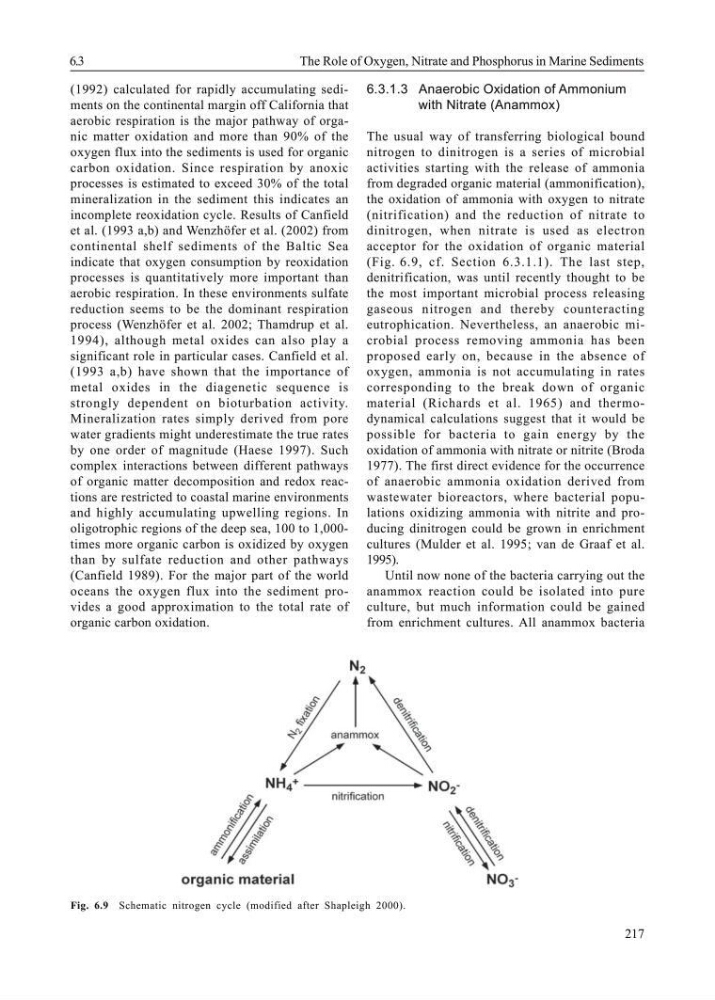
The usual way of transferring biological bound
nitrogen to dinitrogen is a series of microbial
activities starting with the release of ammonia
from degraded organic material (ammonification),
the oxidation of ammonia with oxygen to nitrate
(nitrification) and the reduction of nitrate to
dinitrogen, when nitrate is used as electron
acceptor for the oxidation of organic material
(Fig. 6.9, cf. Section 6.3.1.1). The last step,
denitrification, was until recently thought to be
the most important microbial process releasing
gaseous nitrogen and thereby counteracting
eutrophication. Nevertheless, an anaerobic microbial process removing ammonia has been
proposed early on, because in the absence of
oxygen, ammonia is not accumulating in rates
corresponding to the break down of organic
material (Richards et al. 1965) and thermodynamical calculations suggest that it would be
possible for bacteria to gain energy by the
oxidation of ammonia with nitrate or nitrite (Broda
1977). The first direct evidence for the occurrence
of anaerobic ammonia oxidation derived from
wastewater bioreactors, where bacterial populations oxidizing ammonia with nitrite and producing dinitrogen could be grown in enrichment
cultures (Mulder et al. 1995; van de Graaf et al.
1995).
Until now none of the bacteria carrying out the
anammox reaction could be isolated into pure
culture, but much information could be gained
from enrichment cultures. All anammox bacteria
Fig. 6.9 Schematic nitrogen cycle (modified after Shapleigh 2000).
6.3
The Role of Oxygen, Nitrate and Phosphorus in Marine Sediments
(1992) calculated for rapidly accumulating sediments on the continental margin off California that
aerobic respiration is the major pathway of organic matter oxidation and more than 90% of the
oxygen flux into the sediments is used for organic
carbon oxidation. Since respiration by anoxic
processes is estimated to exceed 30% of the total
mineralization in the sediment this indicates an
incomplete reoxidation cycle. Results of Canfield
et al. (1993 a,b) and Wenzhöfer et al. (2002) from
continental shelf sediments of the Baltic Sea
indicate that oxygen consumption by reoxidation
processes is quantitatively more important than
aerobic respiration. In these environments sulfate
reduction seems to be the dominant respiration
process (Wenzhöfer et al. 2002; Thamdrup et al.
1994), although metal oxides can also play a
significant role in particular cases. Canfield et al.
(1993 a,b) have shown that the importance of
metal oxides in the diagenetic sequence is
strongly dependent on bioturbation activity.
Mineralization rates simply derived from pore
water gradients might underestimate the true rates
by one order of magnitude (Haese 1997). Such
complex interactions between different pathways
of organic matter decomposition and redox reactions are restricted to coastal marine environments
and highly accumulating upwelling regions. In
oligotrophic regions of the deep sea, 100 to 1,000times more organic carbon is oxidized by oxygen
than by sulfate reduction and other pathways
(Canfield 1989). For the major part of the world
oceans the oxygen flux into the sediment provides a good approximation to the total rate of
organic carbon oxidation.
6.3.1.3 Anaerobic Oxidation of Ammonium
with Nitrate (Anammox)
The usual way of transferring biological bound
nitrogen to dinitrogen is a series of microbial
activities starting with the release of ammonia
from degraded organic material (ammonification),
the oxidation of ammonia with oxygen to nitrate
(nitrification) and the reduction of nitrate to
dinitrogen, when nitrate is used as electron
acceptor for the oxidation of organic material
(Fig. 6.9, cf. Section 6.3.1.1). The last step,
denitrification, was until recently thought to be
the most important microbial process releasing
gaseous nitrogen and thereby counteracting
eutrophication. Nevertheless, an anaerobic microbial process removing ammonia has been
proposed early on, because in the absence of
oxygen, ammonia is not accumulating in rates
corresponding to the break down of organic
material (Richards et al. 1965) and thermodynamical calculations suggest that it would be
possible for bacteria to gain energy by the
oxidation of ammonia with nitrate or nitrite (Broda
1977). The first direct evidence for the occurrence
of anaerobic ammonia oxidation derived from
wastewater bioreactors, where bacterial populations oxidizing ammonia with nitrite and producing dinitrogen could be grown in enrichment
cultures (Mulder et al. 1995; van de Graaf et al.
1995).
Until now none of the bacteria carrying out the
anammox reaction could be isolated into pure
culture, but much information could be gained
from enrichment cultures. All anammox bacteria
Fig. 6.9 Schematic nitrogen cycle (modified after Shapleigh 2000).
6.3
The Role of Oxygen, Nitrate and Phosphorus in Marine Sediments