

6
Benthic Cycling of Oxygen, Nitrogen and Phosphorus
216
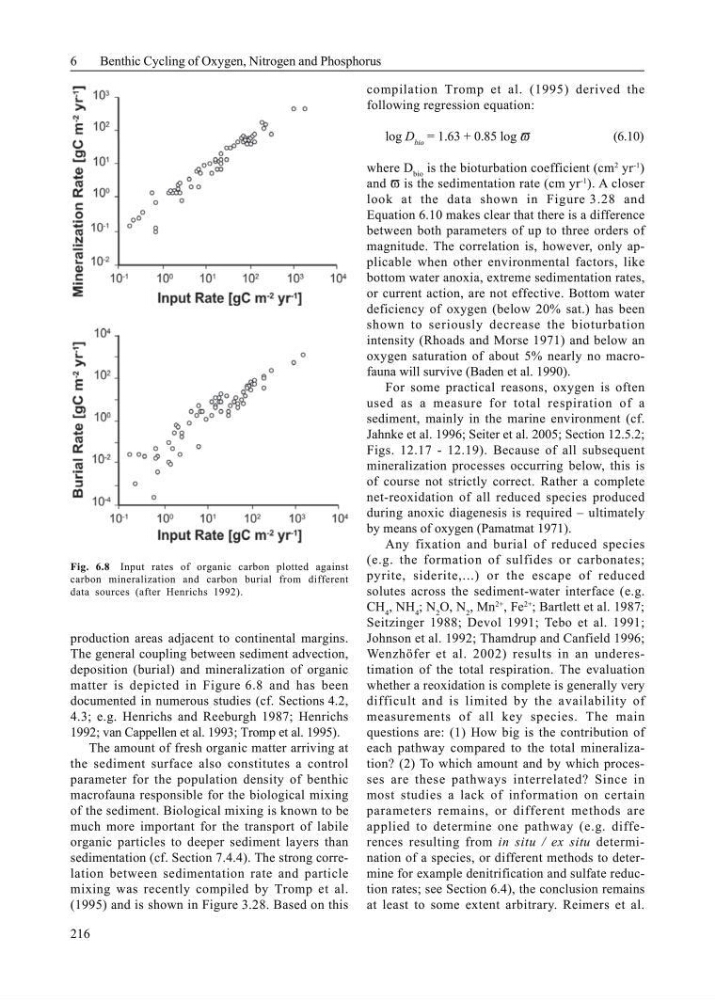
production areas adjacent to continental margins.
The general coupling between sediment advection,
deposition (burial) and mineralization of organic
matter is depicted in Figure 6.8 and has been
documented in numerous studies (cf. Sections 4.2,
4.3; e.g. Henrichs and Reeburgh 1987; Henrichs
1992; van Cappellen et al. 1993; Tromp et al. 1995).
The amount of fresh organic matter arriving at
the sediment surface also constitutes a control
parameter for the population density of benthic
macrofauna responsible for the biological mixing
of the sediment. Biological mixing is known to be
much more important for the transport of labile
organic particles to deeper sediment layers than
sedimentation (cf. Section 7.4.4). The strong correlation between sedimentation rate and particle
mixing was recently compiled by Tromp et al.
(1995) and is shown in Figure 3.28. Based on this
compilation Tromp et al. (1995) derived the
following regression equation:
log D bio = 1.63 + 0.85 log ϖ
(6.10)
where D bio is the bioturbation coefficient (cm
2
yr
-1
)
and ϖ is the sedimentation rate (cm yr
-1
). A closer
look at the data shown in Figure 3.28 and
Equation 6.10 makes clear that there is a difference
between both parameters of up to three orders of
magnitude. The correlation is, however, only applicable when other environmental factors, like
bottom water anoxia, extreme sedimentation rates,
or current action, are not effective. Bottom water
deficiency of oxygen (below 20% sat.) has been
shown to seriously decrease the bioturbation
intensity (Rhoads and Morse 1971) and below an
oxygen saturation of about 5% nearly no macrofauna will survive (Baden et al. 1990).
For some practical reasons, oxygen is often
used as a measure for total respiration of a
sediment, mainly in the marine environment (cf.
Jahnke et al. 1996; Seiter et al. 2005; Section 12.5.2;
Figs. 12.17 - 12.19). Because of all subsequent
mineralization processes occurring below, this is
of course not strictly correct. Rather a complete
net-reoxidation of all reduced species produced
during anoxic diagenesis is required – ultimately
by means of oxygen (Pamatmat 1971).
Any fixation and burial of reduced species
(e.g. the formation of sulfides or carbonates;
pyrite, siderite,...) or the escape of reduced
solutes across the sediment-water interface (e.g.
CH 4 , NH 4 ; N 2 O, N 2 , Mn
2+
, Fe
2+
; Bartlett et al. 1987;
Seitzinger 1988; Devol 1991; Tebo et al. 1991;
Johnson et al. 1992; Thamdrup and Canfield 1996;
Wenzhöfer et al. 2002) results in an underestimation of the total respiration. The evaluation
whether a reoxidation is complete is generally very
difficult and is limited by the availability of
measurements of all key species. The main
questions are: (1) How big is the contribution of
each pathway compared to the total mineralization? (2) To which amount and by which processes are these pathways interrelated? Since in
most studies a lack of information on certain
parameters remains, or different methods are
applied to determine one pathway (e.g. differences resulting from in situ / ex situ determination of a species, or different methods to determine for example denitrification and sulfate reduction rates; see Section 6.4), the conclusion remains
at least to some extent arbitrary. Reimers et al.
Fig. 6.8 Input rates of organic carbon plotted against
carbon mineralization and carbon burial from different
data sources (after Henrichs 1992).
Benthic Cycling of Oxygen, Nitrogen and Phosphorus
216
production areas adjacent to continental margins.
The general coupling between sediment advection,
deposition (burial) and mineralization of organic
matter is depicted in Figure 6.8 and has been
documented in numerous studies (cf. Sections 4.2,
4.3; e.g. Henrichs and Reeburgh 1987; Henrichs
1992; van Cappellen et al. 1993; Tromp et al. 1995).
The amount of fresh organic matter arriving at
the sediment surface also constitutes a control
parameter for the population density of benthic
macrofauna responsible for the biological mixing
of the sediment. Biological mixing is known to be
much more important for the transport of labile
organic particles to deeper sediment layers than
sedimentation (cf. Section 7.4.4). The strong correlation between sedimentation rate and particle
mixing was recently compiled by Tromp et al.
(1995) and is shown in Figure 3.28. Based on this
compilation Tromp et al. (1995) derived the
following regression equation:
log D bio = 1.63 + 0.85 log ϖ
(6.10)
where D bio is the bioturbation coefficient (cm
2
yr
-1
)
and ϖ is the sedimentation rate (cm yr
-1
). A closer
look at the data shown in Figure 3.28 and
Equation 6.10 makes clear that there is a difference
between both parameters of up to three orders of
magnitude. The correlation is, however, only applicable when other environmental factors, like
bottom water anoxia, extreme sedimentation rates,
or current action, are not effective. Bottom water
deficiency of oxygen (below 20% sat.) has been
shown to seriously decrease the bioturbation
intensity (Rhoads and Morse 1971) and below an
oxygen saturation of about 5% nearly no macrofauna will survive (Baden et al. 1990).
For some practical reasons, oxygen is often
used as a measure for total respiration of a
sediment, mainly in the marine environment (cf.
Jahnke et al. 1996; Seiter et al. 2005; Section 12.5.2;
Figs. 12.17 - 12.19). Because of all subsequent
mineralization processes occurring below, this is
of course not strictly correct. Rather a complete
net-reoxidation of all reduced species produced
during anoxic diagenesis is required – ultimately
by means of oxygen (Pamatmat 1971).
Any fixation and burial of reduced species
(e.g. the formation of sulfides or carbonates;
pyrite, siderite,...) or the escape of reduced
solutes across the sediment-water interface (e.g.
CH 4 , NH 4 ; N 2 O, N 2 , Mn
2+
, Fe
2+
; Bartlett et al. 1987;
Seitzinger 1988; Devol 1991; Tebo et al. 1991;
Johnson et al. 1992; Thamdrup and Canfield 1996;
Wenzhöfer et al. 2002) results in an underestimation of the total respiration. The evaluation
whether a reoxidation is complete is generally very
difficult and is limited by the availability of
measurements of all key species. The main
questions are: (1) How big is the contribution of
each pathway compared to the total mineralization? (2) To which amount and by which processes are these pathways interrelated? Since in
most studies a lack of information on certain
parameters remains, or different methods are
applied to determine one pathway (e.g. differences resulting from in situ / ex situ determination of a species, or different methods to determine for example denitrification and sulfate reduction rates; see Section 6.4), the conclusion remains
at least to some extent arbitrary. Reimers et al.
Fig. 6.8 Input rates of organic carbon plotted against
carbon mineralization and carbon burial from different
data sources (after Henrichs 1992).