

215
motile and do not form true filaments. The
individual, spherical cells are hold together in
strings by a slime sheath (Fig. 6.7). They are the
largest bacteria known so far (>700 µm diameter)
and may survive up to several years in sulfidic
sediments without getting into contact with nitrate
or oxygen. Instead of actively gliding in between
different sediment horizons they seem to rely on
getting passively transported into nitrate containing water by sediment suspension.
Even though it is quite obvious that the nitrate
storing sulfur bacteria use nitrate as electron
acceptor for the oxidation of sulfide, it is still not
completely clear, whether the end product of
nitrate respiration is ammonia or nitrogen. As this
group of bacteria cannot be grown in pure
cultures yet, all conclusions on their metabolism
are drawn from indirect evidences and remain to
some degree speculative. Earlier reports on denitrification in Beggiatoa (Sweerts et al. 1990) have
been doubted since Otte et al. (1999) could show
ammonia production in cleaned Thioploca filaments. At first glance, it seems more likely to
assume denitrification, as the energy yield per
mole sulfide oxidized with nitrate is much higher if
nitrate is reduced to nitrogen (-714.7 kJ mol
-1
) and
not to ammonia (-436.2 kJ mol
-1
) (Jørgensen and
Nelson 2004). Nevertheless, per mole nitrate the
energy yields of both processes are quite
comparable with -446.7 kJ mol
-1
for denitrification
and 436.2 kJ mol
-1
for dissimilatory reduction of
nitrate to ammonia (DRNA). Furthermore, the last
step of denitrification is easily blocked by sulfide,
which suggests that DNRA might be a more
efficient way of anaerobic sulfide oxidation than
denitrification (Jørgensen and Nelson 2004).
6.3.1.2 Coupling of Oxygen and Nitrate to
other Redox Pathways
Below the oxygenated zone anoxic diagenesis is
stimulated, if biodegradable organic matter is still
sufficiently available. Anoxic mineralization processes result in a release of reduced species, like
ammonia (Fig. 6.6), into pore water which might be
re-oxidized again as they diffuse back to the surface layers. Stimulation of anoxic diagenesis requires high input of organic matter to the sediment surface which is usually combined with high
sediment advection restricted to coastal and high
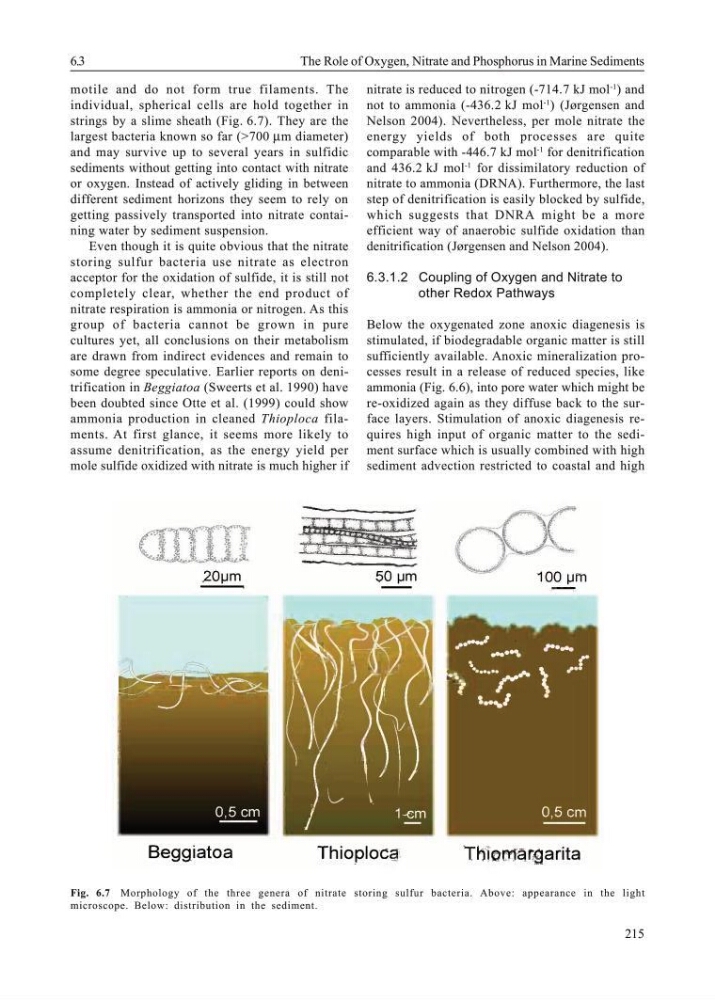
Fig. 6.7 Morphology of the three genera of nitrate storing sulfur bacteria. Above: appearance in the light
microscope. Below: distribution in the sediment.
6.3
The Role of Oxygen, Nitrate and Phosphorus in Marine Sediments
motile and do not form true filaments. The
individual, spherical cells are hold together in
strings by a slime sheath (Fig. 6.7). They are the
largest bacteria known so far (>700 µm diameter)
and may survive up to several years in sulfidic
sediments without getting into contact with nitrate
or oxygen. Instead of actively gliding in between
different sediment horizons they seem to rely on
getting passively transported into nitrate containing water by sediment suspension.
Even though it is quite obvious that the nitrate
storing sulfur bacteria use nitrate as electron
acceptor for the oxidation of sulfide, it is still not
completely clear, whether the end product of
nitrate respiration is ammonia or nitrogen. As this
group of bacteria cannot be grown in pure
cultures yet, all conclusions on their metabolism
are drawn from indirect evidences and remain to
some degree speculative. Earlier reports on denitrification in Beggiatoa (Sweerts et al. 1990) have
been doubted since Otte et al. (1999) could show
ammonia production in cleaned Thioploca filaments. At first glance, it seems more likely to
assume denitrification, as the energy yield per
mole sulfide oxidized with nitrate is much higher if
nitrate is reduced to nitrogen (-714.7 kJ mol
-1
) and
not to ammonia (-436.2 kJ mol
-1
) (Jørgensen and
Nelson 2004). Nevertheless, per mole nitrate the
energy yields of both processes are quite
comparable with -446.7 kJ mol
-1
for denitrification
and 436.2 kJ mol
-1
for dissimilatory reduction of
nitrate to ammonia (DRNA). Furthermore, the last
step of denitrification is easily blocked by sulfide,
which suggests that DNRA might be a more
efficient way of anaerobic sulfide oxidation than
denitrification (Jørgensen and Nelson 2004).
6.3.1.2 Coupling of Oxygen and Nitrate to
other Redox Pathways
Below the oxygenated zone anoxic diagenesis is
stimulated, if biodegradable organic matter is still
sufficiently available. Anoxic mineralization processes result in a release of reduced species, like
ammonia (Fig. 6.6), into pore water which might be
re-oxidized again as they diffuse back to the surface layers. Stimulation of anoxic diagenesis requires high input of organic matter to the sediment surface which is usually combined with high
sediment advection restricted to coastal and high
Fig. 6.7 Morphology of the three genera of nitrate storing sulfur bacteria. Above: appearance in the light
microscope. Below: distribution in the sediment.
6.3
The Role of Oxygen, Nitrate and Phosphorus in Marine Sediments