

5
Bacteria and Marine Biogeochemistry
196
5.6.1
Incubation Experiments
In addition to modeling, process rates can be
measured experimentally in sediment samples by
following the concentration changes of the
chemical species over time, either in the pore
water or in the solid phase. By such incubation
experiments it is critical that the physico-chemical
conditions and the biology of the sediment remain
close to the natural situation. Since gradual
changes with time are difficult to avoid, the
duration of the experiment should preferably be
restricted to several hours up to a day. This is
generally too short a time interval for significant
changes in the populations of anaerobic bacteria.
A careful way of containing the sediment samples
is to distribute the sediment from different depths
into gas-tight plastic bags under an atmosphere of
nitrogen and keep these at the natural temperature. The sediment can then be mixed without
dilution or contact with a gas phase, and subsamples can be taken over time for the analyses of
chemical concentrations. Such a technique has
been used to measure the rates of organic matter
mineralization from the evolution of CO 2 or NH 4
+
or to measure the reduction rates of manganese
and iron oxides (Fig. 5.12, Canfield et al. 1993;
Hansen et al. 2000).
5.6.2
Radioactive Tracers
Radioactive tracers are used to identify and
measure microbial or chemical processes in marine
sediments. Radiotracers are mostly applied when
chemical analysis alone is too insensitive or if the
pathway of processes is more complex or cyclic.
Thus, if a process is very slow relative to the pool
sizes of the reactants or products, a long-term
experiment of many days or months would be
required to detect a chemical change. Since this
would lead to changing sediment conditions and
thus to non-natural process rates, higher sensitivity is required. By the use of a radiotracer, hundredor thousand-fold shorter experiment durations may
often be achieved. An example is the measurement
of sulfate reduction rates (see Sect. 5.6.3). Sulfate
can be analyzed in pore water samples with a
precision of about ±2%, and a reduction of 5-10%
or more is, therefore, required to determine its rate
with a reasonable confidence. If radioactive,
35
Slabelled sulfate is used to trace the process, it is
possible to detect the reduction of only 1/100,000
of the SO 4
2by analyzing the radioactivity of the
sulfide formed (Kallmeyer et al. 2004). The
sensitivity by using radiotracer is thus improved
>1000-fold over the chemical analysis.
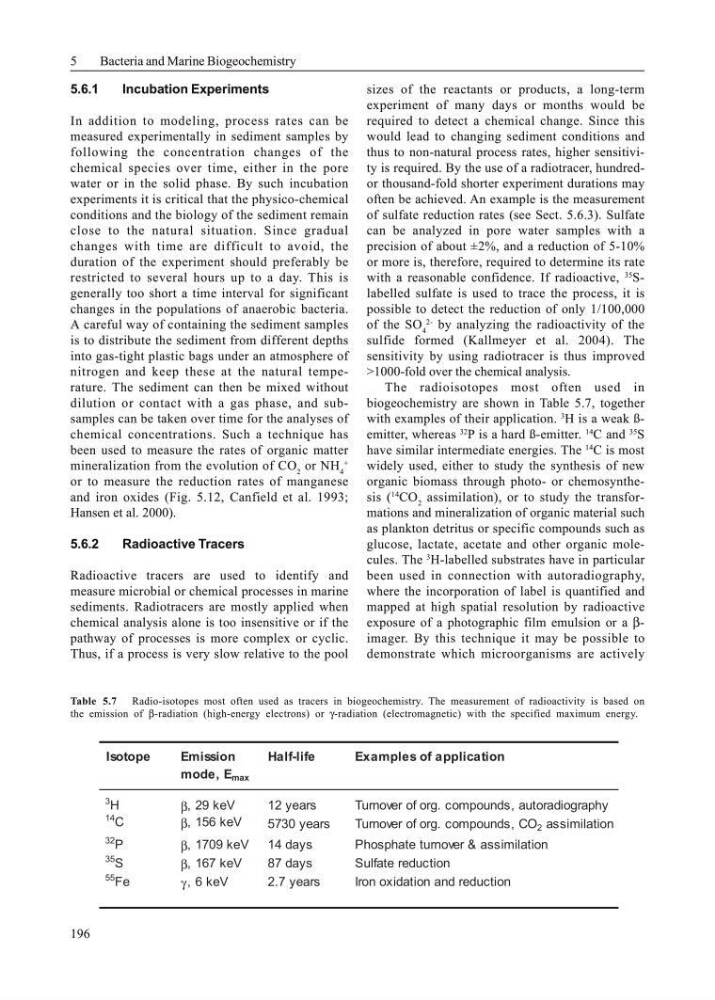
The radioisotopes most often used in
biogeochemistry are shown in Table 5.7, together
with examples of their application.
3
H is a weak ßemitter, whereas
32
P is a hard ß-emitter.
14
C and
35
S
have similar intermediate energies. The
14
C is most
widely used, either to study the synthesis of new
organic biomass through photo- or chemosynthesis (
14
CO 2 assimilation), or to study the transformations and mineralization of organic material such
as plankton detritus or specific compounds such as
glucose, lactate, acetate and other organic molecules. The
3
H-labelled substrates have in particular
been used in connection with autoradiography,
where the incorporation of label is quantified and
mapped at high spatial resolution by radioactive
exposure of a photographic film emulsion or a βimager. By this technique it may be possible to
demonstrate which microorganisms are actively
Table 5.7 Radio-isotopes most often used as tracers in biogeochemistry. The measurement of radioactivity is based on
the emission of β-radiation (high-energy electrons) or γ-radiation (electromagnetic) with the specified maximum energy.
Isotope
Emission
Half-life
Examples of application
mode, E max
3
H
β, 29 keV
12 years
Turnover of org. compounds, autoradiography
14
C
β, 156 keV
5730 years
Turnover of org. compounds, CO 2 assimilation
32
P
β, 1709 keV 14 days
Phosphate turnover & assimilation
35
S
β, 167 keV
87 days
Sulfate reduction
55
Fe
γ , 6 keV
2.7 years
Iron oxidation and reduction
Bacteria and Marine Biogeochemistry
196
5.6.1
Incubation Experiments
In addition to modeling, process rates can be
measured experimentally in sediment samples by
following the concentration changes of the
chemical species over time, either in the pore
water or in the solid phase. By such incubation
experiments it is critical that the physico-chemical
conditions and the biology of the sediment remain
close to the natural situation. Since gradual
changes with time are difficult to avoid, the
duration of the experiment should preferably be
restricted to several hours up to a day. This is
generally too short a time interval for significant
changes in the populations of anaerobic bacteria.
A careful way of containing the sediment samples
is to distribute the sediment from different depths
into gas-tight plastic bags under an atmosphere of
nitrogen and keep these at the natural temperature. The sediment can then be mixed without
dilution or contact with a gas phase, and subsamples can be taken over time for the analyses of
chemical concentrations. Such a technique has
been used to measure the rates of organic matter
mineralization from the evolution of CO 2 or NH 4
+
or to measure the reduction rates of manganese
and iron oxides (Fig. 5.12, Canfield et al. 1993;
Hansen et al. 2000).
5.6.2
Radioactive Tracers
Radioactive tracers are used to identify and
measure microbial or chemical processes in marine
sediments. Radiotracers are mostly applied when
chemical analysis alone is too insensitive or if the
pathway of processes is more complex or cyclic.
Thus, if a process is very slow relative to the pool
sizes of the reactants or products, a long-term
experiment of many days or months would be
required to detect a chemical change. Since this
would lead to changing sediment conditions and
thus to non-natural process rates, higher sensitivity is required. By the use of a radiotracer, hundredor thousand-fold shorter experiment durations may
often be achieved. An example is the measurement
of sulfate reduction rates (see Sect. 5.6.3). Sulfate
can be analyzed in pore water samples with a
precision of about ±2%, and a reduction of 5-10%
or more is, therefore, required to determine its rate
with a reasonable confidence. If radioactive,
35
Slabelled sulfate is used to trace the process, it is
possible to detect the reduction of only 1/100,000
of the SO 4
2by analyzing the radioactivity of the
sulfide formed (Kallmeyer et al. 2004). The
sensitivity by using radiotracer is thus improved
>1000-fold over the chemical analysis.
The radioisotopes most often used in
biogeochemistry are shown in Table 5.7, together
with examples of their application.
3
H is a weak ßemitter, whereas
32
P is a hard ß-emitter.
14
C and
35
S
have similar intermediate energies. The
14
C is most
widely used, either to study the synthesis of new
organic biomass through photo- or chemosynthesis (
14
CO 2 assimilation), or to study the transformations and mineralization of organic material such
as plankton detritus or specific compounds such as
glucose, lactate, acetate and other organic molecules. The
3
H-labelled substrates have in particular
been used in connection with autoradiography,
where the incorporation of label is quantified and
mapped at high spatial resolution by radioactive
exposure of a photographic film emulsion or a βimager. By this technique it may be possible to
demonstrate which microorganisms are actively
Table 5.7 Radio-isotopes most often used as tracers in biogeochemistry. The measurement of radioactivity is based on
the emission of β-radiation (high-energy electrons) or γ-radiation (electromagnetic) with the specified maximum energy.
Isotope
Emission
Half-life
Examples of application
mode, E max
3
H
β, 29 keV
12 years
Turnover of org. compounds, autoradiography
14
C
β, 156 keV
5730 years
Turnover of org. compounds, CO 2 assimilation
32
P
β, 1709 keV 14 days
Phosphate turnover & assimilation
35
S
β, 167 keV
87 days
Sulfate reduction
55
Fe
γ , 6 keV
2.7 years
Iron oxidation and reduction