

195
molecular diffusion. This seawater even transports nitrate and oxygen and enables the existence of aerobic microorganisms hundreds of
meters beneath the ocean floor (D’Hondt et al.
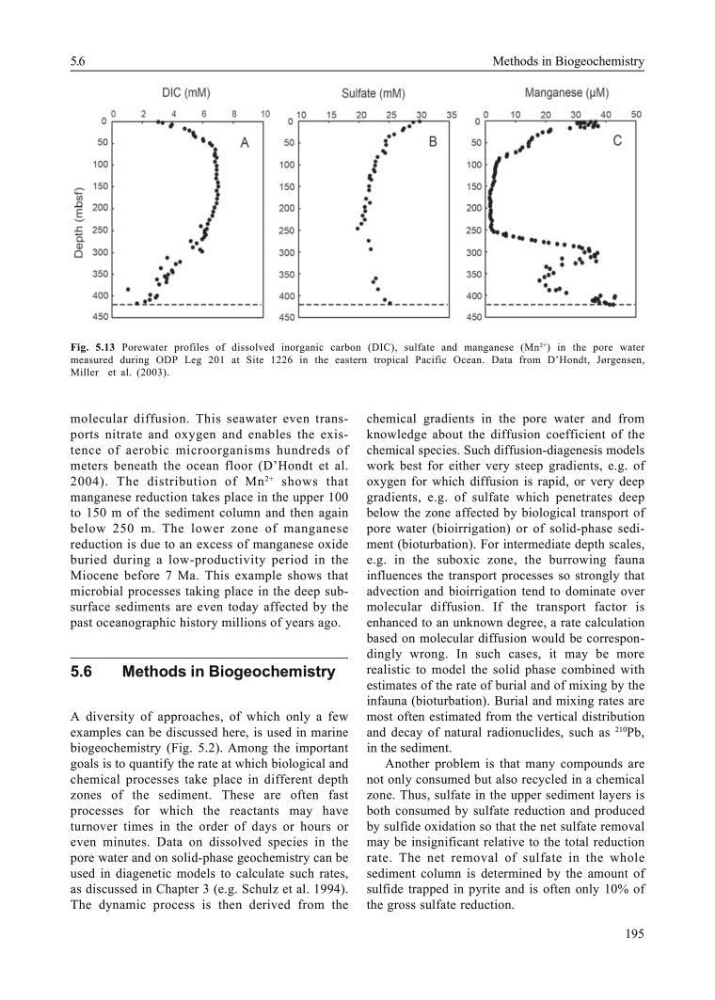
2004). The distribution of Mn
2+
shows that
manganese reduction takes place in the upper 100
to 150 m of the sediment column and then again
below 250 m. The lower zone of manganese
reduction is due to an excess of manganese oxide
buried during a low-productivity period in the
Miocene before 7 Ma. This example shows that
microbial processes taking place in the deep subsurface sediments are even today affected by the
past oceanographic history millions of years ago.
5.6
Methods in Biogeochemistry
A diversity of approaches, of which only a few
examples can be discussed here, is used in marine
biogeochemistry (Fig. 5.2). Among the important
goals is to quantify the rate at which biological and
chemical processes take place in different depth
zones of the sediment. These are often fast
processes for which the reactants may have
turnover times in the order of days or hours or
even minutes. Data on dissolved species in the
pore water and on solid-phase geochemistry can be
used in diagenetic models to calculate such rates,
as discussed in Chapter 3 (e.g. Schulz et al. 1994).
The dynamic process is then derived from the
chemical gradients in the pore water and from
knowledge about the diffusion coefficient of the
chemical species. Such diffusion-diagenesis models
work best for either very steep gradients, e.g. of
oxygen for which diffusion is rapid, or very deep
gradients, e.g. of sulfate which penetrates deep
below the zone affected by biological transport of
pore water (bioirrigation) or of solid-phase sediment (bioturbation). For intermediate depth scales,
e.g. in the suboxic zone, the burrowing fauna
influences the transport processes so strongly that
advection and bioirrigation tend to dominate over
molecular diffusion. If the transport factor is
enhanced to an unknown degree, a rate calculation
based on molecular diffusion would be correspondingly wrong. In such cases, it may be more
realistic to model the solid phase combined with
estimates of the rate of burial and of mixing by the
infauna (bioturbation). Burial and mixing rates are
most often estimated from the vertical distribution
and decay of natural radionuclides, such as
210
Pb,
in the sediment.
Another problem is that many compounds are
not only consumed but also recycled in a chemical
zone. Thus, sulfate in the upper sediment layers is
both consumed by sulfate reduction and produced
by sulfide oxidation so that the net sulfate removal
may be insignificant relative to the total reduction
rate. The net removal of sulfate in the whole
sediment column is determined by the amount of
sulfide trapped in pyrite and is often only 10% of
the gross sulfate reduction.
5.6
Methods in Biogeochemistry
Fig. 5.13 Porewater profiles of dissolved inorganic carbon (DIC), sulfate and manganese (Mn
2+ ) in the pore water
measured during ODP Leg 201 at Site 1226 in the eastern tropical Pacific Ocean. Data from D’Hondt, Jørgensen,
Miller et al. (2003).
molecular diffusion. This seawater even transports nitrate and oxygen and enables the existence of aerobic microorganisms hundreds of
meters beneath the ocean floor (D’Hondt et al.
2004). The distribution of Mn
2+
shows that
manganese reduction takes place in the upper 100
to 150 m of the sediment column and then again
below 250 m. The lower zone of manganese
reduction is due to an excess of manganese oxide
buried during a low-productivity period in the
Miocene before 7 Ma. This example shows that
microbial processes taking place in the deep subsurface sediments are even today affected by the
past oceanographic history millions of years ago.
5.6
Methods in Biogeochemistry
A diversity of approaches, of which only a few
examples can be discussed here, is used in marine
biogeochemistry (Fig. 5.2). Among the important
goals is to quantify the rate at which biological and
chemical processes take place in different depth
zones of the sediment. These are often fast
processes for which the reactants may have
turnover times in the order of days or hours or
even minutes. Data on dissolved species in the
pore water and on solid-phase geochemistry can be
used in diagenetic models to calculate such rates,
as discussed in Chapter 3 (e.g. Schulz et al. 1994).
The dynamic process is then derived from the
chemical gradients in the pore water and from
knowledge about the diffusion coefficient of the
chemical species. Such diffusion-diagenesis models
work best for either very steep gradients, e.g. of
oxygen for which diffusion is rapid, or very deep
gradients, e.g. of sulfate which penetrates deep
below the zone affected by biological transport of
pore water (bioirrigation) or of solid-phase sediment (bioturbation). For intermediate depth scales,
e.g. in the suboxic zone, the burrowing fauna
influences the transport processes so strongly that
advection and bioirrigation tend to dominate over
molecular diffusion. If the transport factor is
enhanced to an unknown degree, a rate calculation
based on molecular diffusion would be correspondingly wrong. In such cases, it may be more
realistic to model the solid phase combined with
estimates of the rate of burial and of mixing by the
infauna (bioturbation). Burial and mixing rates are
most often estimated from the vertical distribution
and decay of natural radionuclides, such as
210
Pb,
in the sediment.
Another problem is that many compounds are
not only consumed but also recycled in a chemical
zone. Thus, sulfate in the upper sediment layers is
both consumed by sulfate reduction and produced
by sulfide oxidation so that the net sulfate removal
may be insignificant relative to the total reduction
rate. The net removal of sulfate in the whole
sediment column is determined by the amount of
sulfide trapped in pyrite and is often only 10% of
the gross sulfate reduction.
5.6
Methods in Biogeochemistry
Fig. 5.13 Porewater profiles of dissolved inorganic carbon (DIC), sulfate and manganese (Mn
2+ ) in the pore water
measured during ODP Leg 201 at Site 1226 in the eastern tropical Pacific Ocean. Data from D’Hondt, Jørgensen,
Miller et al. (2003).