

5
Bacteria and Marine Biogeochemistry
194
decrease can be formally considered to be the
result of a number of different organic carbon
pools, each with its own degradation
characteristics and each being degraded
exponentially with time and depth (Westrich and
Berner 1984). The consecutive depletion of these
pools leads to a steep decrease in organic carbon
reactivity, which follows the sum of several
exponential decays, and which can be
demonstrated from the depth distribution of
oxidant consumption rates. Thus, the O 2 consumption rate per volume in the oxic zone of a
coastal sediment was found to vary between 3,000
and 30,000 nmol O 2 cm
-3
d
-1
as the oxygen
penetration depth varied between 5 mm in winter
and 1 mm in summer (Gundersen et al. 1995). Some
five cm deeper into the sediment, where sulfate
reduction predominated and reached maximal
activity, the rates of carbon mineralization had
decreased 100-fold to 25-150 nmol cm
-3
d
-1
between
winter and summer (Thamdrup et al. 1994). A few
meters deep into the sediment, where methanogenesis predominated below the sulfate zone,
carbon mineralization rates were again about a
100-fold lower. Although the rates down there may
seem insignificant, the slow organic matter
decomposition to methane proceeds to great
depth in the sediment and is therefore important
on an areal basis. This methane diffuses back up
towards the sulfate zone where it is oxidized to
CO 2 at the expense of sulfate (Chap. 8). It is
equivalent to 10% or more of the total sulfate
reduction in coastal sediments, depending on the
depth of sulfate penetration (Iversen and
Jørgensen 1985; Niewöhner et al. 1998; Chap. 8).
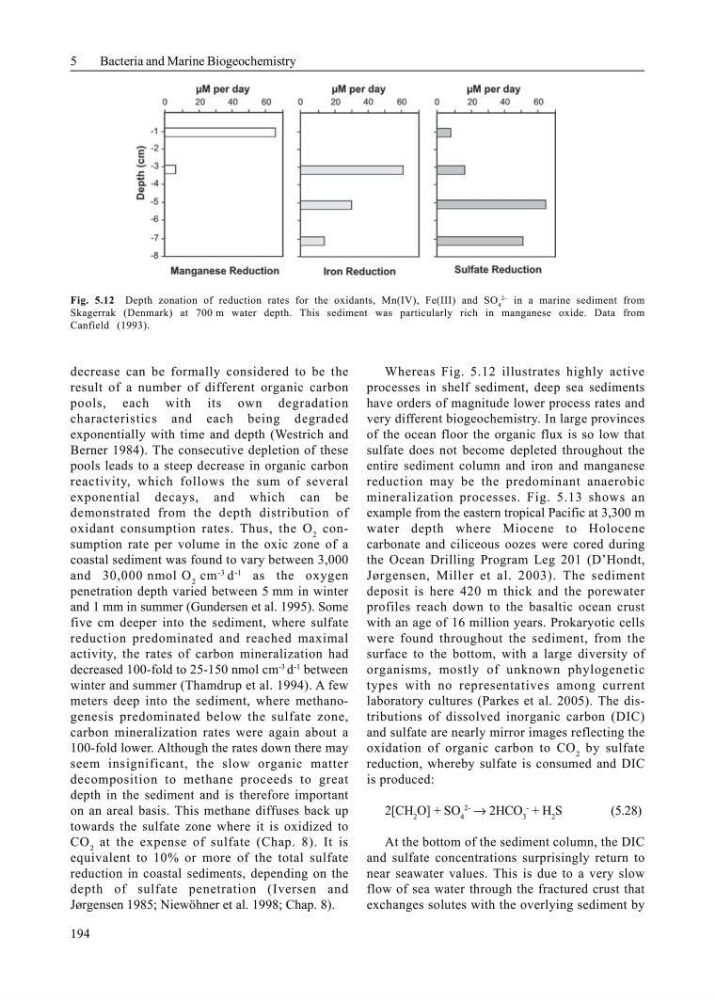
Whereas Fig. 5.12 illustrates highly active
processes in shelf sediment, deep sea sediments
have orders of magnitude lower process rates and
very different biogeochemistry. In large provinces
of the ocean floor the organic flux is so low that
sulfate does not become depleted throughout the
entire sediment column and iron and manganese
reduction may be the predominant anaerobic
mineralization processes. Fig. 5.13 shows an
example from the eastern tropical Pacific at 3,300 m
water depth where Miocene to Holocene
carbonate and ciliceous oozes were cored during
the Ocean Drilling Program Leg 201 (D’Hondt,
Jørgensen, Miller et al. 2003). The sediment
deposit is here 420 m thick and the porewater
profiles reach down to the basaltic ocean crust
with an age of 16 million years. Prokaryotic cells
were found throughout the sediment, from the
surface to the bottom, with a large diversity of
organisms, mostly of unknown phylogenetic
types with no representatives among current
laboratory cultures (Parkes et al. 2005). The distributions of dissolved inorganic carbon (DIC)
and sulfate are nearly mirror images reflecting the
oxidation of organic carbon to CO 2 by sulfate
reduction, whereby sulfate is consumed and DIC
is produced:
2[CH 2 O] + SO 4
2→ 2HCO 3
-
+ H 2 S
(5.28)
At the bottom of the sediment column, the DIC
and sulfate concentrations surprisingly return to
near seawater values. This is due to a very slow
flow of sea water through the fractured crust that
exchanges solutes with the overlying sediment by
Fig. 5.12 Depth zonation of reduction rates for the oxidants, Mn(IV), Fe(III) and SO 4
2– in a marine sediment from
Skagerrak (Denmark) at 700 m water depth. This sediment was particularly rich in manganese oxide. Data from
Canfield (1993).
Bacteria and Marine Biogeochemistry
194
decrease can be formally considered to be the
result of a number of different organic carbon
pools, each with its own degradation
characteristics and each being degraded
exponentially with time and depth (Westrich and
Berner 1984). The consecutive depletion of these
pools leads to a steep decrease in organic carbon
reactivity, which follows the sum of several
exponential decays, and which can be
demonstrated from the depth distribution of
oxidant consumption rates. Thus, the O 2 consumption rate per volume in the oxic zone of a
coastal sediment was found to vary between 3,000
and 30,000 nmol O 2 cm
-3
d
-1
as the oxygen
penetration depth varied between 5 mm in winter
and 1 mm in summer (Gundersen et al. 1995). Some
five cm deeper into the sediment, where sulfate
reduction predominated and reached maximal
activity, the rates of carbon mineralization had
decreased 100-fold to 25-150 nmol cm
-3
d
-1
between
winter and summer (Thamdrup et al. 1994). A few
meters deep into the sediment, where methanogenesis predominated below the sulfate zone,
carbon mineralization rates were again about a
100-fold lower. Although the rates down there may
seem insignificant, the slow organic matter
decomposition to methane proceeds to great
depth in the sediment and is therefore important
on an areal basis. This methane diffuses back up
towards the sulfate zone where it is oxidized to
CO 2 at the expense of sulfate (Chap. 8). It is
equivalent to 10% or more of the total sulfate
reduction in coastal sediments, depending on the
depth of sulfate penetration (Iversen and
Jørgensen 1985; Niewöhner et al. 1998; Chap. 8).
Whereas Fig. 5.12 illustrates highly active
processes in shelf sediment, deep sea sediments
have orders of magnitude lower process rates and
very different biogeochemistry. In large provinces
of the ocean floor the organic flux is so low that
sulfate does not become depleted throughout the
entire sediment column and iron and manganese
reduction may be the predominant anaerobic
mineralization processes. Fig. 5.13 shows an
example from the eastern tropical Pacific at 3,300 m
water depth where Miocene to Holocene
carbonate and ciliceous oozes were cored during
the Ocean Drilling Program Leg 201 (D’Hondt,
Jørgensen, Miller et al. 2003). The sediment
deposit is here 420 m thick and the porewater
profiles reach down to the basaltic ocean crust
with an age of 16 million years. Prokaryotic cells
were found throughout the sediment, from the
surface to the bottom, with a large diversity of
organisms, mostly of unknown phylogenetic
types with no representatives among current
laboratory cultures (Parkes et al. 2005). The distributions of dissolved inorganic carbon (DIC)
and sulfate are nearly mirror images reflecting the
oxidation of organic carbon to CO 2 by sulfate
reduction, whereby sulfate is consumed and DIC
is produced:
2[CH 2 O] + SO 4
2→ 2HCO 3
-
+ H 2 S
(5.28)
At the bottom of the sediment column, the DIC
and sulfate concentrations surprisingly return to
near seawater values. This is due to a very slow
flow of sea water through the fractured crust that
exchanges solutes with the overlying sediment by
Fig. 5.12 Depth zonation of reduction rates for the oxidants, Mn(IV), Fe(III) and SO 4
2– in a marine sediment from
Skagerrak (Denmark) at 700 m water depth. This sediment was particularly rich in manganese oxide. Data from
Canfield (1993).