

5
Bacteria and Marine Biogeochemistry
178
bacteria may have an impressingly high substrate
uptake efficiency which corresponds to each
second clearing the substrate from a seawater
volume that is several hundred times their own
volume. In sediments, on the other hand, bacteria
often form microcolonies or their diffusion supply
is impeded by sediment structures so that the
microorganisms may at times be diffusion limited
in their substrate uptake. It is not clear, however,
how this affects the kinetics of substrate turnover
in sediments.
The recent discovery of ‘giant’ bacteria of
up to ¾ mm diameter in the seabed off Namibia
seems contradictory to the constraints on
bacterial size discussed above (Schulz et al. 2001;
Chap. 8). These sulfide-oxidizing and nitratereducing bacteria of a new genus, Thiomargarita
namibiensis, have a unique intracellular organelle,
a liquid vacuole, which fills more than 90% of the
cellular volume. The cytoplasm is thus only a thin
peripheral layer a few µm thick that is not
diffusion limited.
5.3.2
Substrate Limitation in the Deep
Sub-surface
The theoretical limit for substrate availability
required to sustain bacterial growth and survival
is of great biogeochemical significance, e.g. in
relation to the exceedingly slow degradation of
organic material in million-year old sediments and
oil reservoirs deep under the sea floor (Stetter et
al. 1993; Parkes et al. 1994). Until a few decades
ago, the microbial world was thought to be limited
to the upper meters of the seabed, while the
deeper sediments were thought to be sterile in
spite of significant amounts of organic material
buried at much greater depths. The exploration of
the deep sub-seafloor biosphere started in the
early 1980’ies when the first evidence of microbial
activity was provided by studies of methane
formation and sulfate reduction in cores obtained
from the Deep Sea Drilling Program. Systematic
counts of fluorescently stained cells in cores of
the Ocean Drilling Program have since then led to
a large data base on the population size of deep
biosphere microorganisms (Parkes et al. 2000;
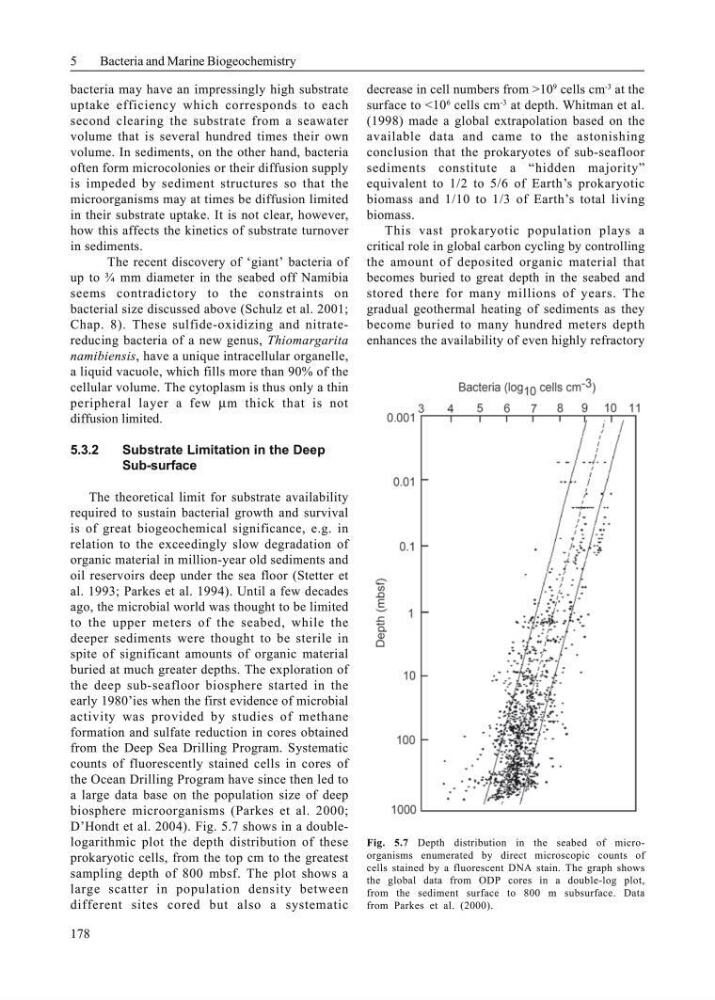
D’Hondt et al. 2004). Fig. 5.7 shows in a doublelogarithmic plot the depth distribution of these
prokaryotic cells, from the top cm to the greatest
sampling depth of 800 mbsf. The plot shows a
large scatter in population density between
different sites cored but also a systematic
decrease in cell numbers from >10
9
cells cm
-3
at the
surface to <10
6
cells cm
-3
at depth. Whitman et al.
(1998) made a global extrapolation based on the
available data and came to the astonishing
conclusion that the prokaryotes of sub-seafloor
sediments constitute a “hidden majority”
equivalent to 1/2 to 5/6 of Earth’s prokaryotic
biomass and 1/10 to 1/3 of Earth’s total living
biomass.
This vast prokaryotic population plays a
critical role in global carbon cycling by controlling
the amount of deposited organic material that
becomes buried to great depth in the seabed and
stored there for many millions of years. The
gradual geothermal heating of sediments as they
become buried to many hundred meters depth
enhances the availability of even highly refractory
Fig. 5.7 Depth distribution in the seabed of microorganisms enumerated by direct microscopic counts of
cells stained by a fluorescent DNA stain. The graph shows
the global data from ODP cores in a double-log plot,
from the sediment surface to 800 m subsurface. Data
from Parkes et al. (2000).
Bacteria and Marine Biogeochemistry
178
bacteria may have an impressingly high substrate
uptake efficiency which corresponds to each
second clearing the substrate from a seawater
volume that is several hundred times their own
volume. In sediments, on the other hand, bacteria
often form microcolonies or their diffusion supply
is impeded by sediment structures so that the
microorganisms may at times be diffusion limited
in their substrate uptake. It is not clear, however,
how this affects the kinetics of substrate turnover
in sediments.
The recent discovery of ‘giant’ bacteria of
up to ¾ mm diameter in the seabed off Namibia
seems contradictory to the constraints on
bacterial size discussed above (Schulz et al. 2001;
Chap. 8). These sulfide-oxidizing and nitratereducing bacteria of a new genus, Thiomargarita
namibiensis, have a unique intracellular organelle,
a liquid vacuole, which fills more than 90% of the
cellular volume. The cytoplasm is thus only a thin
peripheral layer a few µm thick that is not
diffusion limited.
5.3.2
Substrate Limitation in the Deep
Sub-surface
The theoretical limit for substrate availability
required to sustain bacterial growth and survival
is of great biogeochemical significance, e.g. in
relation to the exceedingly slow degradation of
organic material in million-year old sediments and
oil reservoirs deep under the sea floor (Stetter et
al. 1993; Parkes et al. 1994). Until a few decades
ago, the microbial world was thought to be limited
to the upper meters of the seabed, while the
deeper sediments were thought to be sterile in
spite of significant amounts of organic material
buried at much greater depths. The exploration of
the deep sub-seafloor biosphere started in the
early 1980’ies when the first evidence of microbial
activity was provided by studies of methane
formation and sulfate reduction in cores obtained
from the Deep Sea Drilling Program. Systematic
counts of fluorescently stained cells in cores of
the Ocean Drilling Program have since then led to
a large data base on the population size of deep
biosphere microorganisms (Parkes et al. 2000;
D’Hondt et al. 2004). Fig. 5.7 shows in a doublelogarithmic plot the depth distribution of these
prokaryotic cells, from the top cm to the greatest
sampling depth of 800 mbsf. The plot shows a
large scatter in population density between
different sites cored but also a systematic
decrease in cell numbers from >10
9
cells cm
-3
at the
surface to <10
6
cells cm
-3
at depth. Whitman et al.
(1998) made a global extrapolation based on the
available data and came to the astonishing
conclusion that the prokaryotes of sub-seafloor
sediments constitute a “hidden majority”
equivalent to 1/2 to 5/6 of Earth’s prokaryotic
biomass and 1/10 to 1/3 of Earth’s total living
biomass.
This vast prokaryotic population plays a
critical role in global carbon cycling by controlling
the amount of deposited organic material that
becomes buried to great depth in the seabed and
stored there for many millions of years. The
gradual geothermal heating of sediments as they
become buried to many hundred meters depth
enhances the availability of even highly refractory
Fig. 5.7 Depth distribution in the seabed of microorganisms enumerated by direct microscopic counts of
cells stained by a fluorescent DNA stain. The graph shows
the global data from ODP cores in a double-log plot,
from the sediment surface to 800 m subsurface. Data
from Parkes et al. (2000).