

179
organic material to microbial attack and leads to
further mineralization with the ultimate formation
of methane (Wellsbury et al. 1997). The methane
slowly diffuses upwards from the deep deposits
and becomes oxidized to CO 2 as it reaches the
bottom of the sulfate zone (Chap. 8), or it
accumulates as gas hydrate within the upper
sediment strata (Borowski et al. 1996). The gas
hydrates constitute a reduced carbon reservoir
that greatly exceeds the amount of carbon in all
living organisms on Earth (Kvenvolden, 1993;
Chap. 14).
It remains an open question how the
microorganisms in subsurface sediments are able
to survive on the extremely low energy and carbon
flux available for each cell. By DNA/RNA based
techniques it could be shown that a significant
fraction of the bacteria are alive and active rather
than dormant or even dead (Schippers et al. 2005).
Yet, calculations from cell numbers and measured
or modeled mineralization rates show that the
organic carbon flux available in million year old
sediments allows only generation times of years
to thousands of years (Whitman et al. 1998;
Schippers et al. 2005).
5.3.3
Temperature as a Regulating Factor
The sea floor is mostly a cold environment with
85% of the global ocean having temperatures
below 5°C. At the other extreme, hydrothermal
vents along the mid-oceanic ridges have
temperatures reaching above 350°C. In each
temperature range from the freezing point to an
upper limit of around 110°C there appear to be
prokaryotic organisms that are well adapted and
even thrive optimally at that temperature. Thus,
extremely warm-adapted (hyperthermophilic)
methane producing or elemental-sulfur reducing
bacteria, which live at the boiling point of water,
are unable to grow at temperatures below 60-70°C
because it is too cold for them (Stetter 1996).
It is well known that chemical processes as
well as bacterial metabolism are slowed down by
low temperature. Yet, the biogeochemical
recycling of deposited organic material in marine
sediments does not appear to be less efficient or
less complete in polar regions than in temperate or
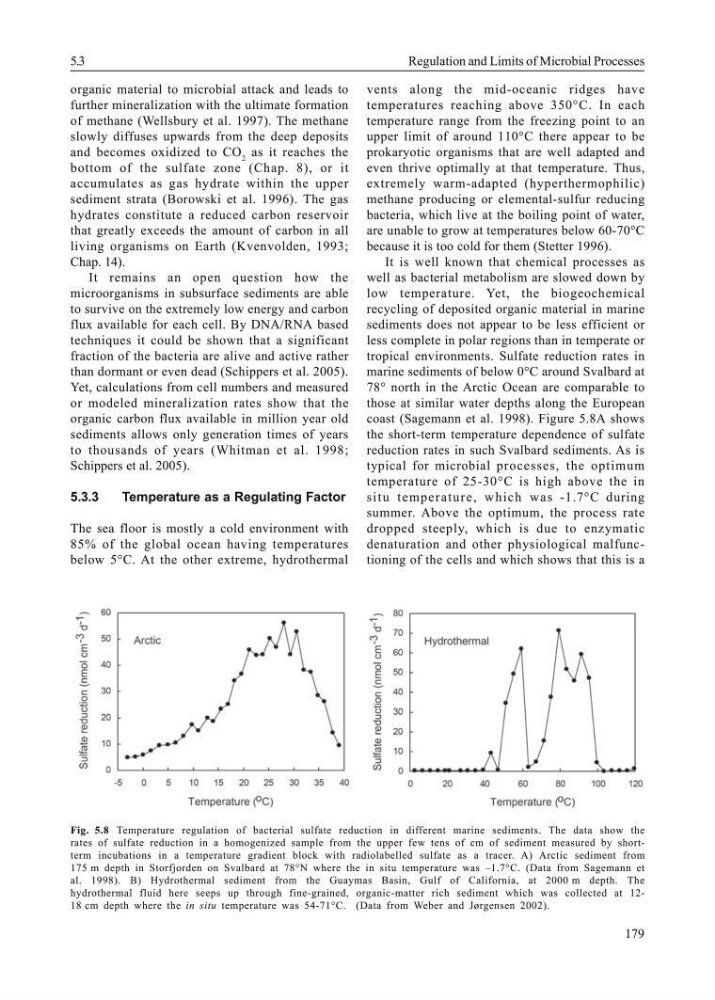
tropical environments. Sulfate reduction rates in
marine sediments of below 0°C around Svalbard at
78° north in the Arctic Ocean are comparable to
those at similar water depths along the European
coast (Sagemann et al. 1998). Figure 5.8A shows
the short-term temperature dependence of sulfate
reduction rates in such Svalbard sediments. As is
typical for microbial processes, the optimum
temperature of 25-30°C is high above the in
situ temperature, which was -1.7°C during
summer. Above the optimum, the process rate
dropped steeply, which is due to enzymatic
denaturation and other physiological malfunctioning of the cells and which shows that this is a
Fig. 5.8 Temperature regulation of bacterial sulfate reduction in different marine sediments. The data show the
rates of sulfate reduction in a homogenized sample from the upper few tens of cm of sediment measured by shortterm incubations in a temperature gradient block with radiolabelled sulfate as a tracer. A) Arctic sediment from
175 m depth in Storfjorden on Svalbard at 78°N where the in situ temperature was –1.7°C. (Data from Sagemann et
al. 1998). B) Hydrothermal sediment from the Guaymas Basin, Gulf of California, at 2000 m depth. The
hydrothermal fluid here seeps up through fine-grained, organic-matter rich sediment which was collected at 1218 cm depth where the in situ temperature was 54-71°C. (Data from Weber and Jørgensen 2002).
5.3
Regulation and Limits of Microbial Processes
organic material to microbial attack and leads to
further mineralization with the ultimate formation
of methane (Wellsbury et al. 1997). The methane
slowly diffuses upwards from the deep deposits
and becomes oxidized to CO 2 as it reaches the
bottom of the sulfate zone (Chap. 8), or it
accumulates as gas hydrate within the upper
sediment strata (Borowski et al. 1996). The gas
hydrates constitute a reduced carbon reservoir
that greatly exceeds the amount of carbon in all
living organisms on Earth (Kvenvolden, 1993;
Chap. 14).
It remains an open question how the
microorganisms in subsurface sediments are able
to survive on the extremely low energy and carbon
flux available for each cell. By DNA/RNA based
techniques it could be shown that a significant
fraction of the bacteria are alive and active rather
than dormant or even dead (Schippers et al. 2005).
Yet, calculations from cell numbers and measured
or modeled mineralization rates show that the
organic carbon flux available in million year old
sediments allows only generation times of years
to thousands of years (Whitman et al. 1998;
Schippers et al. 2005).
5.3.3
Temperature as a Regulating Factor
The sea floor is mostly a cold environment with
85% of the global ocean having temperatures
below 5°C. At the other extreme, hydrothermal
vents along the mid-oceanic ridges have
temperatures reaching above 350°C. In each
temperature range from the freezing point to an
upper limit of around 110°C there appear to be
prokaryotic organisms that are well adapted and
even thrive optimally at that temperature. Thus,
extremely warm-adapted (hyperthermophilic)
methane producing or elemental-sulfur reducing
bacteria, which live at the boiling point of water,
are unable to grow at temperatures below 60-70°C
because it is too cold for them (Stetter 1996).
It is well known that chemical processes as
well as bacterial metabolism are slowed down by
low temperature. Yet, the biogeochemical
recycling of deposited organic material in marine
sediments does not appear to be less efficient or
less complete in polar regions than in temperate or
tropical environments. Sulfate reduction rates in
marine sediments of below 0°C around Svalbard at
78° north in the Arctic Ocean are comparable to
those at similar water depths along the European
coast (Sagemann et al. 1998). Figure 5.8A shows
the short-term temperature dependence of sulfate
reduction rates in such Svalbard sediments. As is
typical for microbial processes, the optimum
temperature of 25-30°C is high above the in
situ temperature, which was -1.7°C during
summer. Above the optimum, the process rate
dropped steeply, which is due to enzymatic
denaturation and other physiological malfunctioning of the cells and which shows that this is a
Fig. 5.8 Temperature regulation of bacterial sulfate reduction in different marine sediments. The data show the
rates of sulfate reduction in a homogenized sample from the upper few tens of cm of sediment measured by shortterm incubations in a temperature gradient block with radiolabelled sulfate as a tracer. A) Arctic sediment from
175 m depth in Storfjorden on Svalbard at 78°N where the in situ temperature was –1.7°C. (Data from Sagemann et
al. 1998). B) Hydrothermal sediment from the Guaymas Basin, Gulf of California, at 2000 m depth. The
hydrothermal fluid here seeps up through fine-grained, organic-matter rich sediment which was collected at 1218 cm depth where the in situ temperature was 54-71°C. (Data from Weber and Jørgensen 2002).
5.3
Regulation and Limits of Microbial Processes