

177
requirements and limits for its physical and
chemical environment, its supply of nutrients,
growth rate and mortality, interaction with other
organisms, etc..
5.3.1
Substrate Uptake by Microorganisms
Among the many reasons for the importance of
prokaryotic organisms in biogeochemical cycling
are:
A) Their metabolic versatility, especially the many
types of anaerobic metabolism and the ability
to degrade complex polymeric substances or to
catalyze reactions among inorganic compounds.
B) Their small size which allows them to inhabit
nearly any environment on the surface of the
Earth and which strongly enhances the efficiency of their catalytic activity.
C) The wide range of environmental conditions
under which they thrive, including temperature, salinity, pH, hydrostatic pressure, etc..
The metabolic versatility of prokaryotic organisms
is discussed in Section 5.4. The small size of the
individual cells is related to their nutrition exclusively on solutes such as small organic molecules,
inorganic ions or gases. The uptake of food by
the prokaryotic cells thus takes place principally
by molecular diffusion of small molecules to the
cell surface and their transport through the
cytoplasmic membrane into the cell. This constrains the relationships between cell size,
metabolic rate, substrate concentration and molecular diffusion coefficients (D) (e.g. Koch 1990;
1996; Karp-Boss et al. 1996). The concentration
gradient around the spherical cell is:
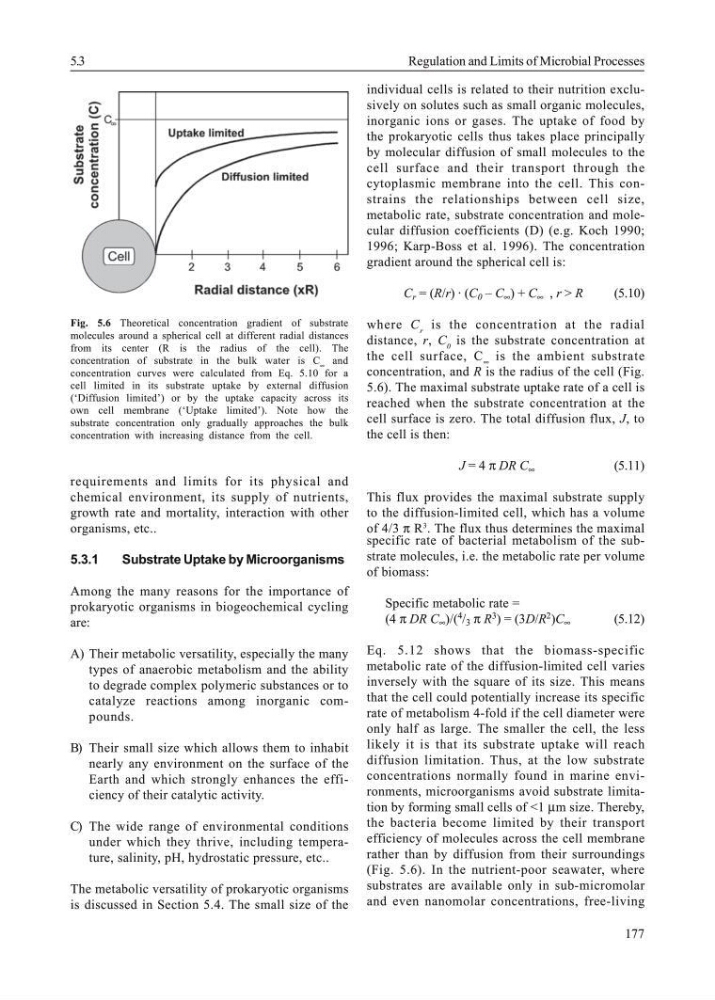
C r = (R/r) · (C 0 – C ∞ ) + C ∞ , r > R
(5.10)
where C r is the concentration at the radial
distance, r, C 0 is the substrate concentration at
the cell surface, C ∞ is the ambient substrate
concentration, and R is the radius of the cell (Fig.
5.6). The maximal substrate uptake rate of a cell is
reached when the substrate concentration at the
cell surface is zero. The total diffusion flux, J, to
the cell is then:
J = 4 π DR C ∞
(5.11)
This flux provides the maximal substrate supply
to the diffusion-limited cell, which has a volume
of 4/3 π R
3
. The flux thus determines the maximal
specific rate of bacterial metabolism of the substrate molecules, i.e. the metabolic rate per volume
of biomass:
Specific metabolic rate =
(4 π DR C ∞ )/( 4 / 3 π R 3 ) = (3D/R 2 )C ∞
(5.12)
Eq. 5.12 shows that the biomass-specific
metabolic rate of the diffusion-limited cell varies
inversely with the square of its size. This means
that the cell could potentially increase its specific
rate of metabolism 4-fold if the cell diameter were
only half as large. The smaller the cell, the less
likely it is that its substrate uptake will reach
diffusion limitation. Thus, at the low substrate
concentrations normally found in marine environments, microorganisms avoid substrate limitation by forming small cells of <1 µm size. Thereby,
the bacteria become limited by their transport
efficiency of molecules across the cell membrane
rather than by diffusion from their surroundings
(Fig. 5.6). In the nutrient-poor seawater, where
substrates are available only in sub-micromolar
and even nanomolar concentrations, free-living
5.3
Regulation and Limits of Microbial Processes
Fig. 5.6 Theoretical concentration gradient of substrate
molecules around a spherical cell at different radial distances
from its center (R is the radius of the cell). The
concentration of substrate in the bulk water is C ∞ and
concentration curves were calculated from Eq. 5.10 for a
cell limited in its substrate uptake by external diffusion
(‘Diffusion limited’) or by the uptake capacity across its
own cell membrane (‘Uptake limited’). Note how the
substrate concentration only gradually approaches the bulk
concentration with increasing distance from the cell.
requirements and limits for its physical and
chemical environment, its supply of nutrients,
growth rate and mortality, interaction with other
organisms, etc..
5.3.1
Substrate Uptake by Microorganisms
Among the many reasons for the importance of
prokaryotic organisms in biogeochemical cycling
are:
A) Their metabolic versatility, especially the many
types of anaerobic metabolism and the ability
to degrade complex polymeric substances or to
catalyze reactions among inorganic compounds.
B) Their small size which allows them to inhabit
nearly any environment on the surface of the
Earth and which strongly enhances the efficiency of their catalytic activity.
C) The wide range of environmental conditions
under which they thrive, including temperature, salinity, pH, hydrostatic pressure, etc..
The metabolic versatility of prokaryotic organisms
is discussed in Section 5.4. The small size of the
individual cells is related to their nutrition exclusively on solutes such as small organic molecules,
inorganic ions or gases. The uptake of food by
the prokaryotic cells thus takes place principally
by molecular diffusion of small molecules to the
cell surface and their transport through the
cytoplasmic membrane into the cell. This constrains the relationships between cell size,
metabolic rate, substrate concentration and molecular diffusion coefficients (D) (e.g. Koch 1990;
1996; Karp-Boss et al. 1996). The concentration
gradient around the spherical cell is:
C r = (R/r) · (C 0 – C ∞ ) + C ∞ , r > R
(5.10)
where C r is the concentration at the radial
distance, r, C 0 is the substrate concentration at
the cell surface, C ∞ is the ambient substrate
concentration, and R is the radius of the cell (Fig.
5.6). The maximal substrate uptake rate of a cell is
reached when the substrate concentration at the
cell surface is zero. The total diffusion flux, J, to
the cell is then:
J = 4 π DR C ∞
(5.11)
This flux provides the maximal substrate supply
to the diffusion-limited cell, which has a volume
of 4/3 π R
3
. The flux thus determines the maximal
specific rate of bacterial metabolism of the substrate molecules, i.e. the metabolic rate per volume
of biomass:
Specific metabolic rate =
(4 π DR C ∞ )/( 4 / 3 π R 3 ) = (3D/R 2 )C ∞
(5.12)
Eq. 5.12 shows that the biomass-specific
metabolic rate of the diffusion-limited cell varies
inversely with the square of its size. This means
that the cell could potentially increase its specific
rate of metabolism 4-fold if the cell diameter were
only half as large. The smaller the cell, the less
likely it is that its substrate uptake will reach
diffusion limitation. Thus, at the low substrate
concentrations normally found in marine environments, microorganisms avoid substrate limitation by forming small cells of <1 µm size. Thereby,
the bacteria become limited by their transport
efficiency of molecules across the cell membrane
rather than by diffusion from their surroundings
(Fig. 5.6). In the nutrient-poor seawater, where
substrates are available only in sub-micromolar
and even nanomolar concentrations, free-living
5.3
Regulation and Limits of Microbial Processes
Fig. 5.6 Theoretical concentration gradient of substrate
molecules around a spherical cell at different radial distances
from its center (R is the radius of the cell). The
concentration of substrate in the bulk water is C ∞ and
concentration curves were calculated from Eq. 5.10 for a
cell limited in its substrate uptake by external diffusion
(‘Diffusion limited’) or by the uptake capacity across its
own cell membrane (‘Uptake limited’). Note how the
substrate concentration only gradually approaches the bulk
concentration with increasing distance from the cell.