

171
bacteria are known to be highly efficient H 2
scavengers (Eq. 5.3):
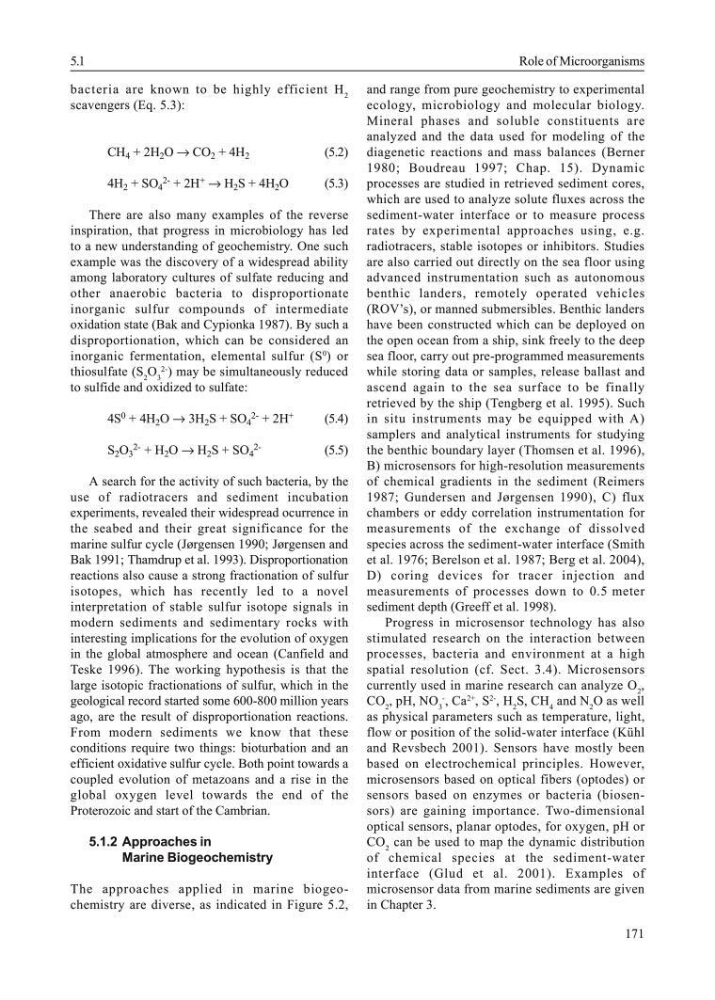
CH 4 + 2H 2 O → CO 2 + 4H 2
(5.2)
4H 2 + SO 4
2- + 2H + → H 2 S + 4H 2 O
(5.3)
There are also many examples of the reverse
inspiration, that progress in microbiology has led
to a new understanding of geochemistry. One such
example was the discovery of a widespread ability
among laboratory cultures of sulfate reducing and
other anaerobic bacteria to disproportionate
inorganic sulfur compounds of intermediate
oxidation state (Bak and Cypionka 1987). By such a
disproportionation, which can be considered an
inorganic fermentation, elemental sulfur (S
0
) or
thiosulfate (S 2 O 3
2) may be simultaneously reduced
to sulfide and oxidized to sulfate:
4S 0 + 4H 2 O → 3H 2 S + SO 4
2- + 2H +
(5.4)
S 2 O 3
2- + H 2 O → H 2 S + SO 4
2(5.5)
A search for the activity of such bacteria, by the
use of radiotracers and sediment incubation
experiments, revealed their widespread ocurrence in
the seabed and their great significance for the
marine sulfur cycle (Jørgensen 1990; Jørgensen and
Bak 1991; Thamdrup et al. 1993). Disproportionation
reactions also cause a strong fractionation of sulfur
isotopes, which has recently led to a novel
interpretation of stable sulfur isotope signals in
modern sediments and sedimentary rocks with
interesting implications for the evolution of oxygen
in the global atmosphere and ocean (Canfield and
Teske 1996). The working hypothesis is that the
large isotopic fractionations of sulfur, which in the
geological record started some 600-800 million years
ago, are the result of disproportionation reactions.
From modern sediments we know that these
conditions require two things: bioturbation and an
efficient oxidative sulfur cycle. Both point towards a
coupled evolution of metazoans and a rise in the
global oxygen level towards the end of the
Proterozoic and start of the Cambrian.
5.1.2 Approaches in
Marine Biogeochemistry
The approaches applied in marine biogeochemistry are diverse, as indicated in Figure 5.2,
and range from pure geochemistry to experimental
ecology, microbiology and molecular biology.
Mineral phases and soluble constituents are
analyzed and the data used for modeling of the
diagenetic reactions and mass balances (Berner
1980; Boudreau 1997; Chap. 15). Dynamic
processes are studied in retrieved sediment cores,
which are used to analyze solute fluxes across the
sediment-water interface or to measure process
rates by experimental approaches using, e.g.
radiotracers, stable isotopes or inhibitors. Studies
are also carried out directly on the sea floor using
advanced instrumentation such as autonomous
benthic landers, remotely operated vehicles
(ROV’s), or manned submersibles. Benthic landers
have been constructed which can be deployed on
the open ocean from a ship, sink freely to the deep
sea floor, carry out pre-programmed measurements
while storing data or samples, release ballast and
ascend again to the sea surface to be finally
retrieved by the ship (Tengberg et al. 1995). Such
in situ instruments may be equipped with A)
samplers and analytical instruments for studying
the benthic boundary layer (Thomsen et al. 1996),
B) microsensors for high-resolution measurements
of chemical gradients in the sediment (Reimers
1987; Gundersen and Jørgensen 1990), C) flux
chambers or eddy correlation instrumentation for
measurements of the exchange of dissolved
species across the sediment-water interface (Smith
et al. 1976; Berelson et al. 1987; Berg et al. 2004),
D) coring devices for tracer injection and
measurements of processes down to 0.5 meter
sediment depth (Greeff et al. 1998).
Progress in microsensor technology has also
stimulated research on the interaction between
processes, bacteria and environment at a high
spatial resolution (cf. Sect. 3.4). Microsensors
currently used in marine research can analyze O 2 ,
CO 2 , pH, NO 3
-
, Ca
2+
, S
2, H 2 S, CH 4 and N 2 O as well
as physical parameters such as temperature, light,
flow or position of the solid-water interface (Kühl
and Revsbech 2001). Sensors have mostly been
based on electrochemical principles. However,
microsensors based on optical fibers (optodes) or
sensors based on enzymes or bacteria (biosensors) are gaining importance. Two-dimensional
optical sensors, planar optodes, for oxygen, pH or
CO 2 can be used to map the dynamic distribution
of chemical species at the sediment-water
interface (Glud et al. 2001). Examples of
microsensor data from marine sediments are given
in Chapter 3.
5.1
Role of Microorganisms
bacteria are known to be highly efficient H 2
scavengers (Eq. 5.3):
CH 4 + 2H 2 O → CO 2 + 4H 2
(5.2)
4H 2 + SO 4
2- + 2H + → H 2 S + 4H 2 O
(5.3)
There are also many examples of the reverse
inspiration, that progress in microbiology has led
to a new understanding of geochemistry. One such
example was the discovery of a widespread ability
among laboratory cultures of sulfate reducing and
other anaerobic bacteria to disproportionate
inorganic sulfur compounds of intermediate
oxidation state (Bak and Cypionka 1987). By such a
disproportionation, which can be considered an
inorganic fermentation, elemental sulfur (S
0
) or
thiosulfate (S 2 O 3
2) may be simultaneously reduced
to sulfide and oxidized to sulfate:
4S 0 + 4H 2 O → 3H 2 S + SO 4
2- + 2H +
(5.4)
S 2 O 3
2- + H 2 O → H 2 S + SO 4
2(5.5)
A search for the activity of such bacteria, by the
use of radiotracers and sediment incubation
experiments, revealed their widespread ocurrence in
the seabed and their great significance for the
marine sulfur cycle (Jørgensen 1990; Jørgensen and
Bak 1991; Thamdrup et al. 1993). Disproportionation
reactions also cause a strong fractionation of sulfur
isotopes, which has recently led to a novel
interpretation of stable sulfur isotope signals in
modern sediments and sedimentary rocks with
interesting implications for the evolution of oxygen
in the global atmosphere and ocean (Canfield and
Teske 1996). The working hypothesis is that the
large isotopic fractionations of sulfur, which in the
geological record started some 600-800 million years
ago, are the result of disproportionation reactions.
From modern sediments we know that these
conditions require two things: bioturbation and an
efficient oxidative sulfur cycle. Both point towards a
coupled evolution of metazoans and a rise in the
global oxygen level towards the end of the
Proterozoic and start of the Cambrian.
5.1.2 Approaches in
Marine Biogeochemistry
The approaches applied in marine biogeochemistry are diverse, as indicated in Figure 5.2,
and range from pure geochemistry to experimental
ecology, microbiology and molecular biology.
Mineral phases and soluble constituents are
analyzed and the data used for modeling of the
diagenetic reactions and mass balances (Berner
1980; Boudreau 1997; Chap. 15). Dynamic
processes are studied in retrieved sediment cores,
which are used to analyze solute fluxes across the
sediment-water interface or to measure process
rates by experimental approaches using, e.g.
radiotracers, stable isotopes or inhibitors. Studies
are also carried out directly on the sea floor using
advanced instrumentation such as autonomous
benthic landers, remotely operated vehicles
(ROV’s), or manned submersibles. Benthic landers
have been constructed which can be deployed on
the open ocean from a ship, sink freely to the deep
sea floor, carry out pre-programmed measurements
while storing data or samples, release ballast and
ascend again to the sea surface to be finally
retrieved by the ship (Tengberg et al. 1995). Such
in situ instruments may be equipped with A)
samplers and analytical instruments for studying
the benthic boundary layer (Thomsen et al. 1996),
B) microsensors for high-resolution measurements
of chemical gradients in the sediment (Reimers
1987; Gundersen and Jørgensen 1990), C) flux
chambers or eddy correlation instrumentation for
measurements of the exchange of dissolved
species across the sediment-water interface (Smith
et al. 1976; Berelson et al. 1987; Berg et al. 2004),
D) coring devices for tracer injection and
measurements of processes down to 0.5 meter
sediment depth (Greeff et al. 1998).
Progress in microsensor technology has also
stimulated research on the interaction between
processes, bacteria and environment at a high
spatial resolution (cf. Sect. 3.4). Microsensors
currently used in marine research can analyze O 2 ,
CO 2 , pH, NO 3
-
, Ca
2+
, S
2, H 2 S, CH 4 and N 2 O as well
as physical parameters such as temperature, light,
flow or position of the solid-water interface (Kühl
and Revsbech 2001). Sensors have mostly been
based on electrochemical principles. However,
microsensors based on optical fibers (optodes) or
sensors based on enzymes or bacteria (biosensors) are gaining importance. Two-dimensional
optical sensors, planar optodes, for oxygen, pH or
CO 2 can be used to map the dynamic distribution
of chemical species at the sediment-water
interface (Glud et al. 2001). Examples of
microsensor data from marine sediments are given
in Chapter 3.
5.1
Role of Microorganisms