

5
Bacteria and Marine Biogeochemistry
170
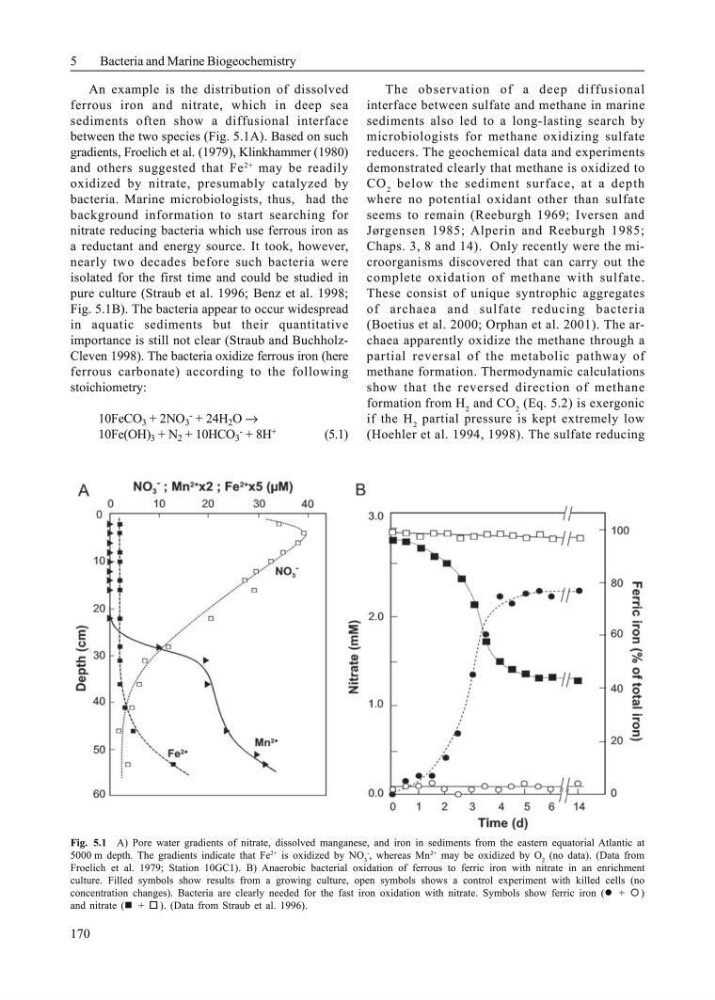
An example is the distribution of dissolved
ferrous iron and nitrate, which in deep sea
sediments often show a diffusional interface
between the two species (Fig. 5.1A). Based on such
gradients, Froelich et al. (1979), Klinkhammer (1980)
and others suggested that Fe
2+
may be readily
oxidized by nitrate, presumably catalyzed by
bacteria. Marine microbiologists, thus, had the
background information to start searching for
nitrate reducing bacteria which use ferrous iron as
a reductant and energy source. It took, however,
nearly two decades before such bacteria were
isolated for the first time and could be studied in
pure culture (Straub et al. 1996; Benz et al. 1998;
Fig. 5.1B). The bacteria appear to occur widespread
in aquatic sediments but their quantitative
importance is still not clear (Straub and BuchholzCleven 1998). The bacteria oxidize ferrous iron (here
ferrous carbonate) according to the following
stoichiometry:
10FeCO 3 + 2NO 3
- + 24H 2 O →
10Fe(OH) 3 + N 2 + 10HCO 3
- + 8H +
(5.1)
The observation of a deep diffusional
interface between sulfate and methane in marine
sediments also led to a long-lasting search by
microbiologists for methane oxidizing sulfate
reducers. The geochemical data and experiments
demonstrated clearly that methane is oxidized to
CO 2 below the sediment surface, at a depth
where no potential oxidant other than sulfate
seems to remain (Reeburgh 1969; Iversen and
Jørgensen 1985; Alperin and Reeburgh 1985;
Chaps. 3, 8 and 14). Only recently were the microorganisms discovered that can carry out the
complete oxidation of methane with sulfate.
These consist of unique syntrophic aggregates
of archaea and sulfate reducing bacteria
(Boetius et al. 2000; Orphan et al. 2001). The archaea apparently oxidize the methane through a
partial reversal of the metabolic pathway of
methane formation. Thermodynamic calculations
show that the reversed direction of methane
formation from H 2 and CO 2 (Eq. 5.2) is exergonic
if the H 2 partial pressure is kept extremely low
(Hoehler et al. 1994, 1998). The sulfate reducing
Fig. 5.1 A) Pore water gradients of nitrate, dissolved manganese, and iron in sediments from the eastern equatorial Atlantic at
5000 m depth. The gradients indicate that Fe
2+ is oxidized by NO 3
-
, whereas Mn
2+ may be oxidized by O 2 (no data). (Data from
Froelich et al. 1979; Station 10GC1). B) Anaerobic bacterial oxidation of ferrous to ferric iron with nitrate in an enrichment
culture. Filled symbols show results from a growing culture, open symbols shows a control experiment with killed cells (no
concentration changes). Bacteria are clearly needed for the fast iron oxidation with nitrate. Symbols show ferric iron ( + )
and nitrate ( + ). (Data from Straub et al. 1996).
Bacteria and Marine Biogeochemistry
170
An example is the distribution of dissolved
ferrous iron and nitrate, which in deep sea
sediments often show a diffusional interface
between the two species (Fig. 5.1A). Based on such
gradients, Froelich et al. (1979), Klinkhammer (1980)
and others suggested that Fe
2+
may be readily
oxidized by nitrate, presumably catalyzed by
bacteria. Marine microbiologists, thus, had the
background information to start searching for
nitrate reducing bacteria which use ferrous iron as
a reductant and energy source. It took, however,
nearly two decades before such bacteria were
isolated for the first time and could be studied in
pure culture (Straub et al. 1996; Benz et al. 1998;
Fig. 5.1B). The bacteria appear to occur widespread
in aquatic sediments but their quantitative
importance is still not clear (Straub and BuchholzCleven 1998). The bacteria oxidize ferrous iron (here
ferrous carbonate) according to the following
stoichiometry:
10FeCO 3 + 2NO 3
- + 24H 2 O →
10Fe(OH) 3 + N 2 + 10HCO 3
- + 8H +
(5.1)
The observation of a deep diffusional
interface between sulfate and methane in marine
sediments also led to a long-lasting search by
microbiologists for methane oxidizing sulfate
reducers. The geochemical data and experiments
demonstrated clearly that methane is oxidized to
CO 2 below the sediment surface, at a depth
where no potential oxidant other than sulfate
seems to remain (Reeburgh 1969; Iversen and
Jørgensen 1985; Alperin and Reeburgh 1985;
Chaps. 3, 8 and 14). Only recently were the microorganisms discovered that can carry out the
complete oxidation of methane with sulfate.
These consist of unique syntrophic aggregates
of archaea and sulfate reducing bacteria
(Boetius et al. 2000; Orphan et al. 2001). The archaea apparently oxidize the methane through a
partial reversal of the metabolic pathway of
methane formation. Thermodynamic calculations
show that the reversed direction of methane
formation from H 2 and CO 2 (Eq. 5.2) is exergonic
if the H 2 partial pressure is kept extremely low
(Hoehler et al. 1994, 1998). The sulfate reducing
Fig. 5.1 A) Pore water gradients of nitrate, dissolved manganese, and iron in sediments from the eastern equatorial Atlantic at
5000 m depth. The gradients indicate that Fe
2+ is oxidized by NO 3
-
, whereas Mn
2+ may be oxidized by O 2 (no data). (Data from
Froelich et al. 1979; Station 10GC1). B) Anaerobic bacterial oxidation of ferrous to ferric iron with nitrate in an enrichment
culture. Filled symbols show results from a growing culture, open symbols shows a control experiment with killed cells (no
concentration changes). Bacteria are clearly needed for the fast iron oxidation with nitrate. Symbols show ferric iron ( + )
and nitrate ( + ). (Data from Straub et al. 1996).