

4
Organic Matter: The Driving Force for Early Diagenesis
156
TEX 86 Paleothermometry
Recently, a new geochemical temperature proxy, the
TEX 86 index, was introduced by Schouten et al. (2002).
It is based on the number of cyclopentane moieties in
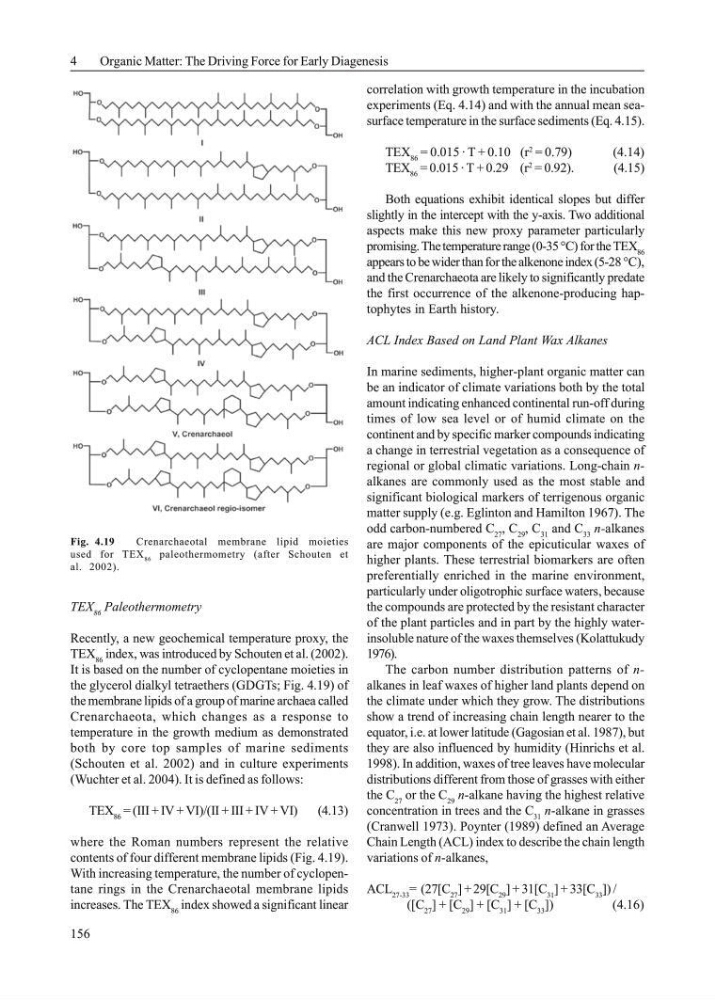
the glycerol dialkyl tetraethers (GDGTs; Fig. 4.19) of
the membrane lipids of a group of marine archaea called
Crenarchaeota, which changes as a response to
temperature in the growth medium as demonstrated
both by core top samples of marine sediments
(Schouten et al. 2002) and in culture experiments
(Wuchter et al. 2004). It is defined as follows:
TEX 86 = (III + IV + VI)/(II + III + IV + VI)
(4.13)
where the Roman numbers represent the relative
contents of four different membrane lipids (Fig. 4.19).
With increasing temperature, the number of cyclopentane rings in the Crenarchaeotal membrane lipids
increases. The TEX 86 index showed a significant linear
correlation with growth temperature in the incubation
experiments (Eq. 4.14) and with the annual mean seasurface temperature in the surface sediments (Eq. 4.15).
TEX 86 = 0.015 · T + 0.10 (r
2
= 0.79)
(4.14)
TEX 86 = 0.015 · T + 0.29 (r
2
= 0.92).
(4.15)
Both equations exhibit identical slopes but differ
slightly in the intercept with the y-axis. Two additional
aspects make this new proxy parameter particularly
promising. The temperature range (0-35 °C) for the TEX 86
appears to be wider than for the alkenone index (5-28 °C),
and the Crenarchaeota are likely to significantly predate
the first occurrence of the alkenone-producing haptophytes in Earth history.
ACL Index Based on Land Plant Wax Alkanes
In marine sediments, higher-plant organic matter can
be an indicator of climate variations both by the total
amount indicating enhanced continental run-off during
times of low sea level or of humid climate on the
continent and by specific marker compounds indicating
a change in terrestrial vegetation as a consequence of
regional or global climatic variations. Long-chain nalkanes are commonly used as the most stable and
significant biological markers of terrigenous organic
matter supply (e.g. Eglinton and Hamilton 1967). The
odd carbon-numbered C 27 , C 29 , C 31 and C 33 n-alkanes
are major components of the epicuticular waxes of
higher plants. These terrestrial biomarkers are often
preferentially enriched in the marine environment,
particularly under oligotrophic surface waters, because
the compounds are protected by the resistant character
of the plant particles and in part by the highly waterinsoluble nature of the waxes themselves (Kolattukudy
1976).
The carbon number distribution patterns of nalkanes in leaf waxes of higher land plants depend on
the climate under which they grow. The distributions
show a trend of increasing chain length nearer to the
equator, i.e. at lower latitude (Gagosian et al. 1987), but
they are also influenced by humidity (Hinrichs et al.
1998). In addition, waxes of tree leaves have molecular
distributions different from those of grasses with either
the C 27 or the C 29 n-alkane having the highest relative
concentration in trees and the C 31 n-alkane in grasses
(Cranwell 1973). Poynter (1989) defined an Average
Chain Length (ACL) index to describe the chain length
variations of n-alkanes,
ACL 27-33 = (27[C 27 ] + 29[C 29 ] + 31[C 31 ] + 33[C 33 ]) /
([C 27 ] + [C 29 ] + [C 31 ] + [C 33 ])
(4.16)
Fig. 4.19
Crenarchaeotal membrane lipid moieties
used for TEX 86 paleothermometry (after Schouten et
al. 2002).
Organic Matter: The Driving Force for Early Diagenesis
156
TEX 86 Paleothermometry
Recently, a new geochemical temperature proxy, the
TEX 86 index, was introduced by Schouten et al. (2002).
It is based on the number of cyclopentane moieties in
the glycerol dialkyl tetraethers (GDGTs; Fig. 4.19) of
the membrane lipids of a group of marine archaea called
Crenarchaeota, which changes as a response to
temperature in the growth medium as demonstrated
both by core top samples of marine sediments
(Schouten et al. 2002) and in culture experiments
(Wuchter et al. 2004). It is defined as follows:
TEX 86 = (III + IV + VI)/(II + III + IV + VI)
(4.13)
where the Roman numbers represent the relative
contents of four different membrane lipids (Fig. 4.19).
With increasing temperature, the number of cyclopentane rings in the Crenarchaeotal membrane lipids
increases. The TEX 86 index showed a significant linear
correlation with growth temperature in the incubation
experiments (Eq. 4.14) and with the annual mean seasurface temperature in the surface sediments (Eq. 4.15).
TEX 86 = 0.015 · T + 0.10 (r
2
= 0.79)
(4.14)
TEX 86 = 0.015 · T + 0.29 (r
2
= 0.92).
(4.15)
Both equations exhibit identical slopes but differ
slightly in the intercept with the y-axis. Two additional
aspects make this new proxy parameter particularly
promising. The temperature range (0-35 °C) for the TEX 86
appears to be wider than for the alkenone index (5-28 °C),
and the Crenarchaeota are likely to significantly predate
the first occurrence of the alkenone-producing haptophytes in Earth history.
ACL Index Based on Land Plant Wax Alkanes
In marine sediments, higher-plant organic matter can
be an indicator of climate variations both by the total
amount indicating enhanced continental run-off during
times of low sea level or of humid climate on the
continent and by specific marker compounds indicating
a change in terrestrial vegetation as a consequence of
regional or global climatic variations. Long-chain nalkanes are commonly used as the most stable and
significant biological markers of terrigenous organic
matter supply (e.g. Eglinton and Hamilton 1967). The
odd carbon-numbered C 27 , C 29 , C 31 and C 33 n-alkanes
are major components of the epicuticular waxes of
higher plants. These terrestrial biomarkers are often
preferentially enriched in the marine environment,
particularly under oligotrophic surface waters, because
the compounds are protected by the resistant character
of the plant particles and in part by the highly waterinsoluble nature of the waxes themselves (Kolattukudy
1976).
The carbon number distribution patterns of nalkanes in leaf waxes of higher land plants depend on
the climate under which they grow. The distributions
show a trend of increasing chain length nearer to the
equator, i.e. at lower latitude (Gagosian et al. 1987), but
they are also influenced by humidity (Hinrichs et al.
1998). In addition, waxes of tree leaves have molecular
distributions different from those of grasses with either
the C 27 or the C 29 n-alkane having the highest relative
concentration in trees and the C 31 n-alkane in grasses
(Cranwell 1973). Poynter (1989) defined an Average
Chain Length (ACL) index to describe the chain length
variations of n-alkanes,
ACL 27-33 = (27[C 27 ] + 29[C 29 ] + 31[C 31 ] + 33[C 33 ]) /
([C 27 ] + [C 29 ] + [C 31 ] + [C 33 ])
(4.16)
Fig. 4.19
Crenarchaeotal membrane lipid moieties
used for TEX 86 paleothermometry (after Schouten et
al. 2002).