

157
4.4
Organic Geochemical Proxies
characterized by drastic changes of temperature and
precipitation. During relatively warm and dry
periods when mainly laminated sediments were
accumulated in the Santa Barbara basin, smaller
proportions of grass-derived biomass may have
contributed to the sedimentary organic matter.
•
• •
• • Changes in continental precipitation significantly
affected the degree of erosion and the transport of
terrigenous detritus to the ocean, enhancing the
proportion of biomass from other source areas
(probably over longer distances from higher
altitudes). This explains best the almost parallel and
abrupt changes of oceanic conditions (e.g. bottomwater oxygen concentrations affecting sediment
texture) and terrestrial signals recorded in the
sediments (e.g. ACL indices).
in which [C x ] signifies the content of the n-alkane with
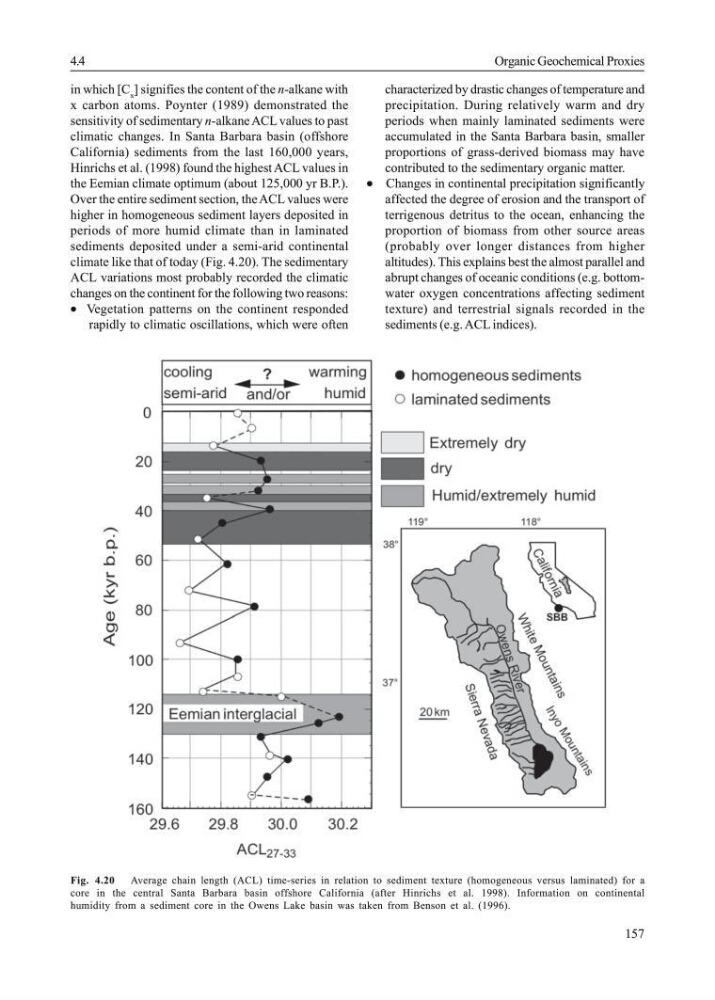
x carbon atoms. Poynter (1989) demonstrated the
sensitivity of sedimentary n-alkane ACL values to past
climatic changes. In Santa Barbara basin (offshore
California) sediments from the last 160,000 years,
Hinrichs et al. (1998) found the highest ACL values in
the Eemian climate optimum (about 125,000 yr B.P.).
Over the entire sediment section, the ACL values were
higher in homogeneous sediment layers deposited in
periods of more humid climate than in laminated
sediments deposited under a semi-arid continental
climate like that of today (Fig. 4.20). The sedimentary
ACL variations most probably recorded the climatic
changes on the continent for the following two reasons:
•
• •
• • Vegetation patterns on the continent responded
rapidly to climatic oscillations, which were often
Fig. 4.20
Average chain length (ACL) time-series in relation to sediment texture (homogeneous versus laminated) for a
core in the central Santa Barbara basin offshore California (after Hinrichs et al. 1998). Information on continental
humidity from a sediment core in the Owens Lake basin was taken from Benson et al. (1996).
4.4
Organic Geochemical Proxies
characterized by drastic changes of temperature and
precipitation. During relatively warm and dry
periods when mainly laminated sediments were
accumulated in the Santa Barbara basin, smaller
proportions of grass-derived biomass may have
contributed to the sedimentary organic matter.
•
• •
• • Changes in continental precipitation significantly
affected the degree of erosion and the transport of
terrigenous detritus to the ocean, enhancing the
proportion of biomass from other source areas
(probably over longer distances from higher
altitudes). This explains best the almost parallel and
abrupt changes of oceanic conditions (e.g. bottomwater oxygen concentrations affecting sediment
texture) and terrestrial signals recorded in the
sediments (e.g. ACL indices).
in which [C x ] signifies the content of the n-alkane with
x carbon atoms. Poynter (1989) demonstrated the
sensitivity of sedimentary n-alkane ACL values to past
climatic changes. In Santa Barbara basin (offshore
California) sediments from the last 160,000 years,
Hinrichs et al. (1998) found the highest ACL values in
the Eemian climate optimum (about 125,000 yr B.P.).
Over the entire sediment section, the ACL values were
higher in homogeneous sediment layers deposited in
periods of more humid climate than in laminated
sediments deposited under a semi-arid continental
climate like that of today (Fig. 4.20). The sedimentary
ACL variations most probably recorded the climatic
changes on the continent for the following two reasons:
•
• •
• • Vegetation patterns on the continent responded
rapidly to climatic oscillations, which were often
Fig. 4.20
Average chain length (ACL) time-series in relation to sediment texture (homogeneous versus laminated) for a
core in the central Santa Barbara basin offshore California (after Hinrichs et al. 1998). Information on continental
humidity from a sediment core in the Owens Lake basin was taken from Benson et al. (1996).