

155
U 37
K' = 0.033T + 0.044
(4.12)
is identical within error limits with the widely used
calibrations of Prahl and Wakeham (1987) and Prahl
et al. (1988) based on Emiliania huxleyi cultures
(U 37
K' = 0.033T + 0.043). Müller et al. (1998) also found
that the best correlations were obtained using ocean
water temperatures from 0 to 10 m water depth,
suggesting that the sedimentary U 37
K' ratio reflects
mixed-layer temperatures and that the production of
alkenones within or below the thermocline was not high
enough to significantly bias the mixed-layer
temperature signal. Regional variations in the seasonality of primary production also have only a negligible
effect on the U signal in the sediments. Furthermore,
the strong linear relationships obtained for the South
Atlantic Ocean and the global ocean indicate that U
values of the sediments are neither affected to a
measurable degree by changing species compositions
nor by growth rate of algae and nutrient availability,
other than expected from culture experiments. Significant effort was undertaken to intercalibrate the
analysis of the alkenone parameter world-wide (RosellMelé et al. 2001). Continuing research on the alkenone
parameter, however, still reveals additional calibrations
for extreme environments (e.g. Sicre et al. 2002) or the
temperature range over which the alkenone index can
be applied (Pelejero and Calvo 2003).
The alkenone index presently is one of the most
frequently used molecular organic geochemical parameters
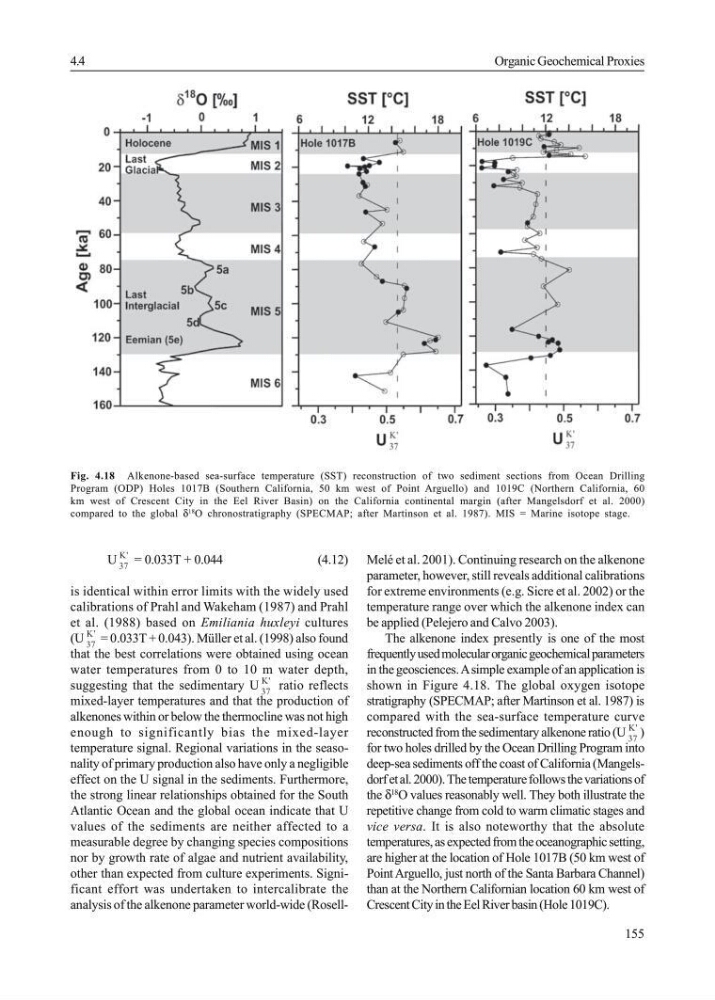
in the geosciences. A simple example of an application is
shown in Figure 4.18. The global oxygen isotope
stratigraphy (SPECMAP; after Martinson et al. 1987) is
compared with the sea-surface temperature curve
reconstructed from the sedimentary alkenone ratio (U 37
K' )
for two holes drilled by the Ocean Drilling Program into
deep-sea sediments off the coast of California (Mangelsdorf et al. 2000). The temperature follows the variations of
the δ
18
O values reasonably well. They both illustrate the
repetitive change from cold to warm climatic stages and
vice versa. It is also noteworthy that the absolute
temperatures, as expected from the oceanographic setting,
are higher at the location of Hole 1017B (50 km west of
Point Arguello, just north of the Santa Barbara Channel)
than at the Northern Californian location 60 km west of
Crescent City in the Eel River basin (Hole 1019C).
4.4
Organic Geochemical Proxies
Fig. 4.18 Alkenone-based sea-surface temperature (SST) reconstruction of two sediment sections from Ocean Drilling
Program (ODP) Holes 1017B (Southern California, 50 km west of Point Arguello) and 1019C (Northern California, 60
km west of Crescent City in the Eel River Basin) on the California continental margin (after Mangelsdorf et al. 2000)
compared to the global δ
18 O chronostratigraphy (SPECMAP; after Martinson et al. 1987). MIS = Marine isotope stage.
U 37
K' = 0.033T + 0.044
(4.12)
is identical within error limits with the widely used
calibrations of Prahl and Wakeham (1987) and Prahl
et al. (1988) based on Emiliania huxleyi cultures
(U 37
K' = 0.033T + 0.043). Müller et al. (1998) also found
that the best correlations were obtained using ocean
water temperatures from 0 to 10 m water depth,
suggesting that the sedimentary U 37
K' ratio reflects
mixed-layer temperatures and that the production of
alkenones within or below the thermocline was not high
enough to significantly bias the mixed-layer
temperature signal. Regional variations in the seasonality of primary production also have only a negligible
effect on the U signal in the sediments. Furthermore,
the strong linear relationships obtained for the South
Atlantic Ocean and the global ocean indicate that U
values of the sediments are neither affected to a
measurable degree by changing species compositions
nor by growth rate of algae and nutrient availability,
other than expected from culture experiments. Significant effort was undertaken to intercalibrate the
analysis of the alkenone parameter world-wide (RosellMelé et al. 2001). Continuing research on the alkenone
parameter, however, still reveals additional calibrations
for extreme environments (e.g. Sicre et al. 2002) or the
temperature range over which the alkenone index can
be applied (Pelejero and Calvo 2003).
The alkenone index presently is one of the most
frequently used molecular organic geochemical parameters
in the geosciences. A simple example of an application is
shown in Figure 4.18. The global oxygen isotope
stratigraphy (SPECMAP; after Martinson et al. 1987) is
compared with the sea-surface temperature curve
reconstructed from the sedimentary alkenone ratio (U 37
K' )
for two holes drilled by the Ocean Drilling Program into
deep-sea sediments off the coast of California (Mangelsdorf et al. 2000). The temperature follows the variations of
the δ
18
O values reasonably well. They both illustrate the
repetitive change from cold to warm climatic stages and
vice versa. It is also noteworthy that the absolute
temperatures, as expected from the oceanographic setting,
are higher at the location of Hole 1017B (50 km west of
Point Arguello, just north of the Santa Barbara Channel)
than at the Northern Californian location 60 km west of
Crescent City in the Eel River basin (Hole 1019C).
4.4
Organic Geochemical Proxies
Fig. 4.18 Alkenone-based sea-surface temperature (SST) reconstruction of two sediment sections from Ocean Drilling
Program (ODP) Holes 1017B (Southern California, 50 km west of Point Arguello) and 1019C (Northern California, 60
km west of Crescent City in the Eel River Basin) on the California continental margin (after Mangelsdorf et al. 2000)
compared to the global δ
18 O chronostratigraphy (SPECMAP; after Martinson et al. 1987). MIS = Marine isotope stage.