

4
Organic Matter: The Driving Force for Early Diagenesis
154
bic methane oxidation (e.g. Orphan et al. 2001, 2002;
Elvert et al. 2003; Wakeham et al. 2003).
Marine sediments may not only be a mixture from
autochthonous and allochthonous sources, the different biogenic components may also be of different age.
Whereas mixing by redeposition of continental slope
sediments by slumping or turbidite flow are well known
and often recognizable on a bulk level, there may also
be more intimate mixing of components of diverse age
when, e.g., terrestrial organic matter is transported to
the ocean through rivers taking a significant amount
of time. Radiocarbon analysis of individual biomarkers
has revealed that their
14
C ages can differ significantly
within a given sediment sample, but some of these
differences are not easy to explain (e.g. Eglinton et al.
1997; Pearson et al. 2001). Mollenhauer et al. (2003)
compared the
14
C ages of carbonate frustrules of
planktonic foraminifera with those of long-chain
alkenones (cf. Sect. 4.4.3), both widely used for
reconstructing the chronostratigraphy of near-surface
marine sediments, in hemipelagic muds from the Namibia
continental margin in the South Atlantic Ocean. They
found the alkenones to be systematically and up to
2000 years older than the foraminifera. Among several
possible alternative explanations for this discrepancy
they favored long-range transport of the alkenones,
possibly from the Argentine basin across the Atlantic
Ocean, before they were ultimately deposited together
with the autochthonous, younger foraminifera.
4.4.3
Molecular Paleo-Seawater
Temperature and Climate Indicators
Past Sea-Surface Temperatures (SST) Based on
Long-Chain Alkenones
Paleoceanographic studies have taken advantage of
the fact that biosynthesis of a major family of organic
compounds by certain microalgae depends on the water
temperature during growth. The microalgae belong to
the class of Haptophyceae (often also named Prymnesiophyceae) and notably comprise the marine coccolithophorids Emiliania huxleyi and Gephyrocapsa
oceanica. The whole family of compounds, which are
found in marine sediments of Recent to Lower
Cretaceous age throughout the world ocean, is a
complex assemblage of aliphatic straight-chain ketones
and esters with 37 to 41 carbon atoms and two to four
double bonds (see Brassell 1993 and Brassell et al. 2004
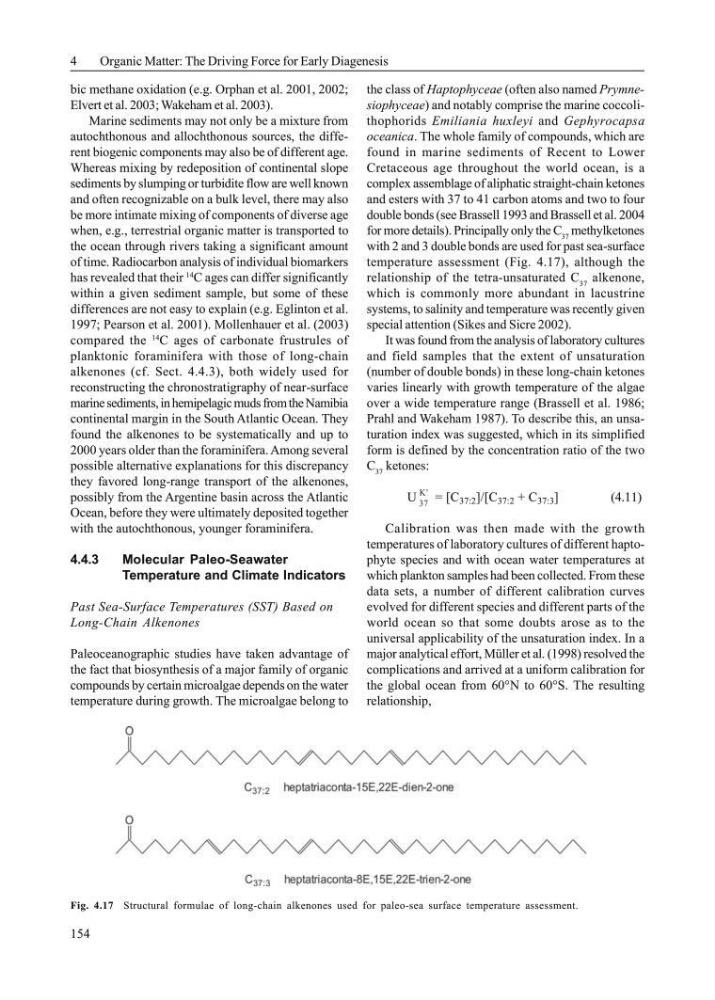
for more details). Principally only the C 37 methylketones
with 2 and 3 double bonds are used for past sea-surface
temperature assessment (Fig. 4.17), although the
relationship of the tetra-unsaturated C 37 alkenone,
which is commonly more abundant in lacustrine
systems, to salinity and temperature was recently given
special attention (Sikes and Sicre 2002).
It was found from the analysis of laboratory cultures
and field samples that the extent of unsaturation
(number of double bonds) in these long-chain ketones
varies linearly with growth temperature of the algae
over a wide temperature range (Brassell et al. 1986;
Prahl and Wakeham 1987). To describe this, an unsaturation index was suggested, which in its simplified
form is defined by the concentration ratio of the two
C 37 ketones:
U 37
K' = [C 37:2 ]/[C 37:2 + C 37:3 ]
(4.11)
Calibration was then made with the growth
temperatures of laboratory cultures of different haptophyte species and with ocean water temperatures at
which plankton samples had been collected. From these
data sets, a number of different calibration curves
evolved for different species and different parts of the
world ocean so that some doubts arose as to the
universal applicability of the unsaturation index. In a
major analytical effort, Müller et al. (1998) resolved the
complications and arrived at a uniform calibration for
the global ocean from 60°N to 60°S. The resulting
relationship,
Fig. 4.17 Structural formulae of long-chain alkenones used for paleo-sea surface temperature assessment.
Organic Matter: The Driving Force for Early Diagenesis
154
bic methane oxidation (e.g. Orphan et al. 2001, 2002;
Elvert et al. 2003; Wakeham et al. 2003).
Marine sediments may not only be a mixture from
autochthonous and allochthonous sources, the different biogenic components may also be of different age.
Whereas mixing by redeposition of continental slope
sediments by slumping or turbidite flow are well known
and often recognizable on a bulk level, there may also
be more intimate mixing of components of diverse age
when, e.g., terrestrial organic matter is transported to
the ocean through rivers taking a significant amount
of time. Radiocarbon analysis of individual biomarkers
has revealed that their
14
C ages can differ significantly
within a given sediment sample, but some of these
differences are not easy to explain (e.g. Eglinton et al.
1997; Pearson et al. 2001). Mollenhauer et al. (2003)
compared the
14
C ages of carbonate frustrules of
planktonic foraminifera with those of long-chain
alkenones (cf. Sect. 4.4.3), both widely used for
reconstructing the chronostratigraphy of near-surface
marine sediments, in hemipelagic muds from the Namibia
continental margin in the South Atlantic Ocean. They
found the alkenones to be systematically and up to
2000 years older than the foraminifera. Among several
possible alternative explanations for this discrepancy
they favored long-range transport of the alkenones,
possibly from the Argentine basin across the Atlantic
Ocean, before they were ultimately deposited together
with the autochthonous, younger foraminifera.
4.4.3
Molecular Paleo-Seawater
Temperature and Climate Indicators
Past Sea-Surface Temperatures (SST) Based on
Long-Chain Alkenones
Paleoceanographic studies have taken advantage of
the fact that biosynthesis of a major family of organic
compounds by certain microalgae depends on the water
temperature during growth. The microalgae belong to
the class of Haptophyceae (often also named Prymnesiophyceae) and notably comprise the marine coccolithophorids Emiliania huxleyi and Gephyrocapsa
oceanica. The whole family of compounds, which are
found in marine sediments of Recent to Lower
Cretaceous age throughout the world ocean, is a
complex assemblage of aliphatic straight-chain ketones
and esters with 37 to 41 carbon atoms and two to four
double bonds (see Brassell 1993 and Brassell et al. 2004
for more details). Principally only the C 37 methylketones
with 2 and 3 double bonds are used for past sea-surface
temperature assessment (Fig. 4.17), although the
relationship of the tetra-unsaturated C 37 alkenone,
which is commonly more abundant in lacustrine
systems, to salinity and temperature was recently given
special attention (Sikes and Sicre 2002).
It was found from the analysis of laboratory cultures
and field samples that the extent of unsaturation
(number of double bonds) in these long-chain ketones
varies linearly with growth temperature of the algae
over a wide temperature range (Brassell et al. 1986;
Prahl and Wakeham 1987). To describe this, an unsaturation index was suggested, which in its simplified
form is defined by the concentration ratio of the two
C 37 ketones:
U 37
K' = [C 37:2 ]/[C 37:2 + C 37:3 ]
(4.11)
Calibration was then made with the growth
temperatures of laboratory cultures of different haptophyte species and with ocean water temperatures at
which plankton samples had been collected. From these
data sets, a number of different calibration curves
evolved for different species and different parts of the
world ocean so that some doubts arose as to the
universal applicability of the unsaturation index. In a
major analytical effort, Müller et al. (1998) resolved the
complications and arrived at a uniform calibration for
the global ocean from 60°N to 60°S. The resulting
relationship,
Fig. 4.17 Structural formulae of long-chain alkenones used for paleo-sea surface temperature assessment.