

153
of dissolved inorganic carbon (DIC; CO 2 , bicarbonate,
carbonate) available for photosynthesis in the cells
varies over the year with the balance between
photosynthetic uptake and respiratory production.
During summer and spring, when rates of
photosynthesis are high, the isotope ratio of remaining
DIC is enriched in
13
C. In fall, when respiration is the
dominant process, the δ
13
C of DIC becomes more
negative because organic matter is remineralized.
Fluctuations that have been measured in the δ
13
C
values of sedimentary organic matter over the Earth’s
history (e.g. Schidlowski 1988) can thus be interpreted
in terms of the productivity in the water column and
the availability of DIC in a particular geological time
period. In a study of sediments from the central
equatorial Pacific Ocean spanning the last 255,000 years
it has been demonstrated that the carbon isotopic
composition of fossil organic matter depends on the
exchange between atmospheric and oceanic CO 2 .
Changes with time can then be used to estimate past
atmospheric carbon dioxide concentrations (Jasper et
al. 1994).
Other than stable carbon isotopes the stable
hydrogen isotopes do not reflect the fixation processes
in photosynthesis, but rather the hydrological cycle
under which the respective plants have grown (Sessions et al. 1999; Sauer et al. 2001). This means that
lake biota will differ in hydrogen isotope composition
from marine organisms, and land plants thriving under
humid or arid conditions will show a large spread in
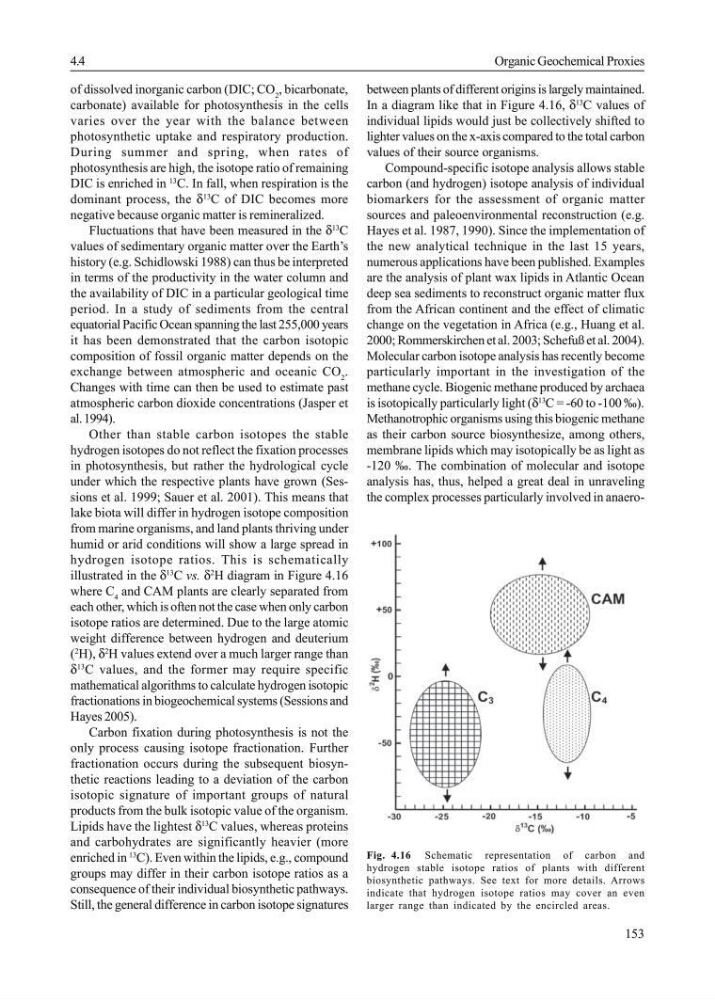
hydrogen isotope ratios. This is schematically
illustrated in the δ
13
C vs. δ
2
H diagram in Figure 4.16
where C 4 and CAM plants are clearly separated from
each other, which is often not the case when only carbon
isotope ratios are determined. Due to the large atomic
weight difference between hydrogen and deuterium
(
2
H), δ
2
H values extend over a much larger range than
δ
13
C values, and the former may require specific
mathematical algorithms to calculate hydrogen isotopic
fractionations in biogeochemical systems (Sessions and
Hayes 2005).
Carbon fixation during photosynthesis is not the
only process causing isotope fractionation. Further
fractionation occurs during the subsequent biosynthetic reactions leading to a deviation of the carbon
isotopic signature of important groups of natural
products from the bulk isotopic value of the organism.
Lipids have the lightest δ
13
C values, whereas proteins
and carbohydrates are significantly heavier (more
enriched in
13
C). Even within the lipids, e.g., compound
groups may differ in their carbon isotope ratios as a
consequence of their individual biosynthetic pathways.
Still, the general difference in carbon isotope signatures
between plants of different origins is largely maintained.
In a diagram like that in Figure 4.16, δ
13
C values of
individual lipids would just be collectively shifted to
lighter values on the x-axis compared to the total carbon
values of their source organisms.
Compound-specific isotope analysis allows stable
carbon (and hydrogen) isotope analysis of individual
biomarkers for the assessment of organic matter
sources and paleoenvironmental reconstruction (e.g.
Hayes et al. 1987, 1990). Since the implementation of
the new analytical technique in the last 15 years,
numerous applications have been published. Examples
are the analysis of plant wax lipids in Atlantic Ocean
deep sea sediments to reconstruct organic matter flux
from the African continent and the effect of climatic
change on the vegetation in Africa (e.g., Huang et al.
2000; Rommerskirchen et al. 2003; Schefuß et al. 2004).
Molecular carbon isotope analysis has recently become
particularly important in the investigation of the
methane cycle. Biogenic methane produced by archaea
is isotopically particularly light (δ
13
C = -60 to -100 ‰).
Methanotrophic organisms using this biogenic methane
as their carbon source biosynthesize, among others,
membrane lipids which may isotopically be as light as
-120 ‰. The combination of molecular and isotope
analysis has, thus, helped a great deal in unraveling
the complex processes particularly involved in anaero4.4
Organic Geochemical Proxies
Fig. 4.16 Schematic representation of carbon and
hydrogen stable isotope ratios of plants with different
biosynthetic pathways. See text for more details. Arrows
indicate that hydrogen isotope ratios may cover an even
larger range than indicated by the encircled areas.
of dissolved inorganic carbon (DIC; CO 2 , bicarbonate,
carbonate) available for photosynthesis in the cells
varies over the year with the balance between
photosynthetic uptake and respiratory production.
During summer and spring, when rates of
photosynthesis are high, the isotope ratio of remaining
DIC is enriched in
13
C. In fall, when respiration is the
dominant process, the δ
13
C of DIC becomes more
negative because organic matter is remineralized.
Fluctuations that have been measured in the δ
13
C
values of sedimentary organic matter over the Earth’s
history (e.g. Schidlowski 1988) can thus be interpreted
in terms of the productivity in the water column and
the availability of DIC in a particular geological time
period. In a study of sediments from the central
equatorial Pacific Ocean spanning the last 255,000 years
it has been demonstrated that the carbon isotopic
composition of fossil organic matter depends on the
exchange between atmospheric and oceanic CO 2 .
Changes with time can then be used to estimate past
atmospheric carbon dioxide concentrations (Jasper et
al. 1994).
Other than stable carbon isotopes the stable
hydrogen isotopes do not reflect the fixation processes
in photosynthesis, but rather the hydrological cycle
under which the respective plants have grown (Sessions et al. 1999; Sauer et al. 2001). This means that
lake biota will differ in hydrogen isotope composition
from marine organisms, and land plants thriving under
humid or arid conditions will show a large spread in
hydrogen isotope ratios. This is schematically
illustrated in the δ
13
C vs. δ
2
H diagram in Figure 4.16
where C 4 and CAM plants are clearly separated from
each other, which is often not the case when only carbon
isotope ratios are determined. Due to the large atomic
weight difference between hydrogen and deuterium
(
2
H), δ
2
H values extend over a much larger range than
δ
13
C values, and the former may require specific
mathematical algorithms to calculate hydrogen isotopic
fractionations in biogeochemical systems (Sessions and
Hayes 2005).
Carbon fixation during photosynthesis is not the
only process causing isotope fractionation. Further
fractionation occurs during the subsequent biosynthetic reactions leading to a deviation of the carbon
isotopic signature of important groups of natural
products from the bulk isotopic value of the organism.
Lipids have the lightest δ
13
C values, whereas proteins
and carbohydrates are significantly heavier (more
enriched in
13
C). Even within the lipids, e.g., compound
groups may differ in their carbon isotope ratios as a
consequence of their individual biosynthetic pathways.
Still, the general difference in carbon isotope signatures
between plants of different origins is largely maintained.
In a diagram like that in Figure 4.16, δ
13
C values of
individual lipids would just be collectively shifted to
lighter values on the x-axis compared to the total carbon
values of their source organisms.
Compound-specific isotope analysis allows stable
carbon (and hydrogen) isotope analysis of individual
biomarkers for the assessment of organic matter
sources and paleoenvironmental reconstruction (e.g.
Hayes et al. 1987, 1990). Since the implementation of
the new analytical technique in the last 15 years,
numerous applications have been published. Examples
are the analysis of plant wax lipids in Atlantic Ocean
deep sea sediments to reconstruct organic matter flux
from the African continent and the effect of climatic
change on the vegetation in Africa (e.g., Huang et al.
2000; Rommerskirchen et al. 2003; Schefuß et al. 2004).
Molecular carbon isotope analysis has recently become
particularly important in the investigation of the
methane cycle. Biogenic methane produced by archaea
is isotopically particularly light (δ
13
C = -60 to -100 ‰).
Methanotrophic organisms using this biogenic methane
as their carbon source biosynthesize, among others,
membrane lipids which may isotopically be as light as
-120 ‰. The combination of molecular and isotope
analysis has, thus, helped a great deal in unraveling
the complex processes particularly involved in anaero4.4
Organic Geochemical Proxies
Fig. 4.16 Schematic representation of carbon and
hydrogen stable isotope ratios of plants with different
biosynthetic pathways. See text for more details. Arrows
indicate that hydrogen isotope ratios may cover an even
larger range than indicated by the encircled areas.