

4
Organic Matter: The Driving Force for Early Diagenesis
152
13
C during photosynthesis (e.g. Hayes 1993). Most
plants, including phytoplankton and almost all trees
and most shrubs, incorporate carbon into their biomass
using the Calvin (C 3 ) pathway which discriminates
against
13
C to produce a shift in δ
13
C values of about
-20 ‰ from the isotope ratio of the inorganic carbon
source. Some plants use the Hatch-Slack (C 4 ) pathway
(many subtropical savannah grasses and sedges) which
leads to an isotope shift of about -7 ‰. Other plants,
mostly succulents, utilize the CAM (crassulacean acid
metabolism) pathway, which more or less switches
between the C 3 and C 4 pathways and causes the δ
13
C
values to depend on the growth dynamics.
Organic matter produced from atmospheric carbon
dioxide (δ
13
C ≈ -7 ‰) by land plants using the C 3
pathway has an average δ
13
C value of approximately
-27 ‰ and by those using the C 4 pathway approximately -14 ‰. Marine algae use dissolved bicarbonate,
which has a δ
13
C value of approximately 0 ‰. As a
consequence, marine organic matter typically has δ
13
C
values varying between -20 ‰ and -22 ‰. Isotopic
fractionation, among others, is also temperature
dependent which, e.g., in cold polar waters may lead to
carbon isotope values for marine organic matter of
-26‰ or lower (e.g. Rau et al. 1991). The fact that a
number of environmental and biological variables
influence the stable carbon isotope composition of
plants may cause variations from the generalized
numbers given above (see Killops and Killops 2005 for
an overview). The ‘typical’ difference of about 7 ‰
between organic matter of marine primary producers
and land plants has nevertheless been successfully
used to trace the sources and distributions of organic
matter in coastal oceanic sediments (e.g. Westerhausen
et al. 1993; Prahl et al. 1994; Rommerskirchen et al. 2003
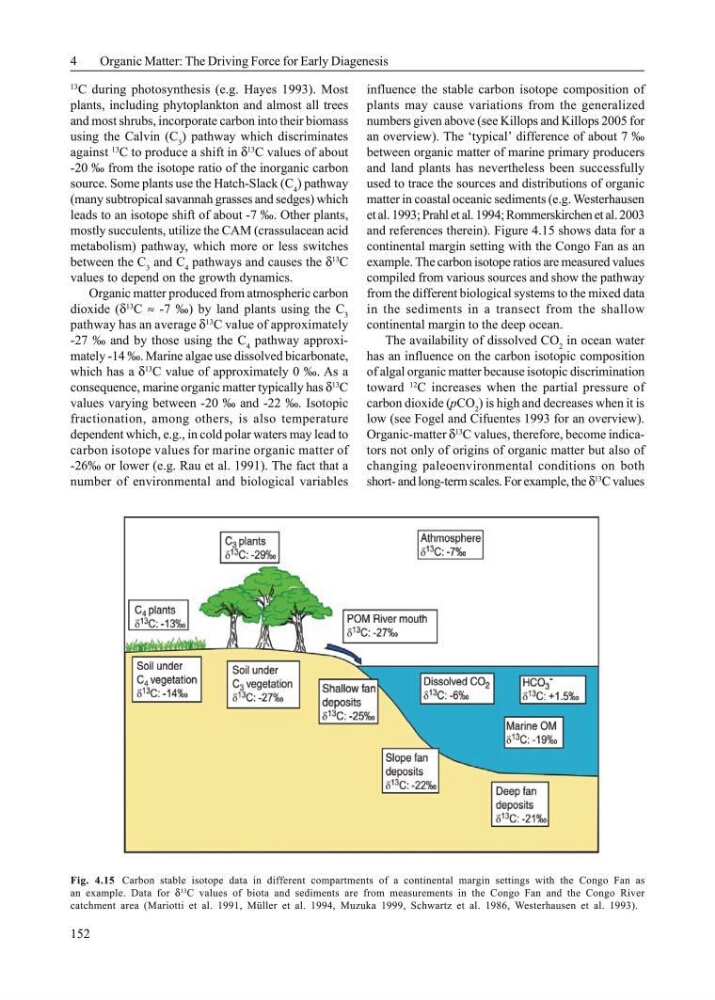
and references therein). Figure 4.15 shows data for a
continental margin setting with the Congo Fan as an
example. The carbon isotope ratios are measured values
compiled from various sources and show the pathway
from the different biological systems to the mixed data
in the sediments in a transect from the shallow
continental margin to the deep ocean.
The availability of dissolved CO 2 in ocean water
has an influence on the carbon isotopic composition
of algal organic matter because isotopic discrimination
toward
12
C increases when the partial pressure of
carbon dioxide (pCO 2 ) is high and decreases when it is
low (see Fogel and Cifuentes 1993 for an overview).
Organic-matter δ
13
C values, therefore, become indicators not only of origins of organic matter but also of
changing paleoenvironmental conditions on both
short- and long-term scales. For example, the δ
13
C values
Fig. 4.15 Carbon stable isotope data in different compartments of a continental margin settings with the Congo Fan as
an example. Data for δ
13 C values of biota and sediments are from measurements in the Congo Fan and the Congo River
catchment area (Mariotti et al. 1991, Müller et al. 1994, Muzuka 1999, Schwartz et al. 1986, Westerhausen et al. 1993).
Organic Matter: The Driving Force for Early Diagenesis
152
13
C during photosynthesis (e.g. Hayes 1993). Most
plants, including phytoplankton and almost all trees
and most shrubs, incorporate carbon into their biomass
using the Calvin (C 3 ) pathway which discriminates
against
13
C to produce a shift in δ
13
C values of about
-20 ‰ from the isotope ratio of the inorganic carbon
source. Some plants use the Hatch-Slack (C 4 ) pathway
(many subtropical savannah grasses and sedges) which
leads to an isotope shift of about -7 ‰. Other plants,
mostly succulents, utilize the CAM (crassulacean acid
metabolism) pathway, which more or less switches
between the C 3 and C 4 pathways and causes the δ
13
C
values to depend on the growth dynamics.
Organic matter produced from atmospheric carbon
dioxide (δ
13
C ≈ -7 ‰) by land plants using the C 3
pathway has an average δ
13
C value of approximately
-27 ‰ and by those using the C 4 pathway approximately -14 ‰. Marine algae use dissolved bicarbonate,
which has a δ
13
C value of approximately 0 ‰. As a
consequence, marine organic matter typically has δ
13
C
values varying between -20 ‰ and -22 ‰. Isotopic
fractionation, among others, is also temperature
dependent which, e.g., in cold polar waters may lead to
carbon isotope values for marine organic matter of
-26‰ or lower (e.g. Rau et al. 1991). The fact that a
number of environmental and biological variables
influence the stable carbon isotope composition of
plants may cause variations from the generalized
numbers given above (see Killops and Killops 2005 for
an overview). The ‘typical’ difference of about 7 ‰
between organic matter of marine primary producers
and land plants has nevertheless been successfully
used to trace the sources and distributions of organic
matter in coastal oceanic sediments (e.g. Westerhausen
et al. 1993; Prahl et al. 1994; Rommerskirchen et al. 2003
and references therein). Figure 4.15 shows data for a
continental margin setting with the Congo Fan as an
example. The carbon isotope ratios are measured values
compiled from various sources and show the pathway
from the different biological systems to the mixed data
in the sediments in a transect from the shallow
continental margin to the deep ocean.
The availability of dissolved CO 2 in ocean water
has an influence on the carbon isotopic composition
of algal organic matter because isotopic discrimination
toward
12
C increases when the partial pressure of
carbon dioxide (pCO 2 ) is high and decreases when it is
low (see Fogel and Cifuentes 1993 for an overview).
Organic-matter δ
13
C values, therefore, become indicators not only of origins of organic matter but also of
changing paleoenvironmental conditions on both
short- and long-term scales. For example, the δ
13
C values
Fig. 4.15 Carbon stable isotope data in different compartments of a continental margin settings with the Congo Fan as
an example. Data for δ
13 C values of biota and sediments are from measurements in the Congo Fan and the Congo River
catchment area (Mariotti et al. 1991, Müller et al. 1994, Muzuka 1999, Schwartz et al. 1986, Westerhausen et al. 1993).