

4
Organic Matter: The Driving Force for Early Diagenesis
148
products presently known to occur in sediments. The
biogenic precursor chosen as an example in Figure 4.12
is cholesterol (structure 1, R=H), a widely distributed
steroid in a variety of plants, but more typical of animals
(e.g. zooplankton). Hydrogenation of the double bond
leads to the formation of the saturated cholestanol (2).
This reaction occurs in the uppermost sediment layers
soon after deposition and is believed to involve
microbial activity. Elimination of water gives rise to the
unsaturated hydrocarbon 3. At the end of the diagenetic
stage, the former unsaturated steroid alcohol 1 will have
been transformed to the saturated steroid hydrocarbon
4 after a further hydrogenation step. An alternative
route to the saturated sterane 4 is via dehydration of
cholesterol (1, R=H), which yields the diunsaturated
compound 5. Hydrogenation leads to a mixture of two
isomeric sterenes (6; isomer with double bond in
position 5 like in the starting material (1) not shown in
Fig. 4.12). This compound cannot be formed from 3 as
suggested for a long time, because such a double bond
migration would require more energy than is available
under the diagenetic conditions in sediments (de Leeuw
et al. 1989). Further hydrogenation of 6 affords the
saturated hydrocarbon 4. A change in steric configuration of this molecule, e.g. to form 7, occurs only during
the catagenesis stage at elevated temperatures. A side
reaction from sterene 6 is a skeletal rearrangement
leading to diasterene 8 where the double bond has
moved to the five-membered ring and two methyl
groups (represented by the bold bonds) are now bound
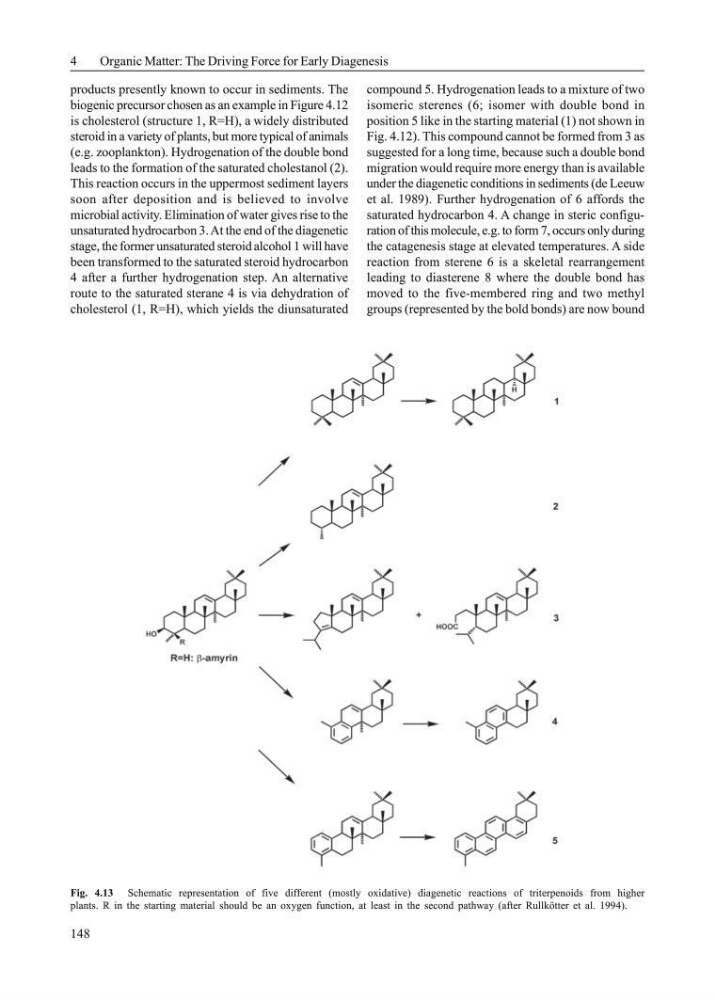
Fig. 4.13 Schematic representation of five different (mostly oxidative) diagenetic reactions of triterpenoids from higher
plants. R in the starting material should be an oxygen function, at least in the second pathway (after Rullkötter et al. 1994).
Organic Matter: The Driving Force for Early Diagenesis
148
products presently known to occur in sediments. The
biogenic precursor chosen as an example in Figure 4.12
is cholesterol (structure 1, R=H), a widely distributed
steroid in a variety of plants, but more typical of animals
(e.g. zooplankton). Hydrogenation of the double bond
leads to the formation of the saturated cholestanol (2).
This reaction occurs in the uppermost sediment layers
soon after deposition and is believed to involve
microbial activity. Elimination of water gives rise to the
unsaturated hydrocarbon 3. At the end of the diagenetic
stage, the former unsaturated steroid alcohol 1 will have
been transformed to the saturated steroid hydrocarbon
4 after a further hydrogenation step. An alternative
route to the saturated sterane 4 is via dehydration of
cholesterol (1, R=H), which yields the diunsaturated
compound 5. Hydrogenation leads to a mixture of two
isomeric sterenes (6; isomer with double bond in
position 5 like in the starting material (1) not shown in
Fig. 4.12). This compound cannot be formed from 3 as
suggested for a long time, because such a double bond
migration would require more energy than is available
under the diagenetic conditions in sediments (de Leeuw
et al. 1989). Further hydrogenation of 6 affords the
saturated hydrocarbon 4. A change in steric configuration of this molecule, e.g. to form 7, occurs only during
the catagenesis stage at elevated temperatures. A side
reaction from sterene 6 is a skeletal rearrangement
leading to diasterene 8 where the double bond has
moved to the five-membered ring and two methyl
groups (represented by the bold bonds) are now bound
Fig. 4.13 Schematic representation of five different (mostly oxidative) diagenetic reactions of triterpenoids from higher
plants. R in the starting material should be an oxygen function, at least in the second pathway (after Rullkötter et al. 1994).