

147
highly-branched isoprenoid alkenes, long-chain nalkandiols, 24-methylenecholesterol and dinosterol.
They have been found to be unique for, or obviously
be preferentially biosynthesized by, haptophytes,
diatoms, eustigmatophytes, diatoms and dinoflagellates, respectively (see Volkman et al. 1998; Volkman
2005 for comprehensive overviews). Other long-chain
n-alkyl lipids (e.g. Eglinton and Hamilton 1967),
diterpenoids and 3-oxygenated triterpenoids (e.g.
Simoneit 1986) are considered useful tracers for organic
matter from vascular land plants.
Although certain biological markers may be
chemotaxonomically very specific, care has to be taken
when using relative biomarker concentrations in
geological samples to derive quantitative figures of
the biological species that have contributed to the total
organic matter. First of all, different types of biological
markers may have different reactivities and, thus, may
be selectively preserved during diagenesis (Hedges
and Prahl 1993). In this respect, sequestering of reactive
biomarkers by the formation of high-molecular-weight
organic sulfur compounds may play an important role
(e.g. Sinninghe Damsté et al 1989b; see Fig. 4.10).
Furthermore, there may be a fractionation between
high- and low-molecular-weight compounds. An
extreme example is the (lacustrine) Messel oil shale. In
its organic matter fraction, the residues of dinoflagellates are represented by abundant 4-methyl steroids in
the bitumen whereas the labile cell walls were not
preserved. On the other hand, certain green algae are
clearly identifiable under the electron microscope due
to the highly aliphatic biopolymers in their cell walls,
but no biomarkers specific for green algae were found
in the extractable organic matter (Goth et al. 1988).
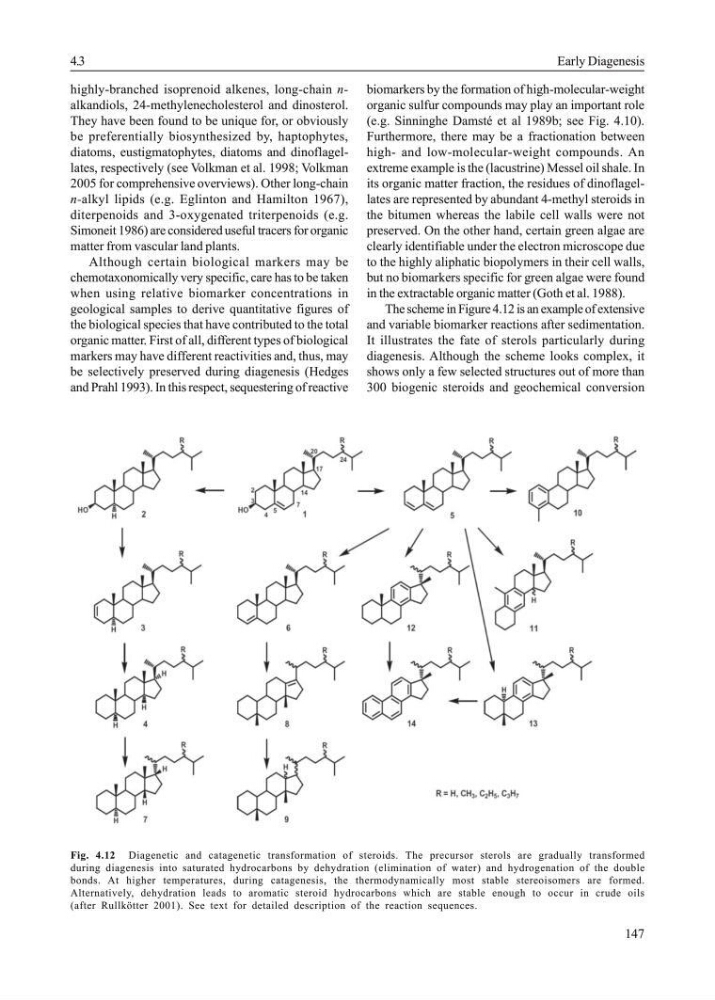
The scheme in Figure 4.12 is an example of extensive
and variable biomarker reactions after sedimentation.
It illustrates the fate of sterols particularly during
diagenesis. Although the scheme looks complex, it
shows only a few selected structures out of more than
300 biogenic steroids and geochemical conversion
4.3
Early Diagenesis
Fig. 4.12 Diagenetic and catagenetic transformation of steroids. The precursor sterols are gradually transformed
during diagenesis into saturated hydrocarbons by dehydration (elimination of water) and hydrogenation of the double
bonds. At higher temperatures, during catagenesis, the thermodynamically most stable stereoisomers are formed.
Alternatively, dehydration leads to aromatic steroid hydrocarbons which are stable enough to occur in crude oils
(after Rullkötter 2001). See text for detailed description of the reaction sequences.
highly-branched isoprenoid alkenes, long-chain nalkandiols, 24-methylenecholesterol and dinosterol.
They have been found to be unique for, or obviously
be preferentially biosynthesized by, haptophytes,
diatoms, eustigmatophytes, diatoms and dinoflagellates, respectively (see Volkman et al. 1998; Volkman
2005 for comprehensive overviews). Other long-chain
n-alkyl lipids (e.g. Eglinton and Hamilton 1967),
diterpenoids and 3-oxygenated triterpenoids (e.g.
Simoneit 1986) are considered useful tracers for organic
matter from vascular land plants.
Although certain biological markers may be
chemotaxonomically very specific, care has to be taken
when using relative biomarker concentrations in
geological samples to derive quantitative figures of
the biological species that have contributed to the total
organic matter. First of all, different types of biological
markers may have different reactivities and, thus, may
be selectively preserved during diagenesis (Hedges
and Prahl 1993). In this respect, sequestering of reactive
biomarkers by the formation of high-molecular-weight
organic sulfur compounds may play an important role
(e.g. Sinninghe Damsté et al 1989b; see Fig. 4.10).
Furthermore, there may be a fractionation between
high- and low-molecular-weight compounds. An
extreme example is the (lacustrine) Messel oil shale. In
its organic matter fraction, the residues of dinoflagellates are represented by abundant 4-methyl steroids in
the bitumen whereas the labile cell walls were not
preserved. On the other hand, certain green algae are
clearly identifiable under the electron microscope due
to the highly aliphatic biopolymers in their cell walls,
but no biomarkers specific for green algae were found
in the extractable organic matter (Goth et al. 1988).
The scheme in Figure 4.12 is an example of extensive
and variable biomarker reactions after sedimentation.
It illustrates the fate of sterols particularly during
diagenesis. Although the scheme looks complex, it
shows only a few selected structures out of more than
300 biogenic steroids and geochemical conversion
4.3
Early Diagenesis
Fig. 4.12 Diagenetic and catagenetic transformation of steroids. The precursor sterols are gradually transformed
during diagenesis into saturated hydrocarbons by dehydration (elimination of water) and hydrogenation of the double
bonds. At higher temperatures, during catagenesis, the thermodynamically most stable stereoisomers are formed.
Alternatively, dehydration leads to aromatic steroid hydrocarbons which are stable enough to occur in crude oils
(after Rullkötter 2001). See text for detailed description of the reaction sequences.