

149
to the bottom part of the ring system. This reaction has
been shown in the laboratory to be catalyzed by acidic
clays. Thus, diasterenes (8) and the corresponding
diasteranes (9), formed from diasterenes by hydrogenation during late diagenesis, are found in shales
but not in those carbonates that lack acidic clays.
An additional alternative diagenetic transformation
pathway of steroids leads to aromatic instead of
saturated hydrocarbons. The diolefin 5 is a likely intermediate on the way to the aromatic steroid hydrocarbons 10-14. Compounds 10 and 11 are those detected
first in the shallow sediment layers. They obviously are
labile and do not survive diagenesis. During late
diagenesis, the aromatic steroid hydrocarbon 12 with the
aromatic ring next to the five-membered ring cooccurs
with compounds 10 and 11 in the sediments, but is also
stable enough to survive elevated temperatures and thus
to be found in crude oils. There is also a corresponding
rearranged monoaromatic steroid hydrocarbon (13).
During catagenesis, monoaromatic steroid hydrocarbons
are progressively transformed into triaromatic hydrocarbons (14) before the steroid record is completely lost
by total destruction of the carbon skeleton at higher
temperatures.
As a second example, Figure 4.13 shows five different
diagenetic reaction pathways for pentacyclic triterpenoids
of terrestrial origin that were found to be abundant, e.g.,
in Tertiary deep-sea sediments of Baffin Bay (ten Haven
et al. 1992). Diagenetic alteration with full retention of the
carbon skeleton (e.g. in the case of β-amyrin; R=H) leads
to an olefinic hydrocarbon after elimination of the oxygen
functionality in the A-ring and later to the fully saturated
hydrocarbon. If the substituent group R is a hydroxyl or
carboxylic acid group, oxidation would yield an unstable
ketocarboxylic acid, which instantaneously eliminates CO 2
leading to a carbon skeleton with one carbon atom less
than the starting molecule (second pathway; see Rullkötter
et al. 1994). Direct chemical elimination of the hydroxyl
group in ring A causes ring contraction, and eventually
the ring is opened by oxidative cleavage of the double
bond (third pathway). If the carbon atoms of the A-ring
are completely lost during degradation, then subsequent
aromatization may lead into the fourth pathway.
Alternatively, aromatization may start with the intact
carbon skeleton giving rise to a series of partly or fully
aromatized pentacyclic hydrocarbons (fifth pathway).
All these alterations are typical for terrigenous
triterpenoids. They probably start soon after the decay of
the organisms (or parts thereof, e.g. leaves) and continue
during transport into the ocean. The compounds
described and several others have been found in
numerous marine sediments (see Corbet et al. 1980 and
Rullkötter et al. 1994 for overviews).
4.4
Organic Geochemical Proxies
4.4.1
Total Organic Carbon and Sulfur
Organic carbon profiles in a sedimentary sequence,
particularly if they are obtained with high stratigraphic
resolution (e.g. Stein and Rack 1995), provide direct
evidence for changes in depositional patterns. An indepth interpretation, however, usually requires
additional information on the quality of the organic
matter, i.e. on its origin (marine versus terrigenous) and/
or its degree of oxidation during deposition. The
relationship between organic carbon and sedimentation
rate may help to distinguish different depositional
environments or to determine paleoproductivity as
already discussed in Section 4.2.
Furthermore, the relationship between organic
carbon and sulfur is also characteristic of the
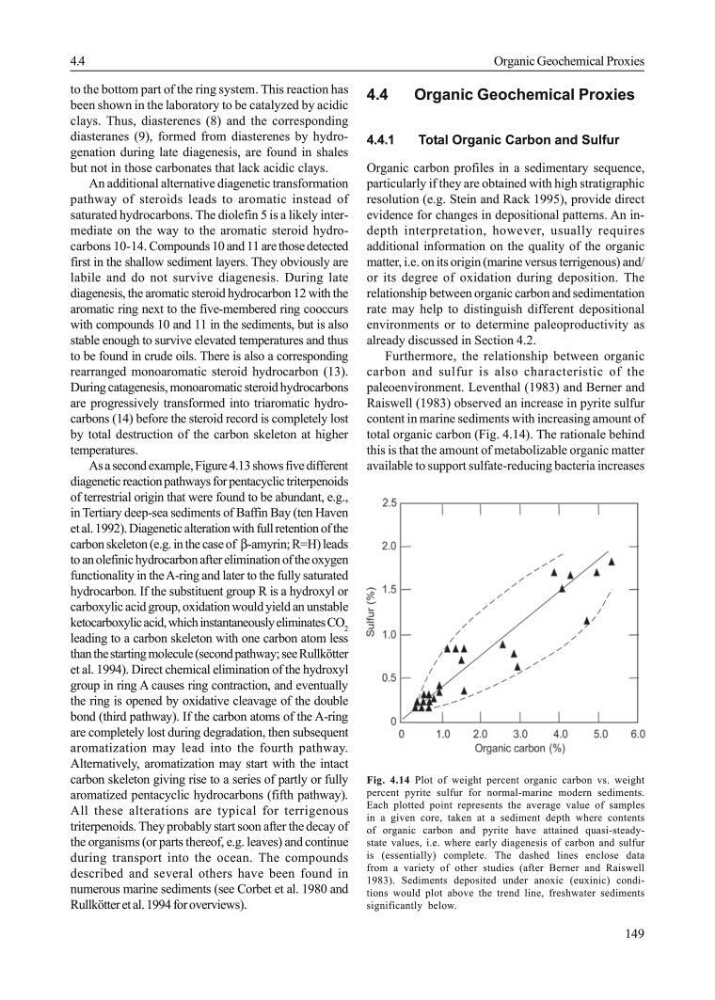
paleoenvironment. Leventhal (1983) and Berner and
Raiswell (1983) observed an increase in pyrite sulfur
content in marine sediments with increasing amount of
total organic carbon (Fig. 4.14). The rationale behind
this is that the amount of metabolizable organic matter
available to support sulfate-reducing bacteria increases
4.4
Organic Geochemical Proxies
Fig. 4.14 Plot of weight percent organic carbon vs. weight
percent pyrite sulfur for normal-marine modern sediments.
Each plotted point represents the average value of samples
in a given core, taken at a sediment depth where contents
of organic carbon and pyrite have attained quasi-steadystate values, i.e. where early diagenesis of carbon and sulfur
is (essentially) complete. The dashed lines enclose data
from a variety of other studies (after Berner and Raiswell
1983). Sediments deposited under anoxic (euxinic) conditions would plot above the trend line, freshwater sediments
significantly below.
to the bottom part of the ring system. This reaction has
been shown in the laboratory to be catalyzed by acidic
clays. Thus, diasterenes (8) and the corresponding
diasteranes (9), formed from diasterenes by hydrogenation during late diagenesis, are found in shales
but not in those carbonates that lack acidic clays.
An additional alternative diagenetic transformation
pathway of steroids leads to aromatic instead of
saturated hydrocarbons. The diolefin 5 is a likely intermediate on the way to the aromatic steroid hydrocarbons 10-14. Compounds 10 and 11 are those detected
first in the shallow sediment layers. They obviously are
labile and do not survive diagenesis. During late
diagenesis, the aromatic steroid hydrocarbon 12 with the
aromatic ring next to the five-membered ring cooccurs
with compounds 10 and 11 in the sediments, but is also
stable enough to survive elevated temperatures and thus
to be found in crude oils. There is also a corresponding
rearranged monoaromatic steroid hydrocarbon (13).
During catagenesis, monoaromatic steroid hydrocarbons
are progressively transformed into triaromatic hydrocarbons (14) before the steroid record is completely lost
by total destruction of the carbon skeleton at higher
temperatures.
As a second example, Figure 4.13 shows five different
diagenetic reaction pathways for pentacyclic triterpenoids
of terrestrial origin that were found to be abundant, e.g.,
in Tertiary deep-sea sediments of Baffin Bay (ten Haven
et al. 1992). Diagenetic alteration with full retention of the
carbon skeleton (e.g. in the case of β-amyrin; R=H) leads
to an olefinic hydrocarbon after elimination of the oxygen
functionality in the A-ring and later to the fully saturated
hydrocarbon. If the substituent group R is a hydroxyl or
carboxylic acid group, oxidation would yield an unstable
ketocarboxylic acid, which instantaneously eliminates CO 2
leading to a carbon skeleton with one carbon atom less
than the starting molecule (second pathway; see Rullkötter
et al. 1994). Direct chemical elimination of the hydroxyl
group in ring A causes ring contraction, and eventually
the ring is opened by oxidative cleavage of the double
bond (third pathway). If the carbon atoms of the A-ring
are completely lost during degradation, then subsequent
aromatization may lead into the fourth pathway.
Alternatively, aromatization may start with the intact
carbon skeleton giving rise to a series of partly or fully
aromatized pentacyclic hydrocarbons (fifth pathway).
All these alterations are typical for terrigenous
triterpenoids. They probably start soon after the decay of
the organisms (or parts thereof, e.g. leaves) and continue
during transport into the ocean. The compounds
described and several others have been found in
numerous marine sediments (see Corbet et al. 1980 and
Rullkötter et al. 1994 for overviews).
4.4
Organic Geochemical Proxies
4.4.1
Total Organic Carbon and Sulfur
Organic carbon profiles in a sedimentary sequence,
particularly if they are obtained with high stratigraphic
resolution (e.g. Stein and Rack 1995), provide direct
evidence for changes in depositional patterns. An indepth interpretation, however, usually requires
additional information on the quality of the organic
matter, i.e. on its origin (marine versus terrigenous) and/
or its degree of oxidation during deposition. The
relationship between organic carbon and sedimentation
rate may help to distinguish different depositional
environments or to determine paleoproductivity as
already discussed in Section 4.2.
Furthermore, the relationship between organic
carbon and sulfur is also characteristic of the
paleoenvironment. Leventhal (1983) and Berner and
Raiswell (1983) observed an increase in pyrite sulfur
content in marine sediments with increasing amount of
total organic carbon (Fig. 4.14). The rationale behind
this is that the amount of metabolizable organic matter
available to support sulfate-reducing bacteria increases
4.4
Organic Geochemical Proxies
Fig. 4.14 Plot of weight percent organic carbon vs. weight
percent pyrite sulfur for normal-marine modern sediments.
Each plotted point represents the average value of samples
in a given core, taken at a sediment depth where contents
of organic carbon and pyrite have attained quasi-steadystate values, i.e. where early diagenesis of carbon and sulfur
is (essentially) complete. The dashed lines enclose data
from a variety of other studies (after Berner and Raiswell
1983). Sediments deposited under anoxic (euxinic) conditions would plot above the trend line, freshwater sediments
significantly below.