

108
3
Quantification of Early Diagenesis: Dissolved Constituents in Marine Pore Water
much experience and many aborted profiles stand
behind those profiles which are now shown in
Figures 3.5 and 3.22.
By using such electrodes it is now possible to
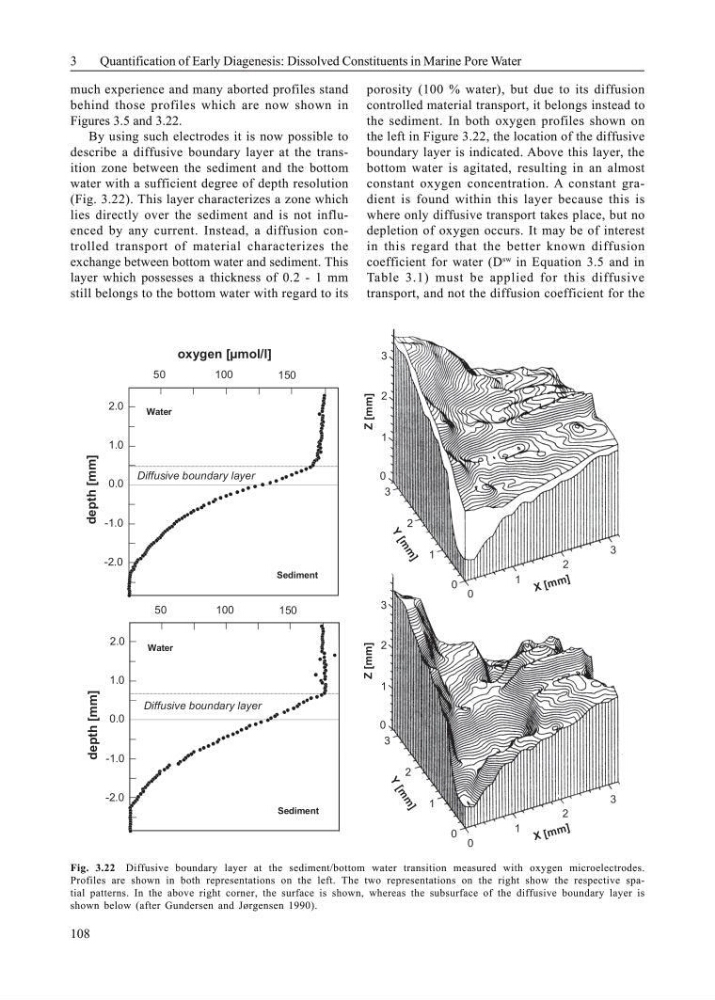
describe a diffusive boundary layer at the transition zone between the sediment and the bottom
water with a sufficient degree of depth resolution
(Fig. 3.22). This layer characterizes a zone which
lies directly over the sediment and is not influenced by any current. Instead, a diffusion controlled transport of material characterizes the
exchange between bottom water and sediment. This
layer which possesses a thickness of 0.2 - 1 mm
still belongs to the bottom water with regard to its
porosity (100 % water), but due to its diffusion
controlled material transport, it belongs instead to
the sediment. In both oxygen profiles shown on
the left in Figure 3.22, the location of the diffusive
boundary layer is indicated. Above this layer, the
bottom water is agitated, resulting in an almost
constant oxygen concentration. A constant gradient is found within this layer because this is
where only diffusive transport takes place, but no
depletion of oxygen occurs. It may be of interest
in this regard that the better known diffusion
coefficient for water (D
sw
in Equation 3.5 and in
Table 3.1) must be applied for this diffusive
transport, and not the diffusion coefficient for the
Fig. 3.22 Diffusive boundary layer at the sediment/bottom water transition measured with oxygen microelectrodes.
Profiles are shown in both representations on the left. The two representations on the right show the respective spatial patterns. In the above right corner, the surface is shown, whereas the subsurface of the diffusive boundary layer is
shown below (after Gundersen and Jørgensen 1990).
3
2
1
0
Z [mm]
3
2
1
0 0
1
2
3
Y
[
m
m
]
X [m m ]
3
2
1
0
Z [mm]
3
1
0 0
1
2
3
X [m m ]
2
Y
[
m
m
]
2.0
1.0
0.0
-1.0
-2.0
depth [mm]
50
100
150
Diffusive boundary layer
2.0
1.0
0.0
-1.0
-2.0
depth [mm]
50
100
150
Diffusive boundary layer
Water
Sediment
Water
Sediment
oxygen [µmol/l]
3
Quantification of Early Diagenesis: Dissolved Constituents in Marine Pore Water
much experience and many aborted profiles stand
behind those profiles which are now shown in
Figures 3.5 and 3.22.
By using such electrodes it is now possible to
describe a diffusive boundary layer at the transition zone between the sediment and the bottom
water with a sufficient degree of depth resolution
(Fig. 3.22). This layer characterizes a zone which
lies directly over the sediment and is not influenced by any current. Instead, a diffusion controlled transport of material characterizes the
exchange between bottom water and sediment. This
layer which possesses a thickness of 0.2 - 1 mm
still belongs to the bottom water with regard to its
porosity (100 % water), but due to its diffusion
controlled material transport, it belongs instead to
the sediment. In both oxygen profiles shown on
the left in Figure 3.22, the location of the diffusive
boundary layer is indicated. Above this layer, the
bottom water is agitated, resulting in an almost
constant oxygen concentration. A constant gradient is found within this layer because this is
where only diffusive transport takes place, but no
depletion of oxygen occurs. It may be of interest
in this regard that the better known diffusion
coefficient for water (D
sw
in Equation 3.5 and in
Table 3.1) must be applied for this diffusive
transport, and not the diffusion coefficient for the
Fig. 3.22 Diffusive boundary layer at the sediment/bottom water transition measured with oxygen microelectrodes.
Profiles are shown in both representations on the left. The two representations on the right show the respective spatial patterns. In the above right corner, the surface is shown, whereas the subsurface of the diffusive boundary layer is
shown below (after Gundersen and Jørgensen 1990).
3
2
1
0
Z [mm]
3
2
1
0 0
1
2
3
Y
[
m
m
]
X [m m ]
3
2
1
0
Z [mm]
3
1
0 0
1
2
3
X [m m ]
2
Y
[
m
m
]
2.0
1.0
0.0
-1.0
-2.0
depth [mm]
50
100
150
Diffusive boundary layer
2.0
1.0
0.0
-1.0
-2.0
depth [mm]
50
100
150
Diffusive boundary layer
Water
Sediment
Water
Sediment
oxygen [µmol/l]