

109
sediment (D sed ). Since the entire diffusive
transport from the bottom water to the sediment
crosses this transitory layer, measurements within
the layer allow for especially reliable estimations
of the oxygen consumption in the sediment.
To date, extremely good results have been obtained with oxygen microelectrodes in sediments
with high reaction rates, because the essential
processes can be analyzed only here, with profiles
most often reaching a few centimeters into the
sediment. The lower ends of these profiles are frequently marked by breakage of the electrodes. In
sediments displaying less vigorous turnovers, the
measurement mostly includes just one single oxygen concentration gradient, not reaching into the
penetration depth for oxygen.
Less frequently, pH-profiles are published in
literature when compared to the oxygen profiles.
The details as to their shapes and their underlying
processes are not yet sufficiently understood.
Additionally, a reliable calibration under the given
pressure conditions has not been accomplished
for in situ pH-measurements. Consequently, only
relative values are measured within one profile.
Electrodes measuring H 2 S can also be built as
microelectrodes. However, they are only suited for
in situ measurements when H 2 S reaches close
enough to the sediment surface.
Optodes
Apart from the great advantages of electrodes - they
have practically opened a domain of the aquatic environment which was previously not accessible to
measurement - the disadvantages should be mentioned as well. On the one hand, only the three
aforementioned types are applicable (O 2 , pH, H 2 S),
on the other hand, these electrodes are commercially
available only at a rather high price or must be selfmade. The manufacturing of one electrode demands
- if one has the necessary experience – half a day up
to one full day of labor. Additionally, the electrodes
tend to break easily. Thus, in the experimental work
that led to the publication by Glud et al. (1994) about
50 to 60 (!) microelectrodes were ‘used up’.
It therefore appears to be reasonable to look for
other methods and other measurement principles.
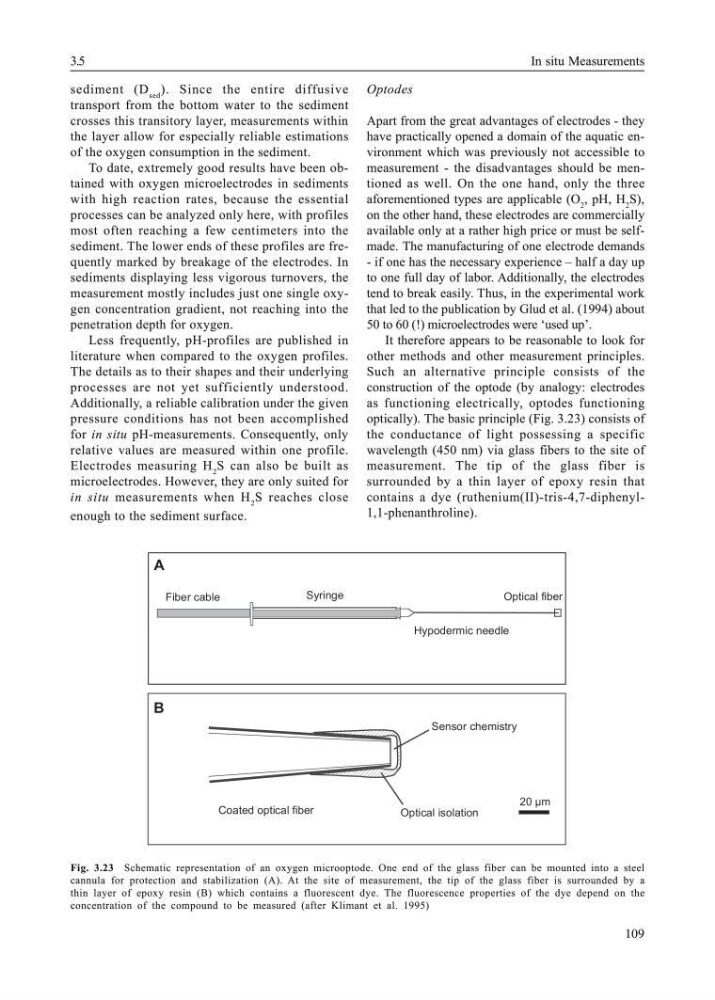
Such an alternative principle consists of the
construction of the optode (by analogy: electrodes
as functioning electrically, optodes functioning
optically). The basic principle (Fig. 3.23) consists of
the conductance of light possessing a specific
wavelength (450 nm) via glass fibers to the site of
measurement. The tip of the glass fiber is
surrounded by a thin layer of epoxy resin that
contains a dye (ruthenium(II)-tris-4,7-diphenyl1,1-phenanthroline).
Optical fiber
Hypodermic needle
Syringe
Fiber cable
A
B
Coated optical fiber
Optical isolation
Sensor chemistry
20 µm
Fig. 3.23 Schematic representation of an oxygen microoptode. One end of the glass fiber can be mounted into a steel
cannula for protection and stabilization (A). At the site of measurement, the tip of the glass fiber is surrounded by a
thin layer of epoxy resin (B) which contains a fluorescent dye. The fluorescence properties of the dye depend on the
concentration of the compound to be measured (after Klimant et al. 1995)
3.5
In situ Measurements
sediment (D sed ). Since the entire diffusive
transport from the bottom water to the sediment
crosses this transitory layer, measurements within
the layer allow for especially reliable estimations
of the oxygen consumption in the sediment.
To date, extremely good results have been obtained with oxygen microelectrodes in sediments
with high reaction rates, because the essential
processes can be analyzed only here, with profiles
most often reaching a few centimeters into the
sediment. The lower ends of these profiles are frequently marked by breakage of the electrodes. In
sediments displaying less vigorous turnovers, the
measurement mostly includes just one single oxygen concentration gradient, not reaching into the
penetration depth for oxygen.
Less frequently, pH-profiles are published in
literature when compared to the oxygen profiles.
The details as to their shapes and their underlying
processes are not yet sufficiently understood.
Additionally, a reliable calibration under the given
pressure conditions has not been accomplished
for in situ pH-measurements. Consequently, only
relative values are measured within one profile.
Electrodes measuring H 2 S can also be built as
microelectrodes. However, they are only suited for
in situ measurements when H 2 S reaches close
enough to the sediment surface.
Optodes
Apart from the great advantages of electrodes - they
have practically opened a domain of the aquatic environment which was previously not accessible to
measurement - the disadvantages should be mentioned as well. On the one hand, only the three
aforementioned types are applicable (O 2 , pH, H 2 S),
on the other hand, these electrodes are commercially
available only at a rather high price or must be selfmade. The manufacturing of one electrode demands
- if one has the necessary experience – half a day up
to one full day of labor. Additionally, the electrodes
tend to break easily. Thus, in the experimental work
that led to the publication by Glud et al. (1994) about
50 to 60 (!) microelectrodes were ‘used up’.
It therefore appears to be reasonable to look for
other methods and other measurement principles.
Such an alternative principle consists of the
construction of the optode (by analogy: electrodes
as functioning electrically, optodes functioning
optically). The basic principle (Fig. 3.23) consists of
the conductance of light possessing a specific
wavelength (450 nm) via glass fibers to the site of
measurement. The tip of the glass fiber is
surrounded by a thin layer of epoxy resin that
contains a dye (ruthenium(II)-tris-4,7-diphenyl1,1-phenanthroline).
Optical fiber
Hypodermic needle
Syringe
Fiber cable
A
B
Coated optical fiber
Optical isolation
Sensor chemistry
20 µm
Fig. 3.23 Schematic representation of an oxygen microoptode. One end of the glass fiber can be mounted into a steel
cannula for protection and stabilization (A). At the site of measurement, the tip of the glass fiber is surrounded by a
thin layer of epoxy resin (B) which contains a fluorescent dye. The fluorescence properties of the dye depend on the
concentration of the compound to be measured (after Klimant et al. 1995)
3.5
In situ Measurements