

96
3
Quantification of Early Diagenesis: Dissolved Constituents in Marine Pore Water
electron donor for sulfate reduction it was, however, of particular importance that methane could
be reliably determined up to a concentration of 23 mmol/l, and that the upwards directed gradient
reached into the zone of the reaction.
Opening and Sampling a Core under
Inert Gas inside the ‘Glove Box’
In order to extract the pore water from the
sediment, the next step consists in opening, or
rather cutting the meter-long segments previously
excised from the sediment in a lengthwise fashion.
In the case of multicorer or high-momentum gravity corer, the cores are pushed upwards by using
an appropriate piston. Caution should be taken
that anoxic sediments (easy to identify: if uncertain, everything that is not distinctly and purely
brown in color) must not, by any means, come into
contact with an oxygen-containing atmosphere in
the course of sampling. Therefore the opening of
the core segments must happen in an inert atmosphere, or, as the case may be, the core must be
pushed from below into the ‘glove box’ where
such an atmosphere is maintained. A ‘glove box’
that suits the purpose and that can also be easily
self-made and adapted to the requirements of the
prevailing conditions is described by De Lange
(1988).
The inert gases of higher molecular weight, as
well as nitrogen, are suited for maintaining the
desired inert gas atmosphere. As for nitrogen it
must be considered that the least expensive
version of the gas does not contain sufficiently
low amounts of oxygen. Argon is often more useful, as ordinary argon that is used for welding
usually has sufficiently low oxygen. A slight
excess pressure in the ‘glove box’ maintains that,
in the event of small leakage, the dissipation of
gas might increase, yet the invasion of oxygen is
securely prevented.
Measurement of E H and pH
with Punch-in Electrodes
In the glove box, the redox potential (E H -value)
and the pH value should be measured by applying
punch-in electrodes directly to the freshly cut
core surface. Suitable electrodes are available
today from most suppliers because they are, for
example, quite often used in the examination of
cheese. However, there is a risk that the electrodes
become damaged when larger particles or solidified kernels are present in the sediment sample.
The measurement of the pH-value is relatively
easy to do since the function of the electrode can
be checked repeatedly with the aid of appropriate
calibration solutions. However it must merely be
taken into consideration that the comparison with
in situ measurements close to the sediment
surface (cf. Sect. 3.5) may not necessarily lead to
corroborated values, because the decompression
within the core material has an immediate effect on
the pH-value as well.
The redox potential (E H -value in mV) is considered as a quite troublesome and controversial
parameter, with regard to the actual measurement
and to its consequences as well. The electrodes
available for this purpose cannot be checked with
calibration solutions. The occasionally mentioned
calibration solutions that function on the basis of
divalent and trivalent Fe-ions are not satisfactory,
since they actually just confirm the electrode’s
electric functioning and, at the same time, ‘shock’
the electrode to such a degree that it may remember the value of the calibration solution for
several days to come. The method of choice can
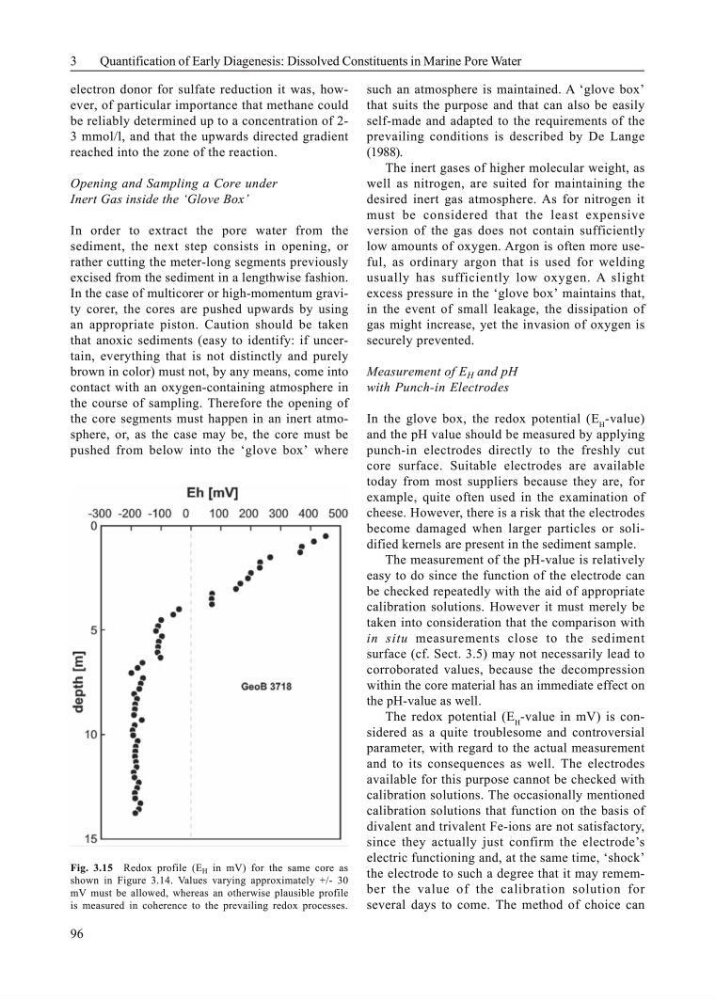
Fig. 3.15 Redox profile (E H in mV) for the same core as
shown in Figure 3.14. Values varying approximately +/- 30
mV must be allowed, whereas an otherwise plausible profile
is measured in coherence to the prevailing redox processes.
3
Quantification of Early Diagenesis: Dissolved Constituents in Marine Pore Water
electron donor for sulfate reduction it was, however, of particular importance that methane could
be reliably determined up to a concentration of 23 mmol/l, and that the upwards directed gradient
reached into the zone of the reaction.
Opening and Sampling a Core under
Inert Gas inside the ‘Glove Box’
In order to extract the pore water from the
sediment, the next step consists in opening, or
rather cutting the meter-long segments previously
excised from the sediment in a lengthwise fashion.
In the case of multicorer or high-momentum gravity corer, the cores are pushed upwards by using
an appropriate piston. Caution should be taken
that anoxic sediments (easy to identify: if uncertain, everything that is not distinctly and purely
brown in color) must not, by any means, come into
contact with an oxygen-containing atmosphere in
the course of sampling. Therefore the opening of
the core segments must happen in an inert atmosphere, or, as the case may be, the core must be
pushed from below into the ‘glove box’ where
such an atmosphere is maintained. A ‘glove box’
that suits the purpose and that can also be easily
self-made and adapted to the requirements of the
prevailing conditions is described by De Lange
(1988).
The inert gases of higher molecular weight, as
well as nitrogen, are suited for maintaining the
desired inert gas atmosphere. As for nitrogen it
must be considered that the least expensive
version of the gas does not contain sufficiently
low amounts of oxygen. Argon is often more useful, as ordinary argon that is used for welding
usually has sufficiently low oxygen. A slight
excess pressure in the ‘glove box’ maintains that,
in the event of small leakage, the dissipation of
gas might increase, yet the invasion of oxygen is
securely prevented.
Measurement of E H and pH
with Punch-in Electrodes
In the glove box, the redox potential (E H -value)
and the pH value should be measured by applying
punch-in electrodes directly to the freshly cut
core surface. Suitable electrodes are available
today from most suppliers because they are, for
example, quite often used in the examination of
cheese. However, there is a risk that the electrodes
become damaged when larger particles or solidified kernels are present in the sediment sample.
The measurement of the pH-value is relatively
easy to do since the function of the electrode can
be checked repeatedly with the aid of appropriate
calibration solutions. However it must merely be
taken into consideration that the comparison with
in situ measurements close to the sediment
surface (cf. Sect. 3.5) may not necessarily lead to
corroborated values, because the decompression
within the core material has an immediate effect on
the pH-value as well.
The redox potential (E H -value in mV) is considered as a quite troublesome and controversial
parameter, with regard to the actual measurement
and to its consequences as well. The electrodes
available for this purpose cannot be checked with
calibration solutions. The occasionally mentioned
calibration solutions that function on the basis of
divalent and trivalent Fe-ions are not satisfactory,
since they actually just confirm the electrode’s
electric functioning and, at the same time, ‘shock’
the electrode to such a degree that it may remember the value of the calibration solution for
several days to come. The method of choice can
Fig. 3.15 Redox profile (E H in mV) for the same core as
shown in Figure 3.14. Values varying approximately +/- 30
mV must be allowed, whereas an otherwise plausible profile
is measured in coherence to the prevailing redox processes.