

97
3.3
Sampling of Pore Water for ex situ Measurements
only consist of using well polished Pt-electrodes
and of being continually aware of the plausibility
and variation of the measured values. Whenever
necessary, the electrode must be substituted for
another well-polished Pt-electrode. Useful recommendations as to the redox potential and its
measurement are described by Kölling (1986, 2000)
and by Seeburger and Käss (1989). A compilation
of fundamentals, processes and applications of
redox measurements in natural aquatic systems
was published by Schüring et al. (2000). A measured E H -profile is shown in Figure 3.15 for the
same core as was shown in the previous Figure
3.14. It can be seen that the values scatter by
approximately +/- 30 mV, but that otherwise a
reasonable profile has been measured that is likely
to contribute to an understanding of the redox
processes occurring in the sediment.
Extraction of Pore water
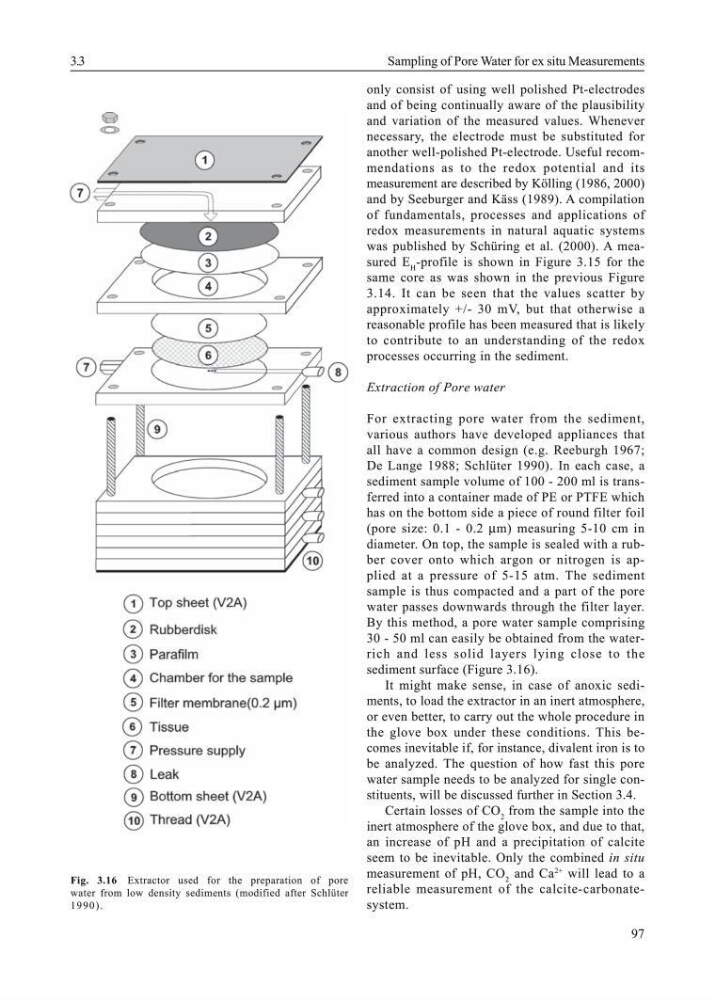
For extracting pore water from the sediment,
various authors have developed appliances that
all have a common design (e.g. Reeburgh 1967;
De Lange 1988; Schlüter 1990). In each case, a
sediment sample volume of 100 - 200 ml is transferred into a container made of PE or PTFE which
has on the bottom side a piece of round filter foil
(pore size: 0.1 - 0.2 µm) measuring 5-10 cm in
diameter. On top, the sample is sealed with a rubber cover onto which argon or nitrogen is applied at a pressure of 5-15 atm. The sediment
sample is thus compacted and a part of the pore
water passes downwards through the filter layer.
By this method, a pore water sample comprising
30 - 50 ml can easily be obtained from the waterrich and less solid layers lying close to the
sediment surface (Figure 3.16).
It might make sense, in case of anoxic sediments, to load the extractor in an inert atmosphere,
or even better, to carry out the whole procedure in
the glove box under these conditions. This becomes inevitable if, for instance, divalent iron is to
be analyzed. The question of how fast this pore
water sample needs to be analyzed for single constituents, will be discussed further in Section 3.4.
Certain losses of CO 2 from the sample into the
inert atmosphere of the glove box, and due to that,
an increase of pH and a precipitation of calcite
seem to be inevitable. Only the combined in situ
measurement of pH, CO 2 and Ca
2+
will lead to a
reliable measurement of the calcite-carbonatesystem.
Fig. 3.16 Extractor used for the preparation of pore
water from low density sediments (modified after Schlüter
1990).
3.3
Sampling of Pore Water for ex situ Measurements
only consist of using well polished Pt-electrodes
and of being continually aware of the plausibility
and variation of the measured values. Whenever
necessary, the electrode must be substituted for
another well-polished Pt-electrode. Useful recommendations as to the redox potential and its
measurement are described by Kölling (1986, 2000)
and by Seeburger and Käss (1989). A compilation
of fundamentals, processes and applications of
redox measurements in natural aquatic systems
was published by Schüring et al. (2000). A measured E H -profile is shown in Figure 3.15 for the
same core as was shown in the previous Figure
3.14. It can be seen that the values scatter by
approximately +/- 30 mV, but that otherwise a
reasonable profile has been measured that is likely
to contribute to an understanding of the redox
processes occurring in the sediment.
Extraction of Pore water
For extracting pore water from the sediment,
various authors have developed appliances that
all have a common design (e.g. Reeburgh 1967;
De Lange 1988; Schlüter 1990). In each case, a
sediment sample volume of 100 - 200 ml is transferred into a container made of PE or PTFE which
has on the bottom side a piece of round filter foil
(pore size: 0.1 - 0.2 µm) measuring 5-10 cm in
diameter. On top, the sample is sealed with a rubber cover onto which argon or nitrogen is applied at a pressure of 5-15 atm. The sediment
sample is thus compacted and a part of the pore
water passes downwards through the filter layer.
By this method, a pore water sample comprising
30 - 50 ml can easily be obtained from the waterrich and less solid layers lying close to the
sediment surface (Figure 3.16).
It might make sense, in case of anoxic sediments, to load the extractor in an inert atmosphere,
or even better, to carry out the whole procedure in
the glove box under these conditions. This becomes inevitable if, for instance, divalent iron is to
be analyzed. The question of how fast this pore
water sample needs to be analyzed for single constituents, will be discussed further in Section 3.4.
Certain losses of CO 2 from the sample into the
inert atmosphere of the glove box, and due to that,
an increase of pH and a precipitation of calcite
seem to be inevitable. Only the combined in situ
measurement of pH, CO 2 and Ca
2+
will lead to a
reliable measurement of the calcite-carbonatesystem.
Fig. 3.16 Extractor used for the preparation of pore
water from low density sediments (modified after Schlüter
1990).