

Petroleum
87
,
Mississippi
N
o
o
0' 0
•
o 0 b~.
-2 /"
-----__ .
~
0: 0".~ _2;-~ O/_ . . . . :~
Of,~--/.~~ ·22
• ~
~ ~
0 '\
. /
~ -
-
I
-21~.
~
I
•
0
Miles
15
\. G u I f 0 , M e x i k 0
1
I
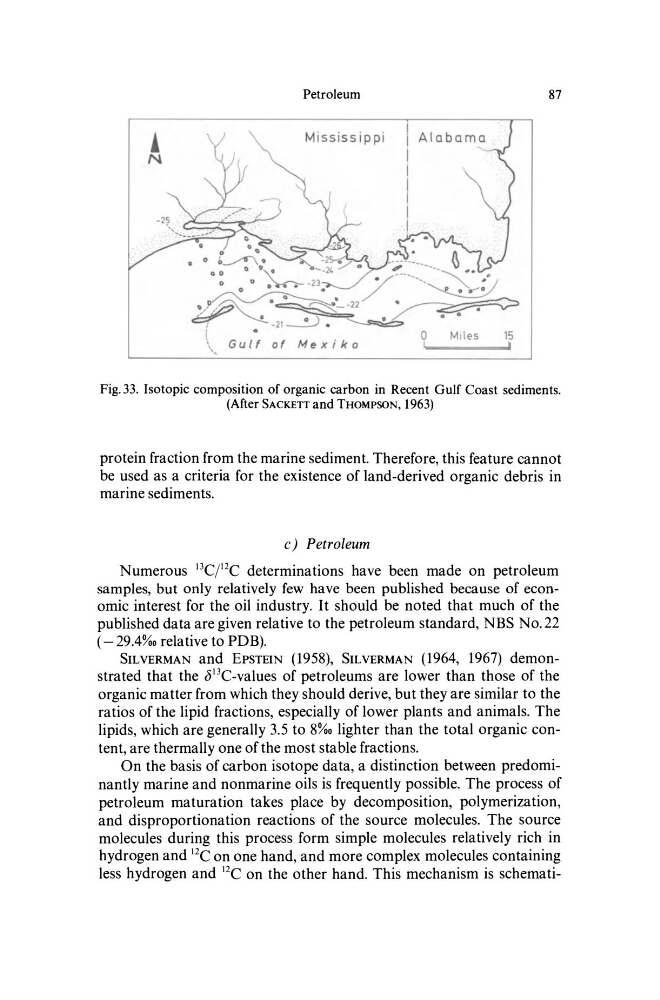
Fig. 33. Isotopic composition of organic carbon in Recent Gulf Coast sediments.
(After SACKETT and THOMPSON, 1963)
protein fraction from the marine sediment. Therefore, this feature cannot
be used as a criteria for the existence of land-derived organic debris in
marine sediments.
c) Petroleum
Numerous 13C/ J2C determinations have been made on petroleum
samples, but only relatively few have been published because of economic interest for the oil industry. It should be noted that much of the
published data are given relative to the petroleum standard, NBS No.22
( - 29.4%0 relative to PDB).
SILVERMAN and EpSTEIN (1958), SILVERMAN (1964, 1967) demonstrated that the J 13 C-values of petroleums are lower than those of the
organic matter from which they should derive, but they are similar to the
ratios of the lipid fractions, especially of lower plants and animals. The
lipids, which are generally 3.5 to 8%0 lighter than the total organic content, are thermally one of the most stable fractions.
On the basis of carbon isotope data, a distinction between predominantly marine and nonmarine oils is frequently possible. The process of
petroleum maturation takes place by decomposition, polymerization,
and disproportionation reactions of the source molecules. The source
molecules during this process form simple molecules relatively rich in
hydrogen and 12C on one hand, and more complex molecules containing
less hydrogen and 12C on the other hand. This mechanism is schemati-
87
,
Mississippi
N
o
o
0' 0
•
o 0 b~.
-2 /"
-----__ .
~
0: 0".~ _2;-~ O/_ . . . . :~
Of,~--/.~~ ·22
• ~
~ ~
0 '\
. /
~ -
-
I
-21~.
~
I
•
0
Miles
15
\. G u I f 0 , M e x i k 0
1
I
Fig. 33. Isotopic composition of organic carbon in Recent Gulf Coast sediments.
(After SACKETT and THOMPSON, 1963)
protein fraction from the marine sediment. Therefore, this feature cannot
be used as a criteria for the existence of land-derived organic debris in
marine sediments.
c) Petroleum
Numerous 13C/ J2C determinations have been made on petroleum
samples, but only relatively few have been published because of economic interest for the oil industry. It should be noted that much of the
published data are given relative to the petroleum standard, NBS No.22
( - 29.4%0 relative to PDB).
SILVERMAN and EpSTEIN (1958), SILVERMAN (1964, 1967) demonstrated that the J 13 C-values of petroleums are lower than those of the
organic matter from which they should derive, but they are similar to the
ratios of the lipid fractions, especially of lower plants and animals. The
lipids, which are generally 3.5 to 8%0 lighter than the total organic content, are thermally one of the most stable fractions.
On the basis of carbon isotope data, a distinction between predominantly marine and nonmarine oils is frequently possible. The process of
petroleum maturation takes place by decomposition, polymerization,
and disproportionation reactions of the source molecules. The source
molecules during this process form simple molecules relatively rich in
hydrogen and 12C on one hand, and more complex molecules containing
less hydrogen and 12C on the other hand. This mechanism is schemati-