

86
C. Variations of Stable Isotope Ratios in Nature
b 13C (°'00)
-15 -20 -25 -30 -35
Pectin
Proteins
Hemicellulose
Total
carbohydrates
Total
organic matter
Cellulose
"Lignin"
CHCl 3 -
Extr lipids
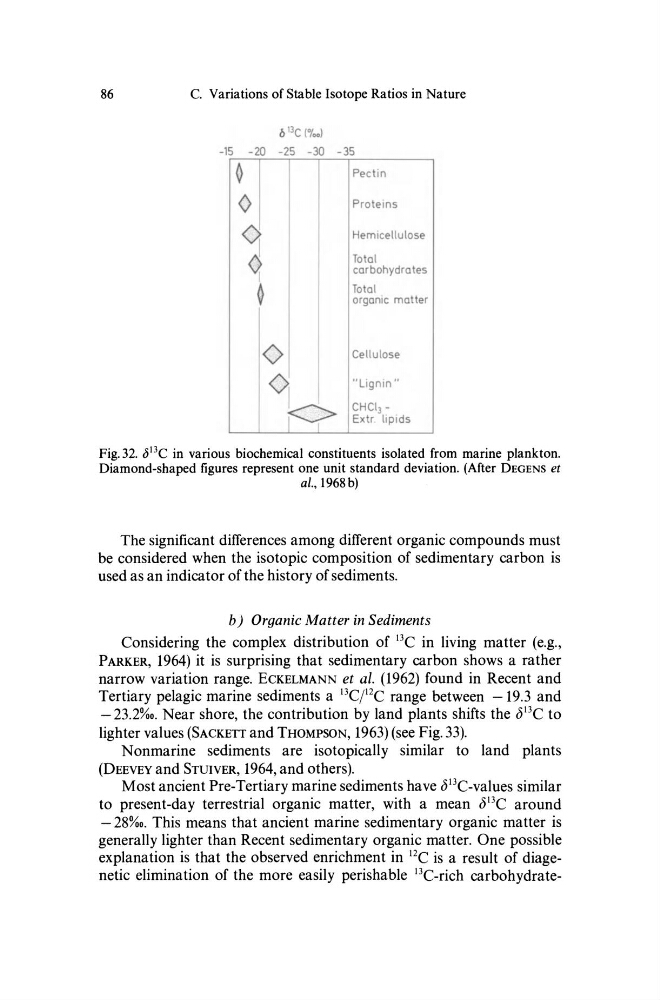
Fig. 32. b13C in various biochemical constituents isolated from marine plankton.
Diamond-shaped figures represent one unit standard deviation. (After DEGENS et
aI., 1968b)
The significant differences among different organic compounds must
be considered when the isotopic composition of sedimentary carbon is
used as an indicator of the history of sediments.
b) Organic Matter in Sediments
Considering the complex distribution of 13C in living matter (e.g.,
PARKER, 1964) it is surprising that sedimentary carbon shows a rather
narrow variation range. ECKELMANN et al. (1962) found in Recent and
Tertiary pelagic marine sediments a 13Cj 12 C range between -19.3 and
- 23.2%0. Near shore, the contribution by land plants shifts the c5 13 C to
lighter values (SACKETT and THOMPSON, 1963) (see Fig. 33).
Nonmarine sediments are isotopically similar to land plants
(DEEVEY and STUIVER, 1964, and others).
Most ancient Pre-Tertiary marine sediments have c5 13 C-values similar
to present-day terrestrial organic matter, with a mean c5 13 C around
- 28%0. This means that ancient marine sedimentary organic matter is
generally lighter than Recent sedimentary organic matter. One possible
explanation is that the observed enrichment in 12C is a result of diagenetic elimination of the more easily perishable 13C-rich carbohydrate-
C. Variations of Stable Isotope Ratios in Nature
b 13C (°'00)
-15 -20 -25 -30 -35
Pectin
Proteins
Hemicellulose
Total
carbohydrates
Total
organic matter
Cellulose
"Lignin"
CHCl 3 -
Extr lipids
Fig. 32. b13C in various biochemical constituents isolated from marine plankton.
Diamond-shaped figures represent one unit standard deviation. (After DEGENS et
aI., 1968b)
The significant differences among different organic compounds must
be considered when the isotopic composition of sedimentary carbon is
used as an indicator of the history of sediments.
b) Organic Matter in Sediments
Considering the complex distribution of 13C in living matter (e.g.,
PARKER, 1964) it is surprising that sedimentary carbon shows a rather
narrow variation range. ECKELMANN et al. (1962) found in Recent and
Tertiary pelagic marine sediments a 13Cj 12 C range between -19.3 and
- 23.2%0. Near shore, the contribution by land plants shifts the c5 13 C to
lighter values (SACKETT and THOMPSON, 1963) (see Fig. 33).
Nonmarine sediments are isotopically similar to land plants
(DEEVEY and STUIVER, 1964, and others).
Most ancient Pre-Tertiary marine sediments have c5 13 C-values similar
to present-day terrestrial organic matter, with a mean c5 13 C around
- 28%0. This means that ancient marine sedimentary organic matter is
generally lighter than Recent sedimentary organic matter. One possible
explanation is that the observed enrichment in 12C is a result of diagenetic elimination of the more easily perishable 13C-rich carbohydrate-