

88
C. Variations of Stable Isotope Ratios in Nature
/
SlmPler
molecules /
Source
molecules
II Methane
II Methane
More
complex
molecu les
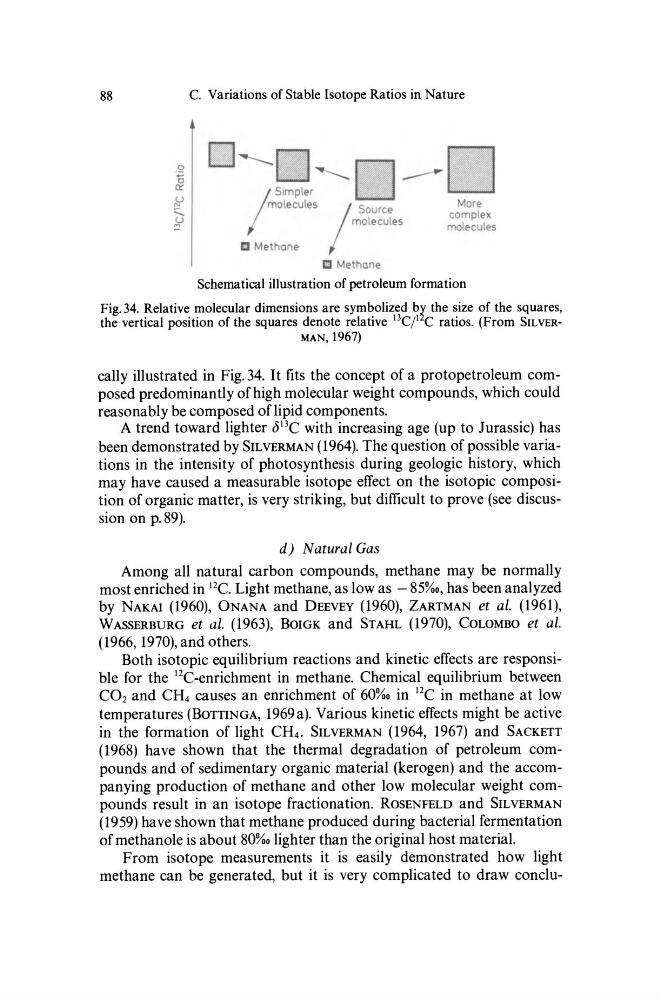
Schema tical illustration of petroleum formation
Fig. 34. Relative molecular dimensions are symbolized bi the size of the squares,
the vertical position of the squares denote relative 13el e ratios. (From SILVERMAN, 1967)
cally illustrated in Fig.34. It fits the concept of a proto petroleum composed predominantly of high molecular weight compounds, which could
reasonably be composed oflipid components.
A trend toward lighter c5 13 c with increasing age (up to Jurassic) has
been demonstrated by SILVERMAN (1964). The question of possible variations in the intensity of photosynthesis during geologic history, which
may have caused a measurable isotope effect on the isotopic composition of organic matter, is very striking, but difficult to prove (see discussion on p.89).
d ) Natural Gas
Among all natural carbon compounds, methane may be normally
most enriched in 12C. Light methane, as low as - 85%0, has been analyzed
by NAKAI (1960), ONANA and DEEVEY (1960), ZARTMAN et al. (1961),
WASSERBURG et al. (1963), BOIGK and STAHL (1970), COLOMBO et al.
(1966, 1970), and others.
Both isotopic equilibrium reactions and kinetic effects are responsible for the 12C-enrichment in methane. Chemical equilibrium between
CO2 and CH4 causes an enrichment of 60%0 in 12C in methane at low
temperatures (BOTTINGA, 1969a). Various kinetic effects might be active
in the formation of light CH4 • SILVERMAN (1964, 1967) and SACKETT
(1968) have shown that the thermal degradation of petroleum compounds and of sedimentary organic material (kerogen) and the accompanying production of methane and other low molecular weight compounds result in an isotope fractionation. ROSENFELD and SILVERMAN
(1959) have shown that methane produced during bacterial fermentation
of methanole is about 80%0 lighter than the original host material.
From isotope measurements it is easily demonstrated how light
methane can be generated, but it is very complicated to draw conclu-
C. Variations of Stable Isotope Ratios in Nature
/
SlmPler
molecules /
Source
molecules
II Methane
II Methane
More
complex
molecu les
Schema tical illustration of petroleum formation
Fig. 34. Relative molecular dimensions are symbolized bi the size of the squares,
the vertical position of the squares denote relative 13el e ratios. (From SILVERMAN, 1967)
cally illustrated in Fig.34. It fits the concept of a proto petroleum composed predominantly of high molecular weight compounds, which could
reasonably be composed oflipid components.
A trend toward lighter c5 13 c with increasing age (up to Jurassic) has
been demonstrated by SILVERMAN (1964). The question of possible variations in the intensity of photosynthesis during geologic history, which
may have caused a measurable isotope effect on the isotopic composition of organic matter, is very striking, but difficult to prove (see discussion on p.89).
d ) Natural Gas
Among all natural carbon compounds, methane may be normally
most enriched in 12C. Light methane, as low as - 85%0, has been analyzed
by NAKAI (1960), ONANA and DEEVEY (1960), ZARTMAN et al. (1961),
WASSERBURG et al. (1963), BOIGK and STAHL (1970), COLOMBO et al.
(1966, 1970), and others.
Both isotopic equilibrium reactions and kinetic effects are responsible for the 12C-enrichment in methane. Chemical equilibrium between
CO2 and CH4 causes an enrichment of 60%0 in 12C in methane at low
temperatures (BOTTINGA, 1969a). Various kinetic effects might be active
in the formation of light CH4 • SILVERMAN (1964, 1967) and SACKETT
(1968) have shown that the thermal degradation of petroleum compounds and of sedimentary organic material (kerogen) and the accompanying production of methane and other low molecular weight compounds result in an isotope fractionation. ROSENFELD and SILVERMAN
(1959) have shown that methane produced during bacterial fermentation
of methanole is about 80%0 lighter than the original host material.
From isotope measurements it is easily demonstrated how light
methane can be generated, but it is very complicated to draw conclu-