

Atmosphere
81
the nitrate ion and in atmospheric nitrogen. He observed a constant
kinetic isotope effect of about 1.004 between the ammonia and the nitrate ion.
Atmospheric oxygen has a rather constant isotopic composition with
a b l8 0-value of +23.5 (DOLE et ai., 1954; KROOPNICK and CRAIG, 1972).
Oxygen dissolved in ocean water is further enriched in 18 0 by nearly 1%0
at 0° C (KROOPNICK and CRAIG, 1972). UREY (1947) calculated the equilibrium constant for the exchange reaction between atmospheric oxygen
and water to be very close to unity. This means that atmospheric oxygen
cannot be in equilibrium with the hydrosphere. Therefore, the enrichment of 18 0 in free O 2 , the so-called Dole effect, must have another
explanation.
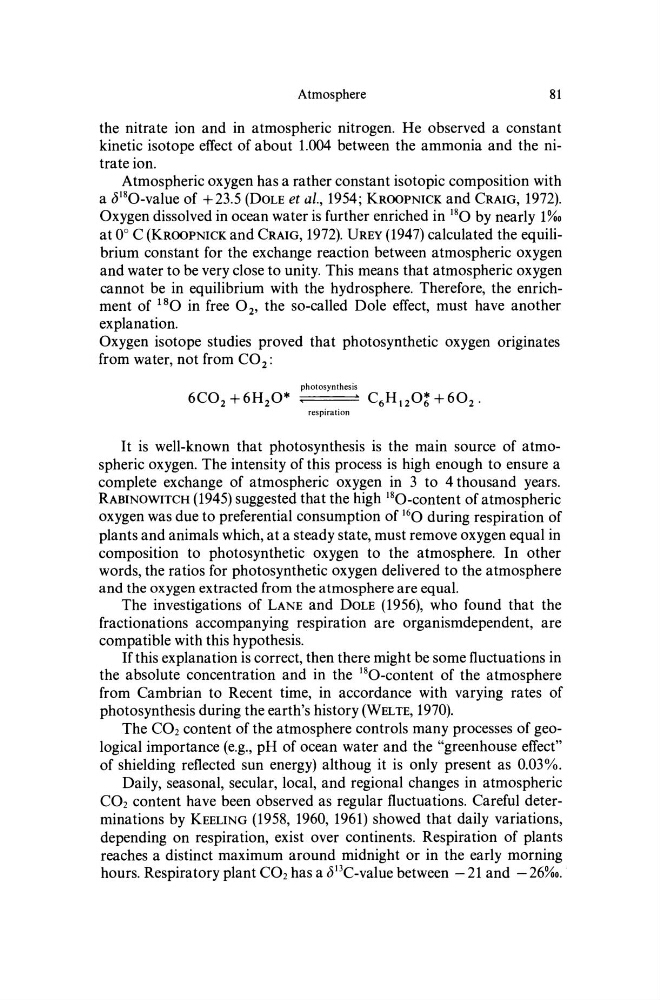
Oxygen isotope studies proved that photosynthetic oxygen originates
from water, not from CO 2 :
photosynthesis
>
respiration
It is well-known that photosynthesis is the main source of atmospheric oxygen. The intensity of this process is high enough to ensure a
complete exchange of atmospheric oxygen in 3 to 4 thousand years.
RABINOWITCH (1945) suggested that the high 180-content of atmospheric
oxygen was due to preferential consumption of 16 0 during respiration of
plants and animals which, at a steady state, must remove oxygen equal in
composition to photosynthetic oxygen to the atmosphere. In other
words, the ratios for photosynthetic oxygen delivered to the atmosphere
and the oxygen extracted from the atmosphere are equal.
The investigations of LANE and DOLE (1956), who found that the
fractionations accompanying respiration are organismdependent, are
compatible with this hypothesis.
If this explanation is correct, then there might be some fluctuations in
the absolute concentration and in the 180-content of the atmosphere
from Cambrian to Recent time, in accordance with varying rates of
photosynthesis during the earth's history (WELTE, 1970).
The CO2 content of the atmosphere controls many processes of geological importance (e.g., pH of ocean water and the "greenhouse effect"
of shielding reflected sun energy) althoug it is only present as 0.03%.
Daily, seasonal, secular, local, and regional changes in atmospheric
CO2 content have been observed as regular fluctuations. Careful determinations by KEELING (1958, 1960, 1961) showed that daily variations,
depending on respiration, exist over continents. Respiration of plants
reaches a distinct maximum around midnight or in the early morning
hours. Respiratory plant CO2 has a b 13 C-value between - 21 and - 26%0.
81
the nitrate ion and in atmospheric nitrogen. He observed a constant
kinetic isotope effect of about 1.004 between the ammonia and the nitrate ion.
Atmospheric oxygen has a rather constant isotopic composition with
a b l8 0-value of +23.5 (DOLE et ai., 1954; KROOPNICK and CRAIG, 1972).
Oxygen dissolved in ocean water is further enriched in 18 0 by nearly 1%0
at 0° C (KROOPNICK and CRAIG, 1972). UREY (1947) calculated the equilibrium constant for the exchange reaction between atmospheric oxygen
and water to be very close to unity. This means that atmospheric oxygen
cannot be in equilibrium with the hydrosphere. Therefore, the enrichment of 18 0 in free O 2 , the so-called Dole effect, must have another
explanation.
Oxygen isotope studies proved that photosynthetic oxygen originates
from water, not from CO 2 :
photosynthesis
>
respiration
It is well-known that photosynthesis is the main source of atmospheric oxygen. The intensity of this process is high enough to ensure a
complete exchange of atmospheric oxygen in 3 to 4 thousand years.
RABINOWITCH (1945) suggested that the high 180-content of atmospheric
oxygen was due to preferential consumption of 16 0 during respiration of
plants and animals which, at a steady state, must remove oxygen equal in
composition to photosynthetic oxygen to the atmosphere. In other
words, the ratios for photosynthetic oxygen delivered to the atmosphere
and the oxygen extracted from the atmosphere are equal.
The investigations of LANE and DOLE (1956), who found that the
fractionations accompanying respiration are organismdependent, are
compatible with this hypothesis.
If this explanation is correct, then there might be some fluctuations in
the absolute concentration and in the 180-content of the atmosphere
from Cambrian to Recent time, in accordance with varying rates of
photosynthesis during the earth's history (WELTE, 1970).
The CO2 content of the atmosphere controls many processes of geological importance (e.g., pH of ocean water and the "greenhouse effect"
of shielding reflected sun energy) althoug it is only present as 0.03%.
Daily, seasonal, secular, local, and regional changes in atmospheric
CO2 content have been observed as regular fluctuations. Careful determinations by KEELING (1958, 1960, 1961) showed that daily variations,
depending on respiration, exist over continents. Respiration of plants
reaches a distinct maximum around midnight or in the early morning
hours. Respiratory plant CO2 has a b 13 C-value between - 21 and - 26%0.