

80
C. Variations of Stable Isotope Ratios in Nature
sphere is moderately homogenous in composition, except for water,
which varies with location and season as well as elevation. The average
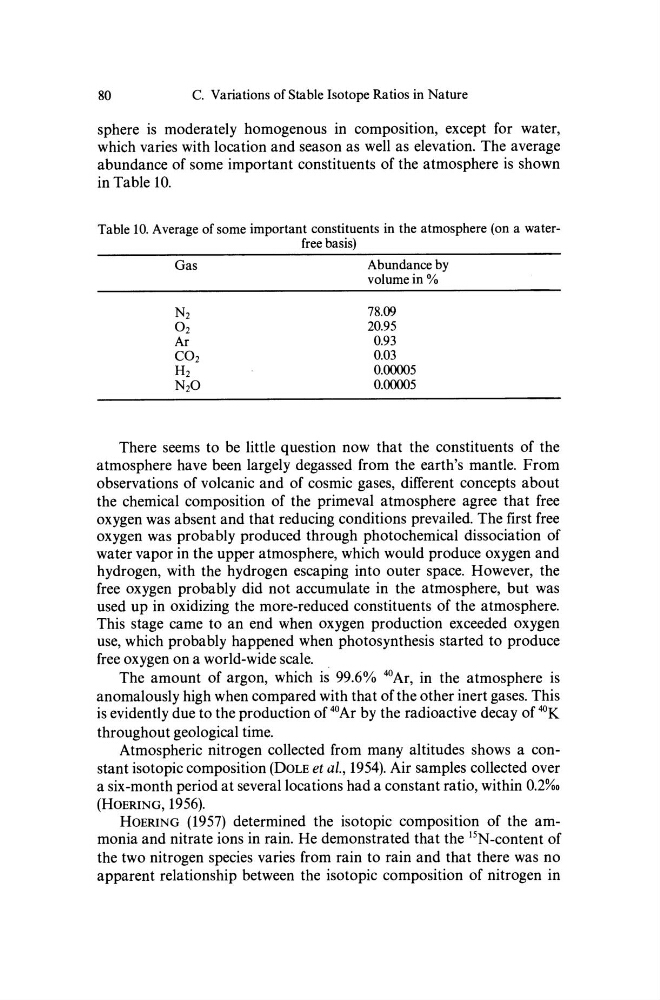
abundance of some important constituents of the atmosphere is shown
in Table 10.
Table 10. Average of some important constituents in the atmosphere (on a waterfree basis)
Gas
Abundance by
volume in %
78.09
20.95
0.93
0.03
0.00005
0.00005
There seems to be little question now that the constituents of the
atmosphere have been largely degassed from the earth's mantle. From
observations of volcanic and of cosmic gases, different concepts about
the chemical composition of the primeval atmosphere agree that free
oxygen was absent and that reducing conditions prevailed. The first free
oxygen was probably produced through photochemical dissociation of
water vapor in the upper atmosphere, which would produce oxygen and
hydrogen, with the hydrogen escaping into outer space. However, the
free oxygen probably did not accumulate in the atmosphere, but was
used up in oxidizing the more-reduced constituents of the atmosphere.
This stage came to an end when oxygen production exceeded oxygen
use, which probably happened when photosynthesis started to produce
free oxygen on a world-wide scale.
The amount of argon, which is 99.6% 4°Ar, in the atmosphere is
anomalously high when compared with that of the other inert gases. This
is evidently due to the production of 4 °Ar by the radioactive decay of 4 °K
throughout geological time.
Atmospheric nitrogen collected from many altitudes shows a constant isotopic composition (DOLE et a/., 1954). Air samples collected over
a six-month period at several locations had a constant ratio, within 0.2%0
(HOERING, 1956).
HOERING (1957) determined the isotopic composition of the ammonia and nitrate ions in rain. He demonstrated that the 15N-content of
the two nitrogen species varies from rain to rain and that there was no
apparent relationship between the isotopic composition of nitrogen in
C. Variations of Stable Isotope Ratios in Nature
sphere is moderately homogenous in composition, except for water,
which varies with location and season as well as elevation. The average
abundance of some important constituents of the atmosphere is shown
in Table 10.
Table 10. Average of some important constituents in the atmosphere (on a waterfree basis)
Gas
Abundance by
volume in %
78.09
20.95
0.93
0.03
0.00005
0.00005
There seems to be little question now that the constituents of the
atmosphere have been largely degassed from the earth's mantle. From
observations of volcanic and of cosmic gases, different concepts about
the chemical composition of the primeval atmosphere agree that free
oxygen was absent and that reducing conditions prevailed. The first free
oxygen was probably produced through photochemical dissociation of
water vapor in the upper atmosphere, which would produce oxygen and
hydrogen, with the hydrogen escaping into outer space. However, the
free oxygen probably did not accumulate in the atmosphere, but was
used up in oxidizing the more-reduced constituents of the atmosphere.
This stage came to an end when oxygen production exceeded oxygen
use, which probably happened when photosynthesis started to produce
free oxygen on a world-wide scale.
The amount of argon, which is 99.6% 4°Ar, in the atmosphere is
anomalously high when compared with that of the other inert gases. This
is evidently due to the production of 4 °Ar by the radioactive decay of 4 °K
throughout geological time.
Atmospheric nitrogen collected from many altitudes shows a constant isotopic composition (DOLE et a/., 1954). Air samples collected over
a six-month period at several locations had a constant ratio, within 0.2%0
(HOERING, 1956).
HOERING (1957) determined the isotopic composition of the ammonia and nitrate ions in rain. He demonstrated that the 15N-content of
the two nitrogen species varies from rain to rain and that there was no
apparent relationship between the isotopic composition of nitrogen in