

36
c
.2
o c
.2
- u
"
u:
B. Fractionation Mechanisms of Selected Elements
1. 0 9 0 . - - - - - - - - - - - - - - - - ,
Temperature (OC)
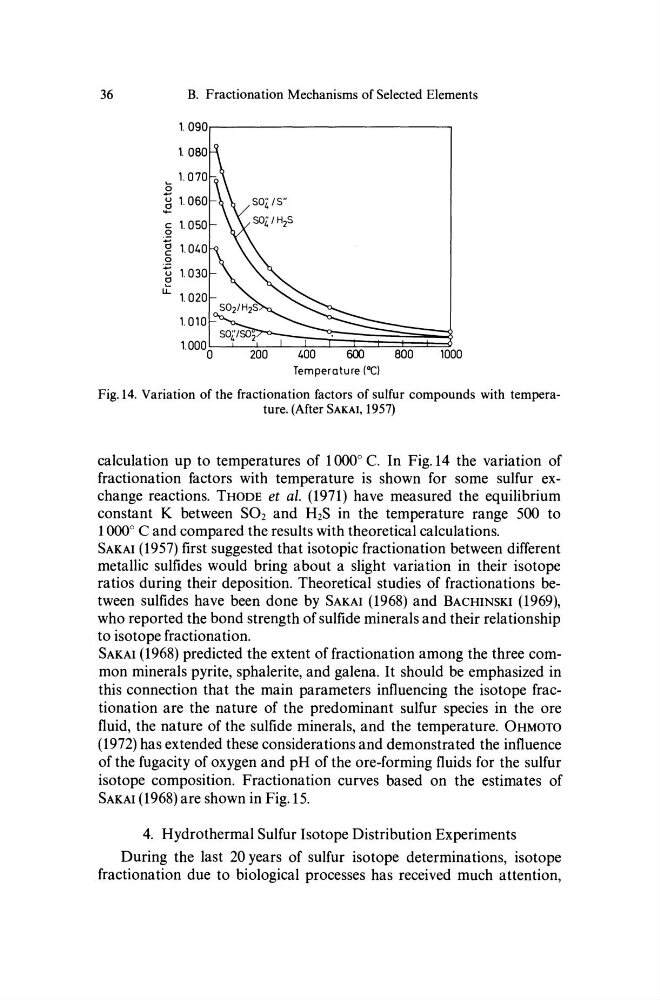
Fig. 14. Variation of the fractionation factors of sulfur compounds with temperature. (After SAKAI, 1957)
calculation up to temperatures of 1000° C. In Fig. 14 the variation of
fractionation factors with temperature is shown for some sulfur exchange reactions. THODE et ai. (1971) have measured the equilibrium
constant K between SOz and HzS in the temperature range 500 to
1 O()()O C and compared the results with theoretical calculations.
SAKAI (1957) first suggested that isotopic fractionation between different
metallic sulfides would bring about a slight variation in their isotope
ratios during their deposition. Theoretical studies of fractionations between sulfides have been done by SAKAI (1968) and BACHINSKI (1969),
who reported the bond strength of sulfide minerals and their relationship
to isotope fractionation.
SAKAI (1968) predicted the extent of fractionation among the three common minerals pyrite, sphalerite, and galena. It should be emphasized in
this connection that the main parameters influencing the isotope fractionation are the nature of the predominant sulfur species in the ore
fluid, the nature of the sulfide minerals, and the temperature. OHMOTO
(1972) has extended these considerations and demonstrated the influence
of the fugacity of oxygen and pH of the ore-forming fluids for the sulfur
isotope composition. Fractionation curves based on the estimates of
SAKAI (1968) are shown in Fig. 15.
4. Hydrothermal Sulfur Isotope Distribution Experiments
During the last 20 years of sulfur isotope determinations, isotope
fractionation due to biological processes has received much attention,
c
.2
o c
.2
- u
"
u:
B. Fractionation Mechanisms of Selected Elements
1. 0 9 0 . - - - - - - - - - - - - - - - - ,
Temperature (OC)
Fig. 14. Variation of the fractionation factors of sulfur compounds with temperature. (After SAKAI, 1957)
calculation up to temperatures of 1000° C. In Fig. 14 the variation of
fractionation factors with temperature is shown for some sulfur exchange reactions. THODE et ai. (1971) have measured the equilibrium
constant K between SOz and HzS in the temperature range 500 to
1 O()()O C and compared the results with theoretical calculations.
SAKAI (1957) first suggested that isotopic fractionation between different
metallic sulfides would bring about a slight variation in their isotope
ratios during their deposition. Theoretical studies of fractionations between sulfides have been done by SAKAI (1968) and BACHINSKI (1969),
who reported the bond strength of sulfide minerals and their relationship
to isotope fractionation.
SAKAI (1968) predicted the extent of fractionation among the three common minerals pyrite, sphalerite, and galena. It should be emphasized in
this connection that the main parameters influencing the isotope fractionation are the nature of the predominant sulfur species in the ore
fluid, the nature of the sulfide minerals, and the temperature. OHMOTO
(1972) has extended these considerations and demonstrated the influence
of the fugacity of oxygen and pH of the ore-forming fluids for the sulfur
isotope composition. Fractionation curves based on the estimates of
SAKAI (1968) are shown in Fig. 15.
4. Hydrothermal Sulfur Isotope Distribution Experiments
During the last 20 years of sulfur isotope determinations, isotope
fractionation due to biological processes has received much attention,