

Q)
u
C
Q)
~
- o
I
37
18.--------------------------------------,
o
100
200
300
400
500
600
700
BOO
Temperature,OC
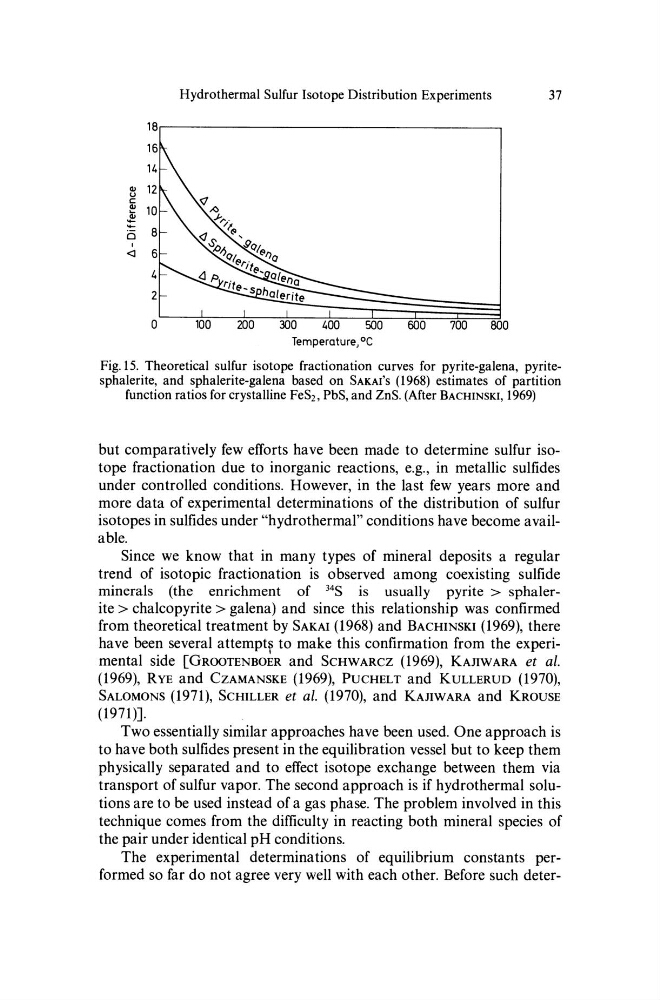
Fig. 15. Theoretical sulfur isotope fractionation curves for pyrite-galena, pyritesphalerite, and sphalerite-galena based on SAKAI'S (1968) estimates of partition
function ratios for crystalline FeS2, PbS, and ZnS. (After BACHINSKI, 1969)
but comparatively few efforts have been made to determine sulfur isotope fractionation due to inorganic reactions, e.g., in metallic sulfides
under controlled conditions. However, in the last few years more and
more data of experimental determinations of the distribution of sulfur
isotopes in sulfides under "hydrothermal" conditions have become available.
Since we know that in many types of mineral deposits a regular
trend of isotopic fractionation is observed among coexisting sulfide
minerals (the enrichment of 34S is usually pyrite > sphalerite> chalcopyrite> galena) and since this relationship was confirmed
from theoretical treatment by SAKAI (1968) and BACHlNSKI (1969), there
have been several attempt~ to make this confirmation from the experimental side [GROOTENBOER and SCHWARCZ (1969), KAJIWARA et al.
(1969), RYE and CZAMANSKE (1969), PUCHELT and KULLERUD (1970),
SALOMONS (1971), SCHILLER et al. (1970), and KAJIWARA and KROUSE
(1971 )].
Two essentially similar approaches have been used. One approach is
to have both sulfides present in the equilibration vessel but to keep them
physically separated and to effect isotope exchange between them via
transport of sulfur vapor. The second approach is if hydrothermal solutions are to be used instead of a gas phase. The problem involved in this
technique comes from the difficulty in reacting both mineral species of
the pair under identical pH conditions.
The experimental determinations of equilibrium constants performed so far do not agree very well with each other. Before such deter-
u
C
Q)
~
- o
I
37
18.--------------------------------------,
o
100
200
300
400
500
600
700
BOO
Temperature,OC
Fig. 15. Theoretical sulfur isotope fractionation curves for pyrite-galena, pyritesphalerite, and sphalerite-galena based on SAKAI'S (1968) estimates of partition
function ratios for crystalline FeS2, PbS, and ZnS. (After BACHINSKI, 1969)
but comparatively few efforts have been made to determine sulfur isotope fractionation due to inorganic reactions, e.g., in metallic sulfides
under controlled conditions. However, in the last few years more and
more data of experimental determinations of the distribution of sulfur
isotopes in sulfides under "hydrothermal" conditions have become available.
Since we know that in many types of mineral deposits a regular
trend of isotopic fractionation is observed among coexisting sulfide
minerals (the enrichment of 34S is usually pyrite > sphalerite> chalcopyrite> galena) and since this relationship was confirmed
from theoretical treatment by SAKAI (1968) and BACHlNSKI (1969), there
have been several attempt~ to make this confirmation from the experimental side [GROOTENBOER and SCHWARCZ (1969), KAJIWARA et al.
(1969), RYE and CZAMANSKE (1969), PUCHELT and KULLERUD (1970),
SALOMONS (1971), SCHILLER et al. (1970), and KAJIWARA and KROUSE
(1971 )].
Two essentially similar approaches have been used. One approach is
to have both sulfides present in the equilibration vessel but to keep them
physically separated and to effect isotope exchange between them via
transport of sulfur vapor. The second approach is if hydrothermal solutions are to be used instead of a gas phase. The problem involved in this
technique comes from the difficulty in reacting both mineral species of
the pair under identical pH conditions.
The experimental determinations of equilibrium constants performed so far do not agree very well with each other. Before such deter-