

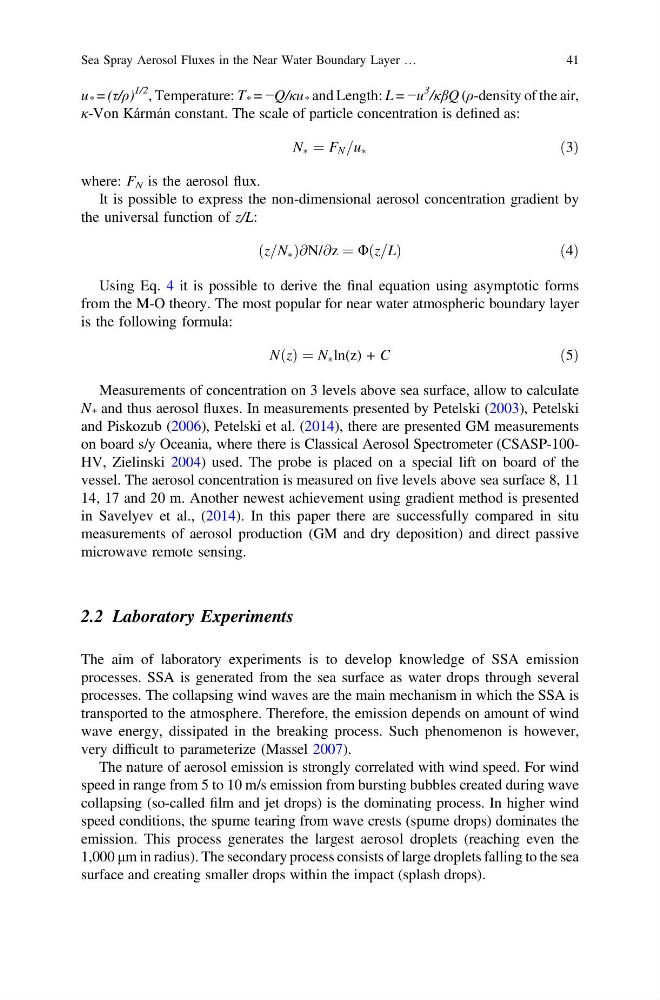
u * = (τ/ρ)
1/2 , Temperature: T * = −Q/κu * and Length: L = −u
3
/κβQ (ρ-density of the air,
κ-Von Kármán constant. The scale of particle concentration is defined as:
N Ã ¼ F N =u Ã
ð3Þ
where: F N is the aerosol flux.
It is possible to express the non-dimensional aerosol concentration gradient by
the universal function of z/L:
ðz=N Ã Þ@N/@z ¼ Uðz=LÞ
ð 4Þ
Using Eq. 4 it is possible to derive the final equation using asymptotic forms
from the M-O theory. The most popular for near water atmospheric boundary layer
is the following formula:
NðzÞ ¼ N Ã ln(z) + C
ð5Þ
Measurements of concentration on 3 levels above sea surface, allow to calculate
N * and thus aerosol fluxes. In measurements presented by Petelski (2003), Petelski
and Piskozub (2006), Petelski et al. (2014), there are presented GM measurements
on board s/y Oceania, where there is Classical Aerosol Spectrometer (CSASP-100HV, Zielinski 2004) used. The probe is placed on a special lift on board of the
vessel. The aerosol concentration is measured on five levels above sea surface 8, 11
14, 17 and 20 m. Another newest achievement using gradient method is presented
in Savelyev et al., (2014). In this paper there are successfully compared in situ
measurements of aerosol production (GM and dry deposition) and direct passive
microwave remote sensing.
2.2 Laboratory Experiments
The aim of laboratory experiments is to develop knowledge of SSA emission
processes. SSA is generated from the sea surface as water drops through several
processes. The collapsing wind waves are the main mechanism in which the SSA is
transported to the atmosphere. Therefore, the emission depends on amount of wind
wave energy, dissipated in the breaking process. Such phenomenon is however,
very difficult to parameterize (Massel 2007).
The nature of aerosol emission is strongly correlated with wind speed. For wind
speed in range from 5 to 10 m/s emission from bursting bubbles created during wave
collapsing (so-called film and jet drops) is the dominating process. In higher wind
speed conditions, the spume tearing from wave crests (spume drops) dominates the
emission. This process generates the largest aerosol droplets (reaching even the
1,000 μm in radius). The secondary process consists of large droplets falling to the sea
surface and creating smaller drops within the impact (splash drops).
Sea Spray Aerosol Fluxes in the Near Water Boundary Layer …
41
1/2 , Temperature: T * = −Q/κu * and Length: L = −u
3
/κβQ (ρ-density of the air,
κ-Von Kármán constant. The scale of particle concentration is defined as:
N Ã ¼ F N =u Ã
ð3Þ
where: F N is the aerosol flux.
It is possible to express the non-dimensional aerosol concentration gradient by
the universal function of z/L:
ðz=N Ã Þ@N/@z ¼ Uðz=LÞ
ð 4Þ
Using Eq. 4 it is possible to derive the final equation using asymptotic forms
from the M-O theory. The most popular for near water atmospheric boundary layer
is the following formula:
NðzÞ ¼ N Ã ln(z) + C
ð5Þ
Measurements of concentration on 3 levels above sea surface, allow to calculate
N * and thus aerosol fluxes. In measurements presented by Petelski (2003), Petelski
and Piskozub (2006), Petelski et al. (2014), there are presented GM measurements
on board s/y Oceania, where there is Classical Aerosol Spectrometer (CSASP-100HV, Zielinski 2004) used. The probe is placed on a special lift on board of the
vessel. The aerosol concentration is measured on five levels above sea surface 8, 11
14, 17 and 20 m. Another newest achievement using gradient method is presented
in Savelyev et al., (2014). In this paper there are successfully compared in situ
measurements of aerosol production (GM and dry deposition) and direct passive
microwave remote sensing.
2.2 Laboratory Experiments
The aim of laboratory experiments is to develop knowledge of SSA emission
processes. SSA is generated from the sea surface as water drops through several
processes. The collapsing wind waves are the main mechanism in which the SSA is
transported to the atmosphere. Therefore, the emission depends on amount of wind
wave energy, dissipated in the breaking process. Such phenomenon is however,
very difficult to parameterize (Massel 2007).
The nature of aerosol emission is strongly correlated with wind speed. For wind
speed in range from 5 to 10 m/s emission from bursting bubbles created during wave
collapsing (so-called film and jet drops) is the dominating process. In higher wind
speed conditions, the spume tearing from wave crests (spume drops) dominates the
emission. This process generates the largest aerosol droplets (reaching even the
1,000 μm in radius). The secondary process consists of large droplets falling to the sea
surface and creating smaller drops within the impact (splash drops).
Sea Spray Aerosol Fluxes in the Near Water Boundary Layer …
41