

Positive correlations between the Mg/Ca ratio and temperature have since been
found in many kinds of organisms, including benthic foraminifera, ostracods,
coccoliths and corals (Wefer et al. 1999; Barker et al. 2005 and references therein).
In cold, near surface environments at high latitudes, the Mg/Ca ratio is lower than
in warmer waters, so the changes with temperatures are small (Meland et al. 2006).
Therefore, it is possible that factors such as salinity, pH, alkalinity, carbonate ion
concentration or secondary calcification may have a significant influence on the
Mg/Ca ratios (Meland et al. 2006). In addition, Rosenthal and Boyle (1993) pointed
out that dissolution may significantly alter the Mg concentrations within foraminifera shells, hence may impact Mg/Ca ratio. Nevertheless, as long as only the most
pristine tests are picked, the Mg content of many planktic foraminifers can be used as
a tool to trace the paleotemperature (Nürnberg 1995; Aagaard-Sørensen et al. 2013),
keeping in mind that Mg incorporation might be species specific (Kristjásdóttir et al.
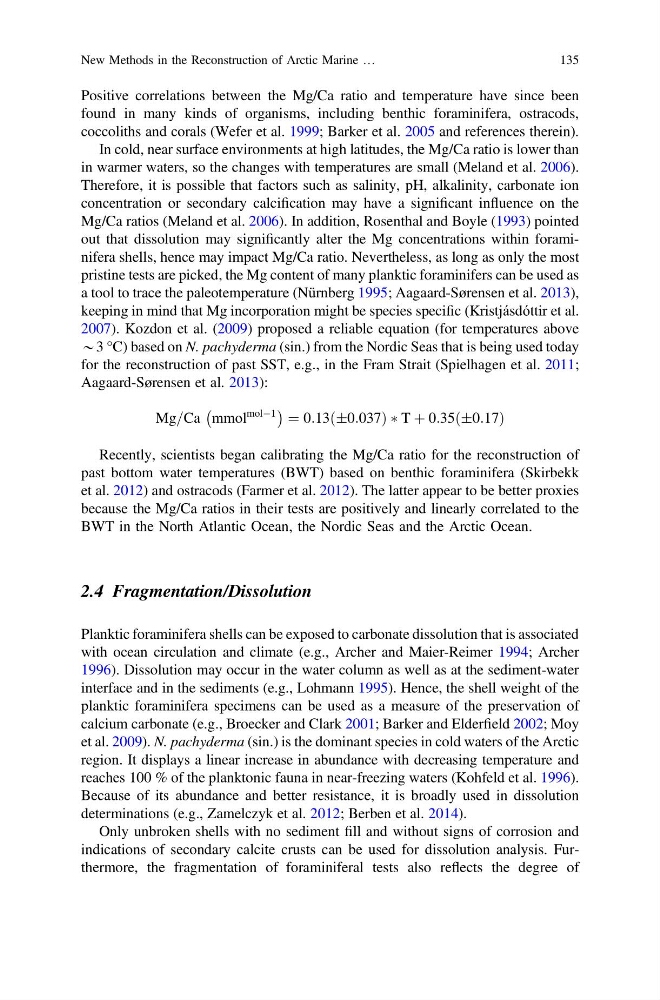
2007). Kozdon et al. (2009) proposed a reliable equation (for temperatures above
*3 °C) based on N. pachyderma (sin.) from the Nordic Seas that is being used today
for the reconstruction of past SST, e.g., in the Fram Strait (Spielhagen et al. 2011;
Aagaard-Sørensen et al. 2013):
Mg=Ca mmol
molÀ1
À
Á ¼ 0:13 Æ0:037
ð
ÞÃT þ 0:35 Æ0:17
ð
Þ
Recently, scientists began calibrating the Mg/Ca ratio for the reconstruction of
past bottom water temperatures (BWT) based on benthic foraminifera (Skirbekk
et al. 2012) and ostracods (Farmer et al. 2012). The latter appear to be better proxies
because the Mg/Ca ratios in their tests are positively and linearly correlated to the
BWT in the North Atlantic Ocean, the Nordic Seas and the Arctic Ocean.
2.4 Fragmentation/Dissolution
Planktic foraminifera shells can be exposed to carbonate dissolution that is associated
with ocean circulation and climate (e.g., Archer and Maier-Reimer 1994; Archer
1996). Dissolution may occur in the water column as well as at the sediment-water
interface and in the sediments (e.g., Lohmann 1995). Hence, the shell weight of the
planktic foraminifera specimens can be used as a measure of the preservation of
calcium carbonate (e.g., Broecker and Clark 2001; Barker and Elderfield 2002; Moy
et al. 2009). N. pachyderma (sin.) is the dominant species in cold waters of the Arctic
region. It displays a linear increase in abundance with decreasing temperature and
reaches 100 % of the planktonic fauna in near-freezing waters (Kohfeld et al. 1996).
Because of its abundance and better resistance, it is broadly used in dissolution
determinations (e.g., Zamelczyk et al. 2012; Berben et al. 2014).
Only unbroken shells with no sediment fill and without signs of corrosion and
indications of secondary calcite crusts can be used for dissolution analysis. Furthermore, the fragmentation of foraminiferal tests also reflects the degree of
New Methods in the Reconstruction of Arctic Marine …
135
found in many kinds of organisms, including benthic foraminifera, ostracods,
coccoliths and corals (Wefer et al. 1999; Barker et al. 2005 and references therein).
In cold, near surface environments at high latitudes, the Mg/Ca ratio is lower than
in warmer waters, so the changes with temperatures are small (Meland et al. 2006).
Therefore, it is possible that factors such as salinity, pH, alkalinity, carbonate ion
concentration or secondary calcification may have a significant influence on the
Mg/Ca ratios (Meland et al. 2006). In addition, Rosenthal and Boyle (1993) pointed
out that dissolution may significantly alter the Mg concentrations within foraminifera shells, hence may impact Mg/Ca ratio. Nevertheless, as long as only the most
pristine tests are picked, the Mg content of many planktic foraminifers can be used as
a tool to trace the paleotemperature (Nürnberg 1995; Aagaard-Sørensen et al. 2013),
keeping in mind that Mg incorporation might be species specific (Kristjásdóttir et al.
2007). Kozdon et al. (2009) proposed a reliable equation (for temperatures above
*3 °C) based on N. pachyderma (sin.) from the Nordic Seas that is being used today
for the reconstruction of past SST, e.g., in the Fram Strait (Spielhagen et al. 2011;
Aagaard-Sørensen et al. 2013):
Mg=Ca mmol
molÀ1
À
Á ¼ 0:13 Æ0:037
ð
ÞÃT þ 0:35 Æ0:17
ð
Þ
Recently, scientists began calibrating the Mg/Ca ratio for the reconstruction of
past bottom water temperatures (BWT) based on benthic foraminifera (Skirbekk
et al. 2012) and ostracods (Farmer et al. 2012). The latter appear to be better proxies
because the Mg/Ca ratios in their tests are positively and linearly correlated to the
BWT in the North Atlantic Ocean, the Nordic Seas and the Arctic Ocean.
2.4 Fragmentation/Dissolution
Planktic foraminifera shells can be exposed to carbonate dissolution that is associated
with ocean circulation and climate (e.g., Archer and Maier-Reimer 1994; Archer
1996). Dissolution may occur in the water column as well as at the sediment-water
interface and in the sediments (e.g., Lohmann 1995). Hence, the shell weight of the
planktic foraminifera specimens can be used as a measure of the preservation of
calcium carbonate (e.g., Broecker and Clark 2001; Barker and Elderfield 2002; Moy
et al. 2009). N. pachyderma (sin.) is the dominant species in cold waters of the Arctic
region. It displays a linear increase in abundance with decreasing temperature and
reaches 100 % of the planktonic fauna in near-freezing waters (Kohfeld et al. 1996).
Because of its abundance and better resistance, it is broadly used in dissolution
determinations (e.g., Zamelczyk et al. 2012; Berben et al. 2014).
Only unbroken shells with no sediment fill and without signs of corrosion and
indications of secondary calcite crusts can be used for dissolution analysis. Furthermore, the fragmentation of foraminiferal tests also reflects the degree of
New Methods in the Reconstruction of Arctic Marine …
135