

dissolution (Conan et al. 2002) and is inversely correlated with the shell weight
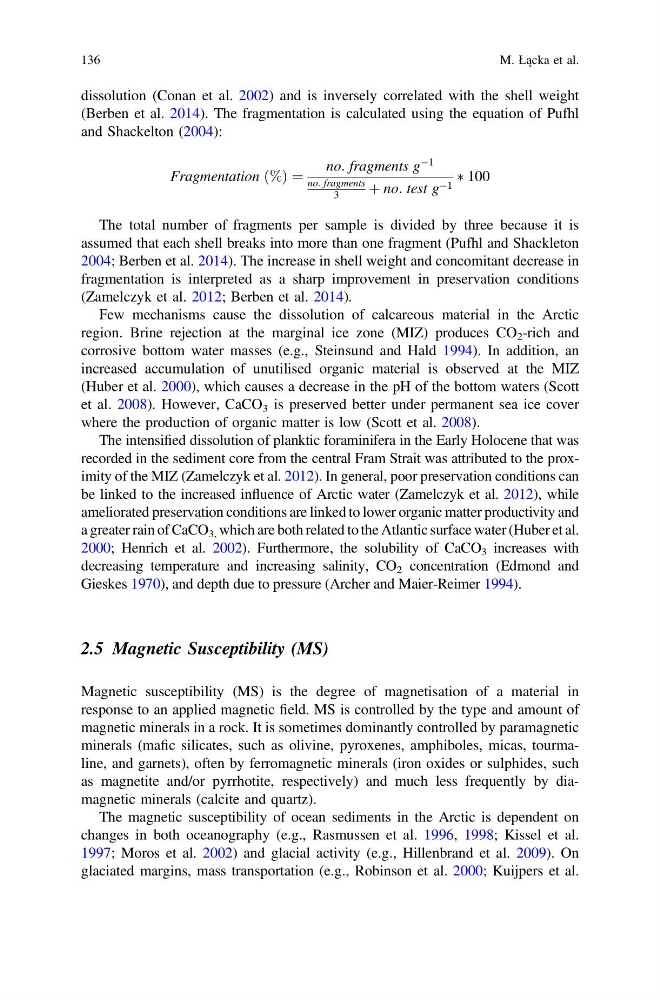
(Berben et al. 2014). The fragmentation is calculated using the equation of Pufhl
and Shackelton (2004):
Fragmentation %
ð Þ ¼
no: fragments g
À1
no: fragments
3
þ no: test g À1
à 100
The total number of fragments per sample is divided by three because it is
assumed that each shell breaks into more than one fragment (Pufhl and Shackleton
2004; Berben et al. 2014). The increase in shell weight and concomitant decrease in
fragmentation is interpreted as a sharp improvement in preservation conditions
(Zamelczyk et al. 2012; Berben et al. 2014).
Few mechanisms cause the dissolution of calcareous material in the Arctic
region. Brine rejection at the marginal ice zone (MIZ) produces CO 2 -rich and
corrosive bottom water masses (e.g., Steinsund and Hald 1994). In addition, an
increased accumulation of unutilised organic material is observed at the MIZ
(Huber et al. 2000), which causes a decrease in the pH of the bottom waters (Scott
et al. 2008). However, CaCO 3 is preserved better under permanent sea ice cover
where the production of organic matter is low (Scott et al. 2008).
The intensified dissolution of planktic foraminifera in the Early Holocene that was
recorded in the sediment core from the central Fram Strait was attributed to the proximity of the MIZ (Zamelczyk et al. 2012). In general, poor preservation conditions can
be linked to the increased influence of Arctic water (Zamelczyk et al. 2012), while
ameliorated preservation conditions are linked to lower organic matter productivity and
a greater rain of CaCO 3, which are both related to the Atlantic surface water (Huber et al.
2000; Henrich et al. 2002). Furthermore, the solubility of CaCO 3 increases with
decreasing temperature and increasing salinity, CO 2 concentration (Edmond and
Gieskes 1970), and depth due to pressure (Archer and Maier-Reimer 1994).
2.5 Magnetic Susceptibility (MS)
Magnetic susceptibility (MS) is the degree of magnetisation of a material in
response to an applied magnetic field. MS is controlled by the type and amount of
magnetic minerals in a rock. It is sometimes dominantly controlled by paramagnetic
minerals (mafic silicates, such as olivine, pyroxenes, amphiboles, micas, tourmaline, and garnets), often by ferromagnetic minerals (iron oxides or sulphides, such
as magnetite and/or pyrrhotite, respectively) and much less frequently by diamagnetic minerals (calcite and quartz).
The magnetic susceptibility of ocean sediments in the Arctic is dependent on
changes in both oceanography (e.g., Rasmussen et al. 1996, 1998; Kissel et al.
1997; Moros et al. 2002) and glacial activity (e.g., Hillenbrand et al. 2009). On
glaciated margins, mass transportation (e.g., Robinson et al. 2000; Kuijpers et al.
136
M. Łącka et al.
(Berben et al. 2014). The fragmentation is calculated using the equation of Pufhl
and Shackelton (2004):
Fragmentation %
ð Þ ¼
no: fragments g
À1
no: fragments
3
þ no: test g À1
à 100
The total number of fragments per sample is divided by three because it is
assumed that each shell breaks into more than one fragment (Pufhl and Shackleton
2004; Berben et al. 2014). The increase in shell weight and concomitant decrease in
fragmentation is interpreted as a sharp improvement in preservation conditions
(Zamelczyk et al. 2012; Berben et al. 2014).
Few mechanisms cause the dissolution of calcareous material in the Arctic
region. Brine rejection at the marginal ice zone (MIZ) produces CO 2 -rich and
corrosive bottom water masses (e.g., Steinsund and Hald 1994). In addition, an
increased accumulation of unutilised organic material is observed at the MIZ
(Huber et al. 2000), which causes a decrease in the pH of the bottom waters (Scott
et al. 2008). However, CaCO 3 is preserved better under permanent sea ice cover
where the production of organic matter is low (Scott et al. 2008).
The intensified dissolution of planktic foraminifera in the Early Holocene that was
recorded in the sediment core from the central Fram Strait was attributed to the proximity of the MIZ (Zamelczyk et al. 2012). In general, poor preservation conditions can
be linked to the increased influence of Arctic water (Zamelczyk et al. 2012), while
ameliorated preservation conditions are linked to lower organic matter productivity and
a greater rain of CaCO 3, which are both related to the Atlantic surface water (Huber et al.
2000; Henrich et al. 2002). Furthermore, the solubility of CaCO 3 increases with
decreasing temperature and increasing salinity, CO 2 concentration (Edmond and
Gieskes 1970), and depth due to pressure (Archer and Maier-Reimer 1994).
2.5 Magnetic Susceptibility (MS)
Magnetic susceptibility (MS) is the degree of magnetisation of a material in
response to an applied magnetic field. MS is controlled by the type and amount of
magnetic minerals in a rock. It is sometimes dominantly controlled by paramagnetic
minerals (mafic silicates, such as olivine, pyroxenes, amphiboles, micas, tourmaline, and garnets), often by ferromagnetic minerals (iron oxides or sulphides, such
as magnetite and/or pyrrhotite, respectively) and much less frequently by diamagnetic minerals (calcite and quartz).
The magnetic susceptibility of ocean sediments in the Arctic is dependent on
changes in both oceanography (e.g., Rasmussen et al. 1996, 1998; Kissel et al.
1997; Moros et al. 2002) and glacial activity (e.g., Hillenbrand et al. 2009). On
glaciated margins, mass transportation (e.g., Robinson et al. 2000; Kuijpers et al.
136
M. Łącka et al.