

from 300–400 kyr-old permafrost sediments (Willerslev et al. 2003), and bacterial
DNA sequences have been found in sediments that are more than half a million
years old (Willerslev et al. 2004b).
With the advent of high-throughput sequencing (HTS) technologies, it is possible
to thoroughly investigate the taxonomic composition of numerous and diverse sediment samples using environmental sequencing approaches (Bik et al. 2011;
Pawlowski et al. 2011). Recent studies have shown that ancient plankton DNA can be
recovered from Holocene marine sediments from species that do not leave fossils in
sediment (Coolen et al. 2006, 2007, 2013; Boere et al. 2009, 2011a, b). The results of
these studies have been promising and show that the marine sediments are an
excellent DNA repository that can be used for the assessment of marine biodiversity.
Several studies have used palaeogenetic data to trace planktonic successions during
the Holocene (e.g., Boere et al. 2011b; Coolen et al. 2013) and to investigate the
histories of dinoflagellates (Boere et al. 2009), haptophytes (Coolen et al. 2006),
radiolarians and foraminifera (Lejzerowicz et al. 2013; Pawłowska et al. 2014).
Comparative multi-proxy surveys have been used to test the accuracy of ancient
DNA approaches in reconstructing past planktonic communities in the Antarctic
(Boere et al. 2009, 2011a) and benthic foraminiferal assemblages in the deep
Atlantic (Lejzerowicz et al. 2013) and Arctic (Pawłowska et al. 2014). Of the
approaches that have been used, ancient DNA records provide the most information. Molecular approaches have been proven to be useful in identifying predominant and potentially important taxa that were not revealed by microfossils or cysts.
Despite the differences between the taxonomic compositions of microfossils
(Lejzerowicz et al. 2013; Pawłowska et al. 2014), cysts (Boere et al. 2009),
dinosterols (Boere et al. 2009, 2011a) and molecular approaches provided complementary information. However, it is important to use a palaeogenetic approach
in combination with other independent methods to gain a better understanding of
the palaeoenvironmental information that is inferred from other proxies.
2.3 Elemental Composition of Calcareous Tests: Mg/Ca
Ratio
Most calcareous shells are composed of calcite and aragonite with the chemical
formula CaCO 3 . However, in almost all shells, especially those formed in shallow
shelf waters, Mg might substitute for Ca during the formation of biogenic calcium
carbonate. The temperature sensitivity of foraminiferal Mg/Ca ratios was first
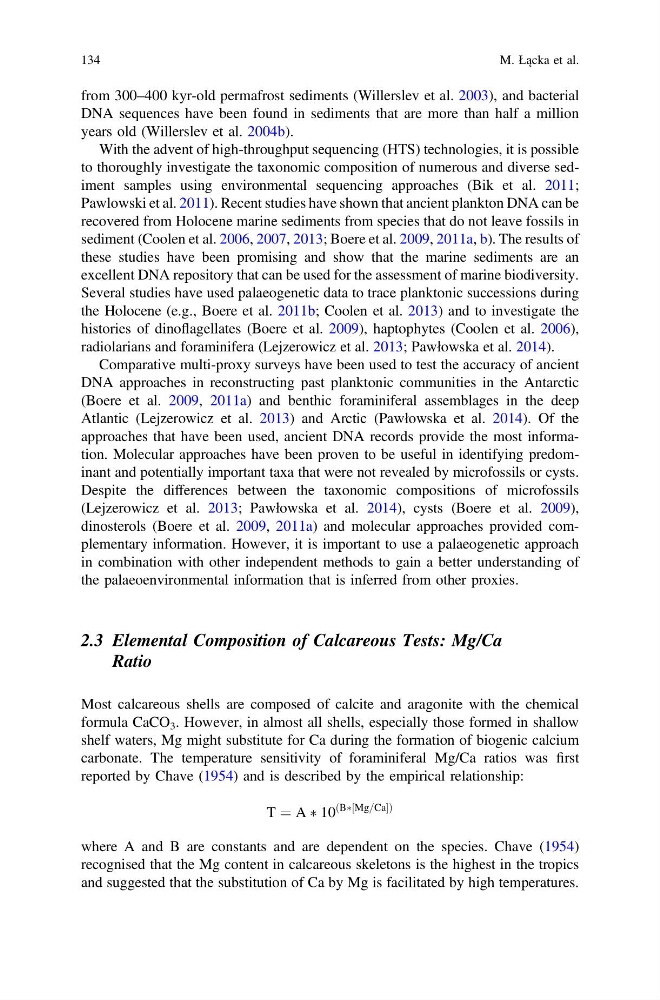
reported by Chave (1954) and is described by the empirical relationship:
T ¼ A Ã 10
ðBýMg=CaÞ
where A and B are constants and are dependent on the species. Chave (1954)
recognised that the Mg content in calcareous skeletons is the highest in the tropics
and suggested that the substitution of Ca by Mg is facilitated by high temperatures.
134
M. Łącka et al.
DNA sequences have been found in sediments that are more than half a million
years old (Willerslev et al. 2004b).
With the advent of high-throughput sequencing (HTS) technologies, it is possible
to thoroughly investigate the taxonomic composition of numerous and diverse sediment samples using environmental sequencing approaches (Bik et al. 2011;
Pawlowski et al. 2011). Recent studies have shown that ancient plankton DNA can be
recovered from Holocene marine sediments from species that do not leave fossils in
sediment (Coolen et al. 2006, 2007, 2013; Boere et al. 2009, 2011a, b). The results of
these studies have been promising and show that the marine sediments are an
excellent DNA repository that can be used for the assessment of marine biodiversity.
Several studies have used palaeogenetic data to trace planktonic successions during
the Holocene (e.g., Boere et al. 2011b; Coolen et al. 2013) and to investigate the
histories of dinoflagellates (Boere et al. 2009), haptophytes (Coolen et al. 2006),
radiolarians and foraminifera (Lejzerowicz et al. 2013; Pawłowska et al. 2014).
Comparative multi-proxy surveys have been used to test the accuracy of ancient
DNA approaches in reconstructing past planktonic communities in the Antarctic
(Boere et al. 2009, 2011a) and benthic foraminiferal assemblages in the deep
Atlantic (Lejzerowicz et al. 2013) and Arctic (Pawłowska et al. 2014). Of the
approaches that have been used, ancient DNA records provide the most information. Molecular approaches have been proven to be useful in identifying predominant and potentially important taxa that were not revealed by microfossils or cysts.
Despite the differences between the taxonomic compositions of microfossils
(Lejzerowicz et al. 2013; Pawłowska et al. 2014), cysts (Boere et al. 2009),
dinosterols (Boere et al. 2009, 2011a) and molecular approaches provided complementary information. However, it is important to use a palaeogenetic approach
in combination with other independent methods to gain a better understanding of
the palaeoenvironmental information that is inferred from other proxies.
2.3 Elemental Composition of Calcareous Tests: Mg/Ca
Ratio
Most calcareous shells are composed of calcite and aragonite with the chemical
formula CaCO 3 . However, in almost all shells, especially those formed in shallow
shelf waters, Mg might substitute for Ca during the formation of biogenic calcium
carbonate. The temperature sensitivity of foraminiferal Mg/Ca ratios was first
reported by Chave (1954) and is described by the empirical relationship:
T ¼ A Ã 10
ðBýMg=CaÞ
where A and B are constants and are dependent on the species. Chave (1954)
recognised that the Mg content in calcareous skeletons is the highest in the tropics
and suggested that the substitution of Ca by Mg is facilitated by high temperatures.
134
M. Łącka et al.