

and SST remains largely linear. However, in the polar oceans, the changes in TEX 86
with temperature were relatively minor (Kim et al. 2008, 2010). Kim et al. (2010)
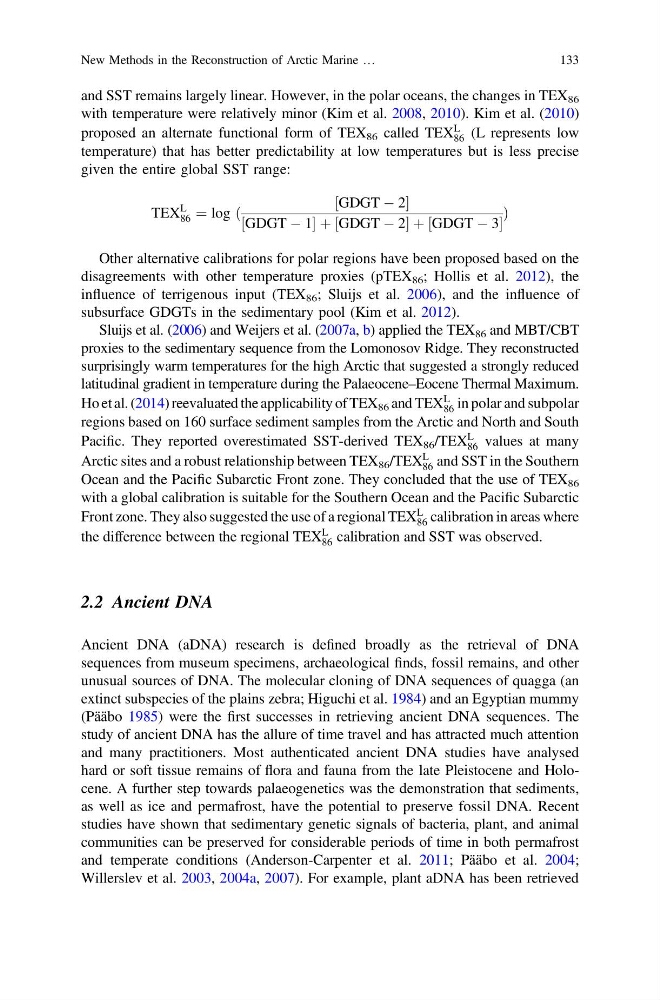
proposed an alternate functional form of TEX 86 called TEX
L
86 (L represents low
temperature) that has better predictability at low temperatures but is less precise
given the entire global SST range:
TEX
L
86 ¼ log ð
GDGT À 2
½
GDGT À 1
½
þGDGT À 2
½
þGDGT À 3
½
Þ
Other alternative calibrations for polar regions have been proposed based on the
disagreements with other temperature proxies (pTEX 86 ; Hollis et al. 2012), the
influence of terrigenous input (TEX 86 ; Sluijs et al. 2006), and the influence of
subsurface GDGTs in the sedimentary pool (Kim et al. 2012).
Sluijs et al. (2006) and Weijers et al. (2007a, b) applied the TEX 86 and MBT/CBT
proxies to the sedimentary sequence from the Lomonosov Ridge. They reconstructed
surprisingly warm temperatures for the high Arctic that suggested a strongly reduced
latitudinal gradient in temperature during the Palaeocene–Eocene Thermal Maximum.
Ho et al. (2014) reevaluated the applicability of TEX 86 and TEX
L
86 in polar and subpolar
regions based on 160 surface sediment samples from the Arctic and North and South
Pacific. They reported overestimated SST-derived TEX 86 /TEX
L
86 values at many
Arctic sites and a robust relationship between TEX 86 /TEX
L
86 and SST in the Southern
Ocean and the Pacific Subarctic Front zone. They concluded that the use of TEX 86
with a global calibration is suitable for the Southern Ocean and the Pacific Subarctic
Front zone. They also suggested the use of a regional TEX
L
86 calibration in areas where
the difference between the regional TEX
L
86 calibration and SST was observed.
2.2 Ancient DNA
Ancient DNA (aDNA) research is defined broadly as the retrieval of DNA
sequences from museum specimens, archaeological finds, fossil remains, and other
unusual sources of DNA. The molecular cloning of DNA sequences of quagga (an
extinct subspecies of the plains zebra; Higuchi et al. 1984) and an Egyptian mummy
(Pääbo 1985) were the first successes in retrieving ancient DNA sequences. The
study of ancient DNA has the allure of time travel and has attracted much attention
and many practitioners. Most authenticated ancient DNA studies have analysed
hard or soft tissue remains of flora and fauna from the late Pleistocene and Holocene. A further step towards palaeogenetics was the demonstration that sediments,
as well as ice and permafrost, have the potential to preserve fossil DNA. Recent
studies have shown that sedimentary genetic signals of bacteria, plant, and animal
communities can be preserved for considerable periods of time in both permafrost
and temperate conditions (Anderson-Carpenter et al. 2011; Pääbo et al. 2004;
Willerslev et al. 2003, 2004a, 2007). For example, plant aDNA has been retrieved
New Methods in the Reconstruction of Arctic Marine …
133
with temperature were relatively minor (Kim et al. 2008, 2010). Kim et al. (2010)
proposed an alternate functional form of TEX 86 called TEX
L
86 (L represents low
temperature) that has better predictability at low temperatures but is less precise
given the entire global SST range:
TEX
L
86 ¼ log ð
GDGT À 2
½
GDGT À 1
½
þGDGT À 2
½
þGDGT À 3
½
Þ
Other alternative calibrations for polar regions have been proposed based on the
disagreements with other temperature proxies (pTEX 86 ; Hollis et al. 2012), the
influence of terrigenous input (TEX 86 ; Sluijs et al. 2006), and the influence of
subsurface GDGTs in the sedimentary pool (Kim et al. 2012).
Sluijs et al. (2006) and Weijers et al. (2007a, b) applied the TEX 86 and MBT/CBT
proxies to the sedimentary sequence from the Lomonosov Ridge. They reconstructed
surprisingly warm temperatures for the high Arctic that suggested a strongly reduced
latitudinal gradient in temperature during the Palaeocene–Eocene Thermal Maximum.
Ho et al. (2014) reevaluated the applicability of TEX 86 and TEX
L
86 in polar and subpolar
regions based on 160 surface sediment samples from the Arctic and North and South
Pacific. They reported overestimated SST-derived TEX 86 /TEX
L
86 values at many
Arctic sites and a robust relationship between TEX 86 /TEX
L
86 and SST in the Southern
Ocean and the Pacific Subarctic Front zone. They concluded that the use of TEX 86
with a global calibration is suitable for the Southern Ocean and the Pacific Subarctic
Front zone. They also suggested the use of a regional TEX
L
86 calibration in areas where
the difference between the regional TEX
L
86 calibration and SST was observed.
2.2 Ancient DNA
Ancient DNA (aDNA) research is defined broadly as the retrieval of DNA
sequences from museum specimens, archaeological finds, fossil remains, and other
unusual sources of DNA. The molecular cloning of DNA sequences of quagga (an
extinct subspecies of the plains zebra; Higuchi et al. 1984) and an Egyptian mummy
(Pääbo 1985) were the first successes in retrieving ancient DNA sequences. The
study of ancient DNA has the allure of time travel and has attracted much attention
and many practitioners. Most authenticated ancient DNA studies have analysed
hard or soft tissue remains of flora and fauna from the late Pleistocene and Holocene. A further step towards palaeogenetics was the demonstration that sediments,
as well as ice and permafrost, have the potential to preserve fossil DNA. Recent
studies have shown that sedimentary genetic signals of bacteria, plant, and animal
communities can be preserved for considerable periods of time in both permafrost
and temperate conditions (Anderson-Carpenter et al. 2011; Pääbo et al. 2004;
Willerslev et al. 2003, 2004a, 2007). For example, plant aDNA has been retrieved
New Methods in the Reconstruction of Arctic Marine …
133