

isoprenoidal GDGTs (isoGDGTs) and non-isoprenoidal branched GDGTs
(brGDGTs). Isoprenoidal GDGTs are characteristic lipids of archaea and are mainly
from the phylum Thaumarchaeota (formerly a division of Crenarchaeota; BrochierArmanet et al. 2008; Spang et al. 2010). Thaumarchaeota and their GDGTs are
commonly found in oceans, lakes and soils (Karner et al. 2001; Ochsenreiter et al.
2003; Leininger et al. 2006; Llirós et al. 2010; Schouten et al. 2012). Thaumarchaeota
are the only archaea known to make the distinctive GDGT crenarchaeol, which is a
diagnostic biomarker for these species (Sinninghe-Damste et al. 2002; Pearson et al.
2004; de la Torre et al. 2008). Branched GDGTs (brGDGTs) are diagnostic of
bacteria (Weijers et al. 2006) and are commonly found in soils, peats, lakes, and
marginal/deltaic environments but are not present in pelagic marine environments
(Hopmans et al. 2004). The producers of most brGDGTs have not been identified;
thus, the physiological relationships between the structure and abundance of
brGDGTs to environmental factors are not understood. Weijers et al. (2007a, b) found
that soil temperature and soil pH was statistically related to the brGDGT distribution.
They proposed indices related to the degree of cyclisation and methylation of
brGDGTs are called CBT (Cyclisation of Branched Tetraethers) and MBT (Methylation of Branched Tethraethers), respectively.
IsoGDGTs are characterised by the presence of cyclopentane moieties. In
response to increasing temperature, the number of cyclopentane moieties of GDGT
membrane lipids also increases (De Rosa et al. 1980; Uda et al. 2001; Wuchter et al.
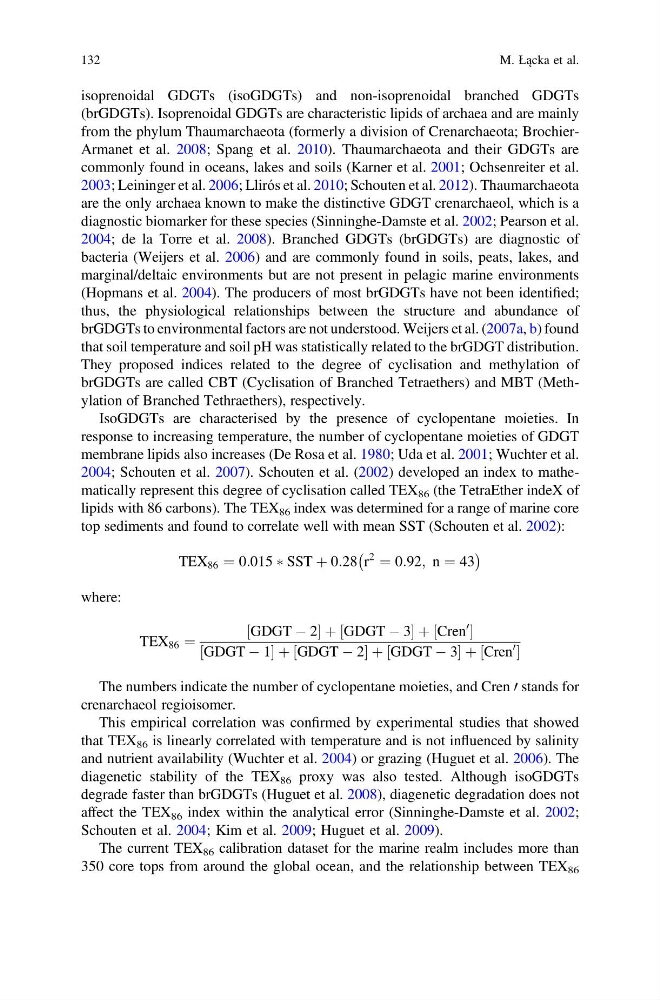
2004; Schouten et al. 2007). Schouten et al. (2002) developed an index to mathematically represent this degree of cyclisation called TEX 86 (the TetraEther indeX of
lipids with 86 carbons). The TEX 86 index was determined for a range of marine core
top sediments and found to correlate well with mean SST (Schouten et al. 2002):
TEX 86 ¼ 0:015 Ã SST þ 0:28 r
2
¼ 0:92; n ¼ 43
À
Á
where:
TEX 86 ¼
GDGT À 2
½
þGDGT À 3
½
þ½ Cren
0
GDGT À 1
½
þGDGT À 2
½
þGDGT À 3
½
þ½ Cren
0
The numbers indicate the number of cyclopentane moieties, and Cren 0 stands for
crenarchaeol regioisomer.
This empirical correlation was confirmed by experimental studies that showed
that TEX 86 is linearly correlated with temperature and is not influenced by salinity
and nutrient availability (Wuchter et al. 2004) or grazing (Huguet et al. 2006). The
diagenetic stability of the TEX 86 proxy was also tested. Although isoGDGTs
degrade faster than brGDGTs (Huguet et al. 2008), diagenetic degradation does not
affect the TEX 86 index within the analytical error (Sinninghe-Damste et al. 2002;
Schouten et al. 2004; Kim et al. 2009; Huguet et al. 2009).
The current TEX 86 calibration dataset for the marine realm includes more than
350 core tops from around the global ocean, and the relationship between TEX 86
132
M. Łącka et al.
(brGDGTs). Isoprenoidal GDGTs are characteristic lipids of archaea and are mainly
from the phylum Thaumarchaeota (formerly a division of Crenarchaeota; BrochierArmanet et al. 2008; Spang et al. 2010). Thaumarchaeota and their GDGTs are
commonly found in oceans, lakes and soils (Karner et al. 2001; Ochsenreiter et al.
2003; Leininger et al. 2006; Llirós et al. 2010; Schouten et al. 2012). Thaumarchaeota
are the only archaea known to make the distinctive GDGT crenarchaeol, which is a
diagnostic biomarker for these species (Sinninghe-Damste et al. 2002; Pearson et al.
2004; de la Torre et al. 2008). Branched GDGTs (brGDGTs) are diagnostic of
bacteria (Weijers et al. 2006) and are commonly found in soils, peats, lakes, and
marginal/deltaic environments but are not present in pelagic marine environments
(Hopmans et al. 2004). The producers of most brGDGTs have not been identified;
thus, the physiological relationships between the structure and abundance of
brGDGTs to environmental factors are not understood. Weijers et al. (2007a, b) found
that soil temperature and soil pH was statistically related to the brGDGT distribution.
They proposed indices related to the degree of cyclisation and methylation of
brGDGTs are called CBT (Cyclisation of Branched Tetraethers) and MBT (Methylation of Branched Tethraethers), respectively.
IsoGDGTs are characterised by the presence of cyclopentane moieties. In
response to increasing temperature, the number of cyclopentane moieties of GDGT
membrane lipids also increases (De Rosa et al. 1980; Uda et al. 2001; Wuchter et al.
2004; Schouten et al. 2007). Schouten et al. (2002) developed an index to mathematically represent this degree of cyclisation called TEX 86 (the TetraEther indeX of
lipids with 86 carbons). The TEX 86 index was determined for a range of marine core
top sediments and found to correlate well with mean SST (Schouten et al. 2002):
TEX 86 ¼ 0:015 Ã SST þ 0:28 r
2
¼ 0:92; n ¼ 43
À
Á
where:
TEX 86 ¼
GDGT À 2
½
þGDGT À 3
½
þ½ Cren
0
GDGT À 1
½
þGDGT À 2
½
þGDGT À 3
½
þ½ Cren
0
The numbers indicate the number of cyclopentane moieties, and Cren 0 stands for
crenarchaeol regioisomer.
This empirical correlation was confirmed by experimental studies that showed
that TEX 86 is linearly correlated with temperature and is not influenced by salinity
and nutrient availability (Wuchter et al. 2004) or grazing (Huguet et al. 2006). The
diagenetic stability of the TEX 86 proxy was also tested. Although isoGDGTs
degrade faster than brGDGTs (Huguet et al. 2008), diagenetic degradation does not
affect the TEX 86 index within the analytical error (Sinninghe-Damste et al. 2002;
Schouten et al. 2004; Kim et al. 2009; Huguet et al. 2009).
The current TEX 86 calibration dataset for the marine realm includes more than
350 core tops from around the global ocean, and the relationship between TEX 86
132
M. Łącka et al.