

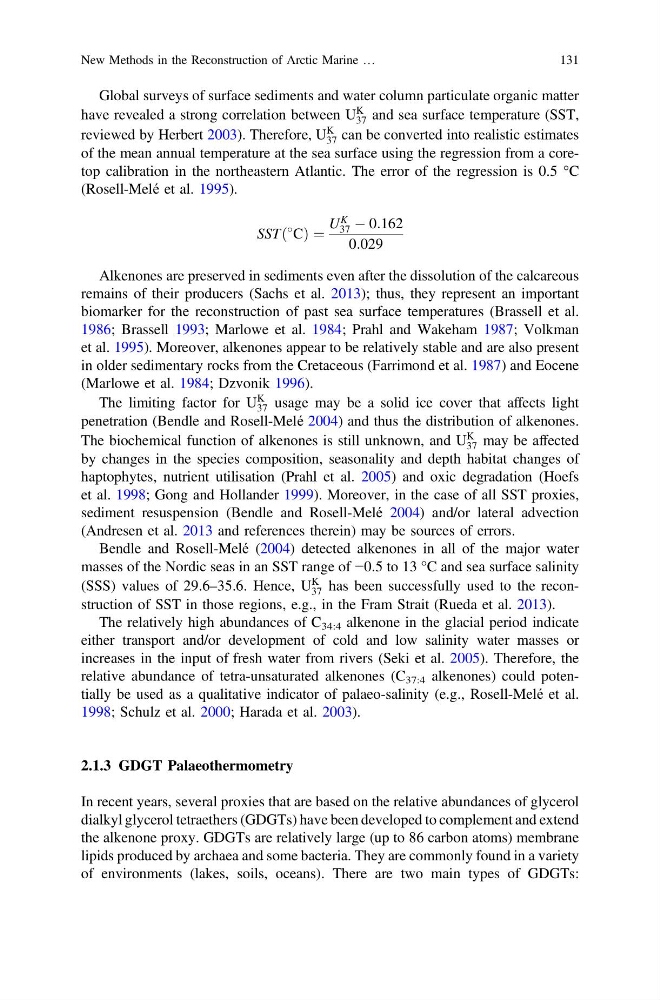
Global surveys of surface sediments and water column particulate organic matter
have revealed a strong correlation between U
K
37 and sea surface temperature (SST,
reviewed by Herbert 2003). Therefore, U
K
37 can be converted into realistic estimates
of the mean annual temperature at the sea surface using the regression from a coretop calibration in the northeastern Atlantic. The error of the regression is 0.5 °C
(Rosell-Melé et al. 1995).
SST
C
ð Þ ¼
U
K
37 À 0:162
0:029
Alkenones are preserved in sediments even after the dissolution of the calcareous
remains of their producers (Sachs et al. 2013); thus, they represent an important
biomarker for the reconstruction of past sea surface temperatures (Brassell et al.
1986; Brassell 1993; Marlowe et al. 1984; Prahl and Wakeham 1987; Volkman
et al. 1995). Moreover, alkenones appear to be relatively stable and are also present
in older sedimentary rocks from the Cretaceous (Farrimond et al. 1987) and Eocene
(Marlowe et al. 1984; Dzvonik 1996).
The limiting factor for U
K
37 usage may be a solid ice cover that affects light
penetration (Bendle and Rosell-Melé 2004) and thus the distribution of alkenones.
The biochemical function of alkenones is still unknown, and U
K
37 may be affected
by changes in the species composition, seasonality and depth habitat changes of
haptophytes, nutrient utilisation (Prahl et al. 2005) and oxic degradation (Hoefs
et al. 1998; Gong and Hollander 1999). Moreover, in the case of all SST proxies,
sediment resuspension (Bendle and Rosell-Melé 2004) and/or lateral advection
(Andresen et al. 2013 and references therein) may be sources of errors.
Bendle and Rosell-Melé (2004) detected alkenones in all of the major water
masses of the Nordic seas in an SST range of −0.5 to 13 °C and sea surface salinity
(SSS) values of 29.6–35.6. Hence, U
K
37 has been successfully used to the reconstruction of SST in those regions, e.g., in the Fram Strait (Rueda et al. 2013).
The relatively high abundances of C 34:4 alkenone in the glacial period indicate
either transport and/or development of cold and low salinity water masses or
increases in the input of fresh water from rivers (Seki et al. 2005). Therefore, the
relative abundance of tetra-unsaturated alkenones (C 37:4 alkenones) could potentially be used as a qualitative indicator of palaeo-salinity (e.g., Rosell-Melé et al.
1998; Schulz et al. 2000; Harada et al. 2003).
2.1.3 GDGT Palaeothermometry
In recent years, several proxies that are based on the relative abundances of glycerol
dialkyl glycerol tetraethers (GDGTs) have been developed to complement and extend
the alkenone proxy. GDGTs are relatively large (up to 86 carbon atoms) membrane
lipids produced by archaea and some bacteria. They are commonly found in a variety
of environments (lakes, soils, oceans). There are two main types of GDGTs:
New Methods in the Reconstruction of Arctic Marine …
131
have revealed a strong correlation between U
K
37 and sea surface temperature (SST,
reviewed by Herbert 2003). Therefore, U
K
37 can be converted into realistic estimates
of the mean annual temperature at the sea surface using the regression from a coretop calibration in the northeastern Atlantic. The error of the regression is 0.5 °C
(Rosell-Melé et al. 1995).
SST
C
ð Þ ¼
U
K
37 À 0:162
0:029
Alkenones are preserved in sediments even after the dissolution of the calcareous
remains of their producers (Sachs et al. 2013); thus, they represent an important
biomarker for the reconstruction of past sea surface temperatures (Brassell et al.
1986; Brassell 1993; Marlowe et al. 1984; Prahl and Wakeham 1987; Volkman
et al. 1995). Moreover, alkenones appear to be relatively stable and are also present
in older sedimentary rocks from the Cretaceous (Farrimond et al. 1987) and Eocene
(Marlowe et al. 1984; Dzvonik 1996).
The limiting factor for U
K
37 usage may be a solid ice cover that affects light
penetration (Bendle and Rosell-Melé 2004) and thus the distribution of alkenones.
The biochemical function of alkenones is still unknown, and U
K
37 may be affected
by changes in the species composition, seasonality and depth habitat changes of
haptophytes, nutrient utilisation (Prahl et al. 2005) and oxic degradation (Hoefs
et al. 1998; Gong and Hollander 1999). Moreover, in the case of all SST proxies,
sediment resuspension (Bendle and Rosell-Melé 2004) and/or lateral advection
(Andresen et al. 2013 and references therein) may be sources of errors.
Bendle and Rosell-Melé (2004) detected alkenones in all of the major water
masses of the Nordic seas in an SST range of −0.5 to 13 °C and sea surface salinity
(SSS) values of 29.6–35.6. Hence, U
K
37 has been successfully used to the reconstruction of SST in those regions, e.g., in the Fram Strait (Rueda et al. 2013).
The relatively high abundances of C 34:4 alkenone in the glacial period indicate
either transport and/or development of cold and low salinity water masses or
increases in the input of fresh water from rivers (Seki et al. 2005). Therefore, the
relative abundance of tetra-unsaturated alkenones (C 37:4 alkenones) could potentially be used as a qualitative indicator of palaeo-salinity (e.g., Rosell-Melé et al.
1998; Schulz et al. 2000; Harada et al. 2003).
2.1.3 GDGT Palaeothermometry
In recent years, several proxies that are based on the relative abundances of glycerol
dialkyl glycerol tetraethers (GDGTs) have been developed to complement and extend
the alkenone proxy. GDGTs are relatively large (up to 86 carbon atoms) membrane
lipids produced by archaea and some bacteria. They are commonly found in a variety
of environments (lakes, soils, oceans). There are two main types of GDGTs:
New Methods in the Reconstruction of Arctic Marine …
131