

238
Ghapter 13: Spatial Patterns: EOFs and GGA
Sometimes the first EOF of,the first few EOFs represent a meaningful physical
summary of relevant processes, which go with characteristic patterns. For
further discussion see Section 13.3.2
Favorable aspects of the EOFs are the geometrical orthogonality of the patterns and the statistical independence, or, more correctly, the zero-correlation
of the "EOF coefficients" (Xi:
(13.22)
A byproduct of the calculation (13.22) is VAR((Xk) = Ak.
EOFs are parameters of the random vector X. If X is a Gaussian distributed random vector then the set of coefficients (Xk form a set of univariate normally distributed independent random variables (with zero means and
standard deviations given by the square root of the respective eigenvalues, if
the mean of X is zero.)
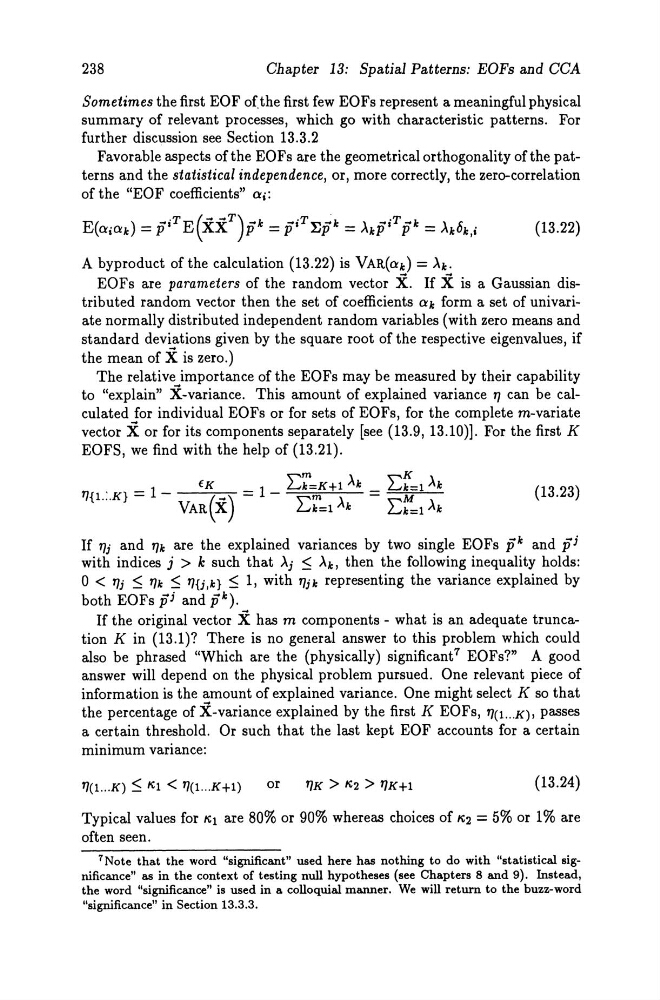
The relative importance of the EOFs may be measured by their capability
to "explain" X-variance. This amount of explained variance 1} can be calculated for individual EOFs or for sets of EOFs, for the complete m-variate
vector X or for its components separately [see (13.9, 13.10)]. For the first K
EOFS, we find with the help of (13.21).
,
_ 1 _
€K
_ 1 _ L:~=K+1 Ak _ L:~-1 Ak
1}{LK} -
( ~) -
""m A - ""M
VAR X
L.."k=l k
L.."k=l Ak
(13.23)
If T/j and 1}k are the explained variances by two single EOFs pk and pi
with indices j > k such that Aj ~ Ak, then the following inequality holds:
o < 1}j ~ 1}k ~ 1}{j ,k} ~ 1, with 1}j Ir. representing the variance explained by
both EOFs pi and pk).
If the original vector X has m components - what is an adequate truncation K in (13.1)? There is no general answer to this problem which could
also be phrased "Which are the (physically) significant 7 EOFs?" A good
answer will depend on the physical problem pursued. One relevant piece of
information is the amount of explained variance. One might select K so that
the percentage of X-variance explained by the first K EOFs, 1}(LK), passes
a certain threshold. Or such that the last kept EOF ac counts for a certain
minimum variance:
T/(LK) ~ 11:1 < 1}(LK+1) or
(13.24)
Typical values for 11:1 are 80% or 90% whereas choices of 11:2 = 5% or 1% are
often seen.
7Note that the word "significant" used here has nothing to do with "statistical significance" as in the context of testing null hypotheses (see Chapters 8 and 9). Instead,
the word "significance" is used in a colloquial manner. We will return to the buzz-word
"significance" in Section 13.3.3.
Ghapter 13: Spatial Patterns: EOFs and GGA
Sometimes the first EOF of,the first few EOFs represent a meaningful physical
summary of relevant processes, which go with characteristic patterns. For
further discussion see Section 13.3.2
Favorable aspects of the EOFs are the geometrical orthogonality of the patterns and the statistical independence, or, more correctly, the zero-correlation
of the "EOF coefficients" (Xi:
(13.22)
A byproduct of the calculation (13.22) is VAR((Xk) = Ak.
EOFs are parameters of the random vector X. If X is a Gaussian distributed random vector then the set of coefficients (Xk form a set of univariate normally distributed independent random variables (with zero means and
standard deviations given by the square root of the respective eigenvalues, if
the mean of X is zero.)
The relative importance of the EOFs may be measured by their capability
to "explain" X-variance. This amount of explained variance 1} can be calculated for individual EOFs or for sets of EOFs, for the complete m-variate
vector X or for its components separately [see (13.9, 13.10)]. For the first K
EOFS, we find with the help of (13.21).
,
_ 1 _
€K
_ 1 _ L:~=K+1 Ak _ L:~-1 Ak
1}{LK} -
( ~) -
""m A - ""M
VAR X
L.."k=l k
L.."k=l Ak
(13.23)
If T/j and 1}k are the explained variances by two single EOFs pk and pi
with indices j > k such that Aj ~ Ak, then the following inequality holds:
o < 1}j ~ 1}k ~ 1}{j ,k} ~ 1, with 1}j Ir. representing the variance explained by
both EOFs pi and pk).
If the original vector X has m components - what is an adequate truncation K in (13.1)? There is no general answer to this problem which could
also be phrased "Which are the (physically) significant 7 EOFs?" A good
answer will depend on the physical problem pursued. One relevant piece of
information is the amount of explained variance. One might select K so that
the percentage of X-variance explained by the first K EOFs, 1}(LK), passes
a certain threshold. Or such that the last kept EOF ac counts for a certain
minimum variance:
T/(LK) ~ 11:1 < 1}(LK+1) or
(13.24)
Typical values for 11:1 are 80% or 90% whereas choices of 11:2 = 5% or 1% are
often seen.
7Note that the word "significant" used here has nothing to do with "statistical significance" as in the context of testing null hypotheses (see Chapters 8 and 9). Instead,
the word "significance" is used in a colloquial manner. We will return to the buzz-word
"significance" in Section 13.3.3.