

Section 13.2: Expansion into a Few Guess Patterns
229
subspace, and the vector nt represents the "noise subspace" . When dealing
with the expressions "signal" and "noise" one has to keep in mind that "noise
subspace" is implicitly defined as that space which does not contain the
"signal". Also, since the noise prevails everywhere in the phase space, a
complete separation between "signal" and "noise" is impossible. Indeed, the
"signal subspace" contains an often considerable amount of noise.
The truncated vector of state X: = E~=l a,,(t)p" is the projection of the
fuH vector of state on the signal subspace. The residual vector nt = Xt - X:
represents the contribution from the noise subspace.
The vector X is conveniently interpreted as a random vector with expectation E(X) = ji, covariance matrix ~ = E((X - ji)(X - ji)T) and the
variance VAR(X) = Ei E((Xi - lli)2). Then, the expansion coefficients ak
are univariate random variables whereas the patterns are constant vectors.
In the case of EOFs, CCA and similar techniques the patterns are derived
from X so that they represent parameters of the random vector X.
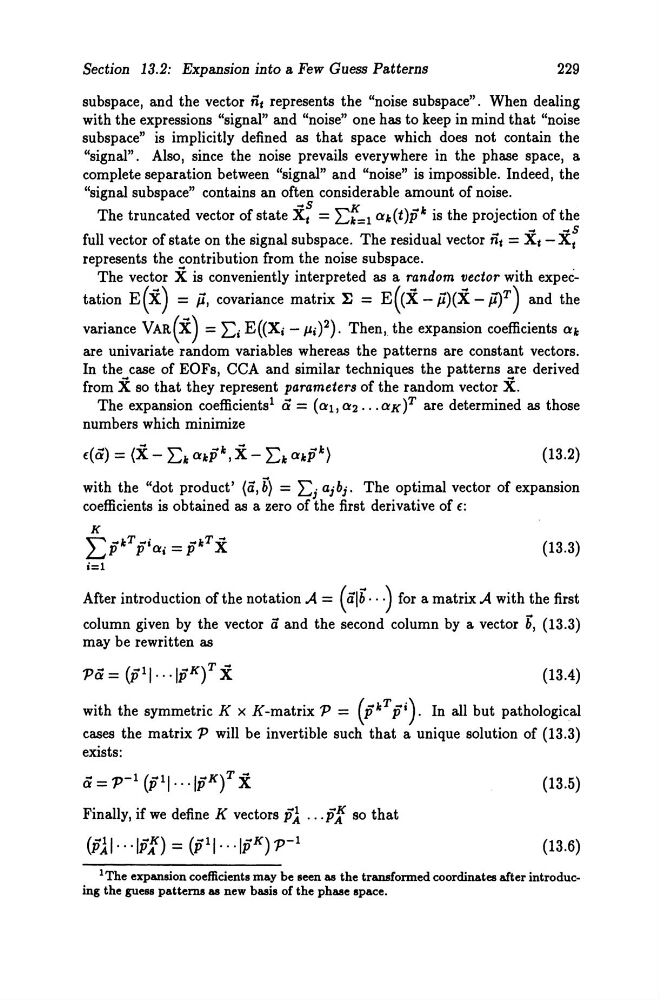
The expansion coefficients l a. = (al, a2 ... aK)T are determined as those
numbers which minimize
(13.2)
with the "dot product' (a, b) = E j ajbj. The optimal vector of expansion
coefficients is obtained as a zero of the first derivative of !:
K
'"' ~kT ~i
~kTX~
L.Jp P ai = P
(13.3)
i=l
After introduction of the notation A = (alb .. -) for a matrix A with the first
column given by the vector a and the second column by a vector b, (13.3)
may be rewritten as
'"~
(~ll
I~K)TX~
ra= p ... p
(13.4)
with the symmetrie K x K-matrix P = (pk T pi). In aH but pathological
cases the matrix P will be invertible such that a unique solution of (13.3)
exists:
~_,"-l(~ll
I~K)TX~
a - r
p ... p
FinaHy, if we define K vectors pi ... pf so that
(13.5)
(13.6)
IThe expansion coefficients may be seen as the transfonned coordinates after introducing the guess patterns as new basis of the phase space.
229
subspace, and the vector nt represents the "noise subspace" . When dealing
with the expressions "signal" and "noise" one has to keep in mind that "noise
subspace" is implicitly defined as that space which does not contain the
"signal". Also, since the noise prevails everywhere in the phase space, a
complete separation between "signal" and "noise" is impossible. Indeed, the
"signal subspace" contains an often considerable amount of noise.
The truncated vector of state X: = E~=l a,,(t)p" is the projection of the
fuH vector of state on the signal subspace. The residual vector nt = Xt - X:
represents the contribution from the noise subspace.
The vector X is conveniently interpreted as a random vector with expectation E(X) = ji, covariance matrix ~ = E((X - ji)(X - ji)T) and the
variance VAR(X) = Ei E((Xi - lli)2). Then, the expansion coefficients ak
are univariate random variables whereas the patterns are constant vectors.
In the case of EOFs, CCA and similar techniques the patterns are derived
from X so that they represent parameters of the random vector X.
The expansion coefficients l a. = (al, a2 ... aK)T are determined as those
numbers which minimize
(13.2)
with the "dot product' (a, b) = E j ajbj. The optimal vector of expansion
coefficients is obtained as a zero of the first derivative of !:
K
'"' ~kT ~i
~kTX~
L.Jp P ai = P
(13.3)
i=l
After introduction of the notation A = (alb .. -) for a matrix A with the first
column given by the vector a and the second column by a vector b, (13.3)
may be rewritten as
'"~
(~ll
I~K)TX~
ra= p ... p
(13.4)
with the symmetrie K x K-matrix P = (pk T pi). In aH but pathological
cases the matrix P will be invertible such that a unique solution of (13.3)
exists:
~_,"-l(~ll
I~K)TX~
a - r
p ... p
FinaHy, if we define K vectors pi ... pf so that
(13.5)
(13.6)
IThe expansion coefficients may be seen as the transfonned coordinates after introducing the guess patterns as new basis of the phase space.