

578
J. Noll
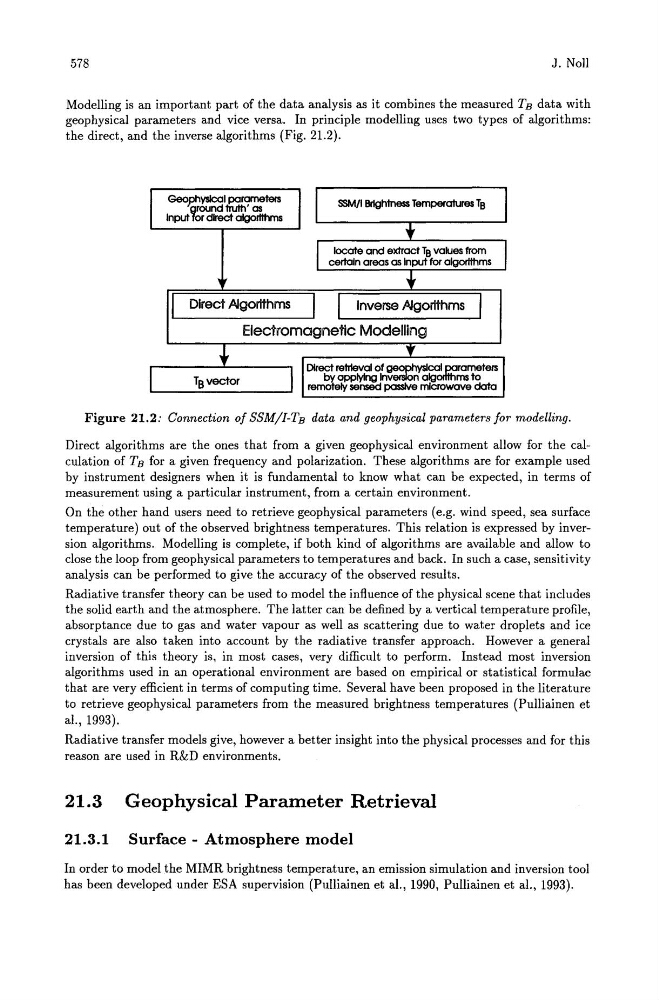
Modelling is an important part of the data analysis as it combines the measured TB data with
geophysical parameters and vice versa. In principle modelling uses two types of algorithms:
the direct, and the inverse algorithms (Fig. 21.2).
I GeoJ'hyslcal parametelS
II
SSM/I Br1ghtness Temperatures T8
I
~OUnd fruth' as
Input r direct algorithms
. .
I
locate and extract T8 values from
I
certain areas as Input for algorithms
...
Direct Algorithms
Inverse Algorithms
Electromagnetic Modelling
I
I I
DIrect retrieval of aeophyslcal parametelS I
li
t
by applying InvelSlon algorithms to
' -_ _ --=:;.B_v_ec_o_r _ _ _ --' remotely sensed passive microwave data
Figure 21.2: Connection of SSM/I-TB data and geophysical parameters for modelling.
Direct algorithms are the ones that from a given geophysical environment allow for the calculation of TB for a given frequency and polarization. These algorithms are for example used
by instrument designers when it is fundamental to know what can be expected, in terms of
measurement using a particular instrument, from a certain environment.
On the other hand users need to retrieve geophysical parameters (e.g. wind speed, sea surface
temperature) out of the observed brightness temperatures. This relation is expressed by inversion algorithms. Modelling is complete, if both kind of algorithms are available and allow to
close the loop from geophysical parameters to temperatures and back. In such a case, sensitivity
analysis can be performed to give the accuracy of the observed results.
Radiative transfer theory can be used to model the influence of the physical scene that includes
the solid earth and the atmosphere. The latter can be defined by a vertical temperature profile,
absorptance due to gas and water vapour as well as scattering due to water droplets and ice
crystals are also taken into account by the radiative transfer approach. However a general
inversion of this theory is, in most cases, very difficult to perform. Instead most inversion
algorithms used in an operational environment are based on empirical or statistical formulae
that are very efficient in terms of computing time. Several have been proposed in the literature
to retrieve geophysical parameters from the measured brightness temperatures (Pulliainen et
aI., 1993).
Radiative transfer models give, however a better insight into the physical processes and for this
reason are used in R&D environments.
21.3 Geophysical Parameter Retrieval
21.3.1 Surface - Atmosphere model
In order to model the MIMR brightness temperature, an emission simulation and inversion tool
has been developed under ESA supervision (Pulliainen et aI., 1990, Pulliainen et aI., 1993).