

Model Development for Passive Microwave Remote Sensing ...
577
Land and Snow
The land applications of MIMR fall into four classes, i.e. soil moisture monitoring using the lower
frequencies (6.8 and 10.65 GHz), large scale vegetation monitoring with polarization difference
and multi-frequency techniques, land surface temperature monitoring (18 GHz H&V), snow
extent monitoring using both spectral and polarisation information and flood monitoring. The
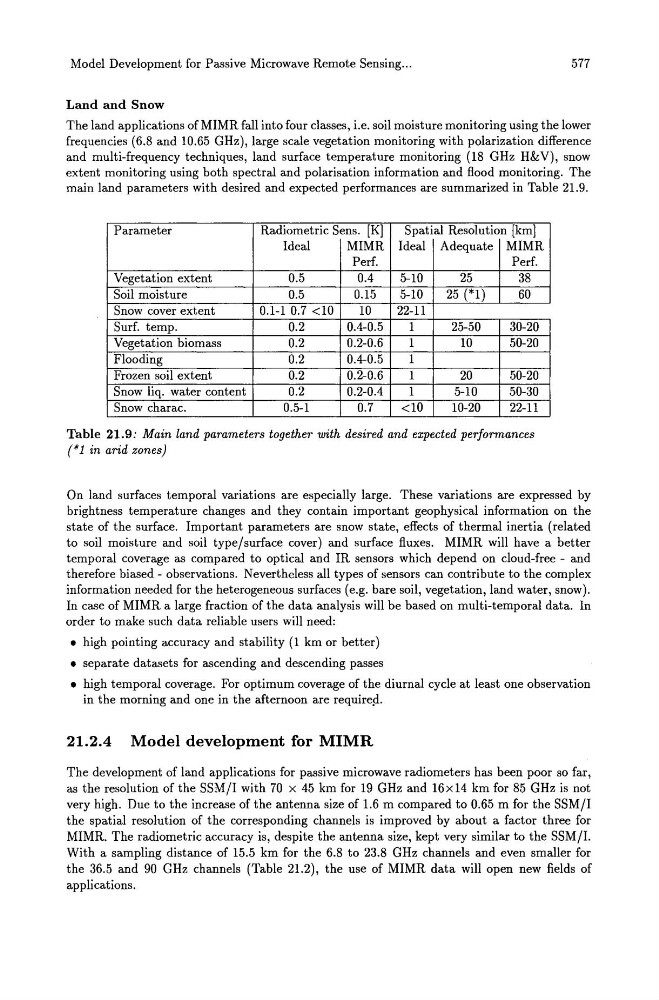
main land parameters with desired and expected performances are summarized in Table 21.9.
Parameter
Radiometric Sens. [K]
Spatial Resolution [km]
Ideal
MIMR Ideal Adequate MIMR
Perf.
Perf.
Vegetation extent
0.5
0.4
5-10
25
38
Soil moisture
0.5
0.15
5-10
25 (*1)
60
Snow cover extent
0.1-1 0.7 <10
10
22-11
Surf. temp.
0.2
0.4-0.5
1
25-50
30-20
Vegetation biomass
0.2
0.2-0.6
1
10
50-20
Flooding
0.2
0.4-0.5
1
Frozen soil extent
0.2
0.2-0.6
1
20
50-20
Snow liq. water content
0.2
0.2-0.4
1
5-10
50-30
Snow charac.
0.5-1
0.7
<10
10-20
22-11
Table 21.9: Main land parameters together with desired and expected performances
(*1 in arid zones)
On land surfaces temporal variations are especially large. These variations are expressed by
brightness temperature changes and they contain important geophysical information on the
state of the surface. Important parameters are snow state, effects of thermal inertia (related
to soil moisture and soil type/surface cover) and surface fluxes. MIMR will have a better
temporal coverage as compared to optical and IR sensors which depend on cloud-free - and
therefore biased - observations. Nevertheless all types of sensors can contribute to the complex
information needed for the heterogeneous surfaces (e.g. bare soil, vegetation, land water, snow).
In case of MIMR a large fraction of the data analysis will be based on multi-temporal data. In
order to make such data reliable users will need:
• high pointing accuracy and stability (1 km or better)
• separate datasets for ascending and descending passes
• high temporal coverage. For optimum coverage of the diurnal cycle at least one observation
in the morning and one in the afternoon are require$l.
21.2.4 Model development for MIMR
The development of land applications for passive microwave radiometers has been poor so far,
as the resolution of the SSM/I with 70 x 45 km for 19 GHz and 16x14 km for 85 GHz is not
very high. Due to the increase of the antenna size of 1.6 m compared to 0.65 m for the SSM/I
the spatial resolution of the corresponding channels is improved by about a factor three for
MIMR. The radiometric accuracy is, despite the antenna size, kept very similar to the SSM/I.
With a sampling distance of 15.5 km for the 6.8 to 23.8 GHz channels and even smaller for
the 36.5 and 90 GHz channels (Table 21.2), the use of MIMR data will open new fields of
applications.