

Retrieval of Sea Ice and Snow Parameters ...
541
19.3.3 Onset of melting
19.3.3.1 Microwave radiometry
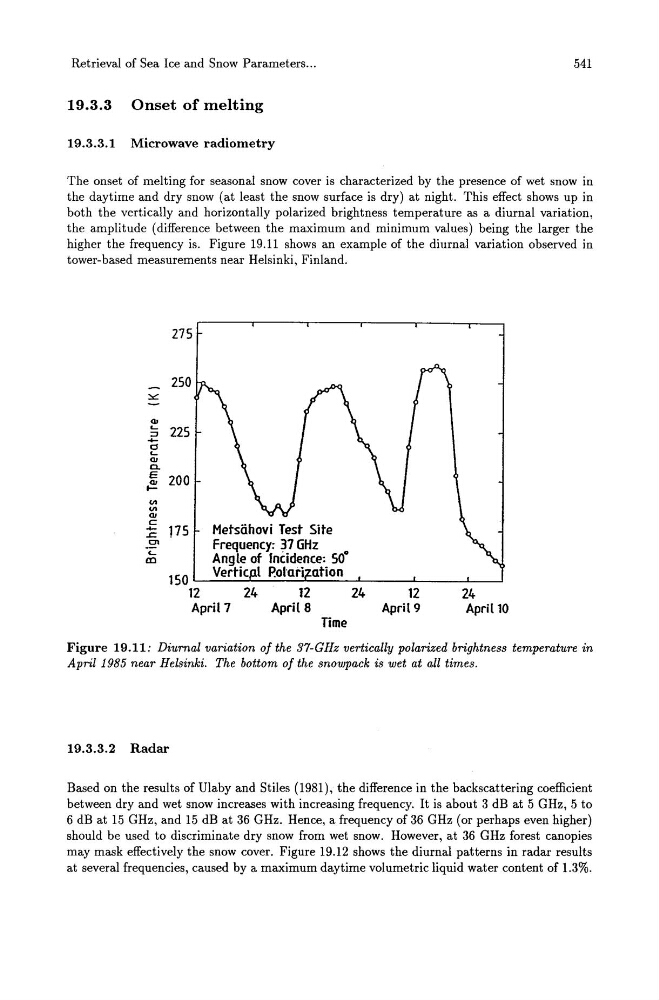
The onset of melting for seasonal snow cover is characterized by the presence of wet snow in
the daytime and dry snow (at least the snow surface is dry) at night. This effect shows up in
both the vertically and horizontally polarized brightness temperature as a diurnal variation,
the amplitude (difference between the maximum and minimum values) being the larger the
higher the frequency is. Figure 19.11 shows an example of the diurnal variation observed in
tower-based measurements near Helsinki, Finland.
275
250
C1I
~ 225
+o
E
~
C
200
:::: 175
en
c....
(D
Metsahovi Test Site
Frequency: 37 GHz
Angle of InCidence: 50°
Vertic I Pol"ari ation
150L-~~~~~~---L----~----L-~
12
24
12
April 7
April 8
Time
24
12
April 9
24
April 10
Figure 19.11: Diurnal variation of the 37-GHz vertically polarized brightness temperature in
April 1985 near Helsinki. The bottom of the snowpack is wet at all times.
19.3.3.2 Radar
Based on the results of Ulaby and Stiles (1981), the difference in the backscattering coefficient
between dry and wet snow increases with increasing frequency. It is about 3 dB at 5 GHz, 5 to
6 dB at 15 GHz, and 15 dB at 36 GHz. Hence, a frequency of 36 GHz (or perhaps even higher)
should be used to discriminate dry snow from wet snow. However, at 36 GHz forest canopies
may mask effectively the snow cover. Figure 19.12 shows the diurnal patterns in radar results
at several frequencies, caused by a maximum daytime volumetric liquid water content of 1.3%.