

Retrieval of Sea Ice and Snow Parameters ...
0,-----.-----.-----.-----,
CD
3-10
.J
~ -20
;g
";;
o
u
go -30
·c .,
:g
o
.,
ii -40
o
(D
Frequency: 5.4 GHz
Incidence Angle: 23·
New Ice
_50L-____ J -____ ~ ____ ~ ____ _ J
-40
-30
-20
-10
o
Bockscottering Coefficient a;'" (dB)
O,----.r----.-----.-----,
m
3-10
.s o
1j -20
~ ., o
u
go -30
·c
2
"0
:;:
<'j -40
o
m
Frequency: 9.8 GHz
Incidence Angle: 45·
_50L-__ ~L-_ _ - J ____ ~ ____ _ J
-40
-30
-20
-10
o
Bockscottering Coefficient a;,., (dB)
535
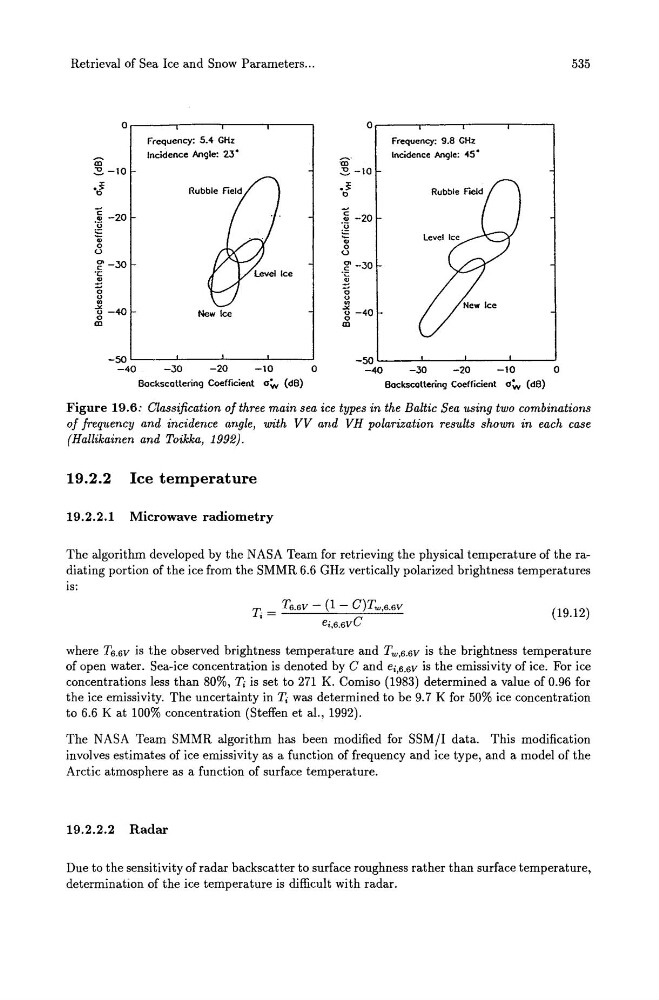
Figure 19.6: Classification of three main sea ice types in the Baltic Sea using two combinations
of frequency and incidence angle, with VV and VH polarization results shown in each case
(Hallikainen and Toikka, 1992).
19.2.2 Ice temperature
19.2.2.1 Microwave radiometry
The algorithm developed by the NASA Team for retrieving the physical temperature of the radiating portion of the ice from the SMMR 6.6 GHz vertically polarized brightness temperatures
IS:
Ti = T 6.6V - (1 - C)Tw ,6.6V
ei,6.6vC
(19.12)
where T 6.6V is the observed brightness temperature and T w ,6.6V is the brightness temperature
of open water. Sea-ice concentration is denoted by C and ei,6.6V is the emissivity of ice. For ice
concentrations less than 80%, Ti is set to 271 K. Comiso (1983) determined a value of 0.96 for
the ice emissivity. The uncertainty in Ti was determined to be 9.7 K for 50% ice concentration
to 6.6 K at 100% concentration (Steffen et al., 1992).
The NASA Team SMMR algorithm has been modified for SSM/I data. This modification
involves estimates of ice emissivity as a function of frequency and ice type, and a model of the
Arctic atmosphere as a function of surface temperature.
19.2.2.2 Radar
Due to the sensitivity of radar backscatter to surface roughness rather than surface temperature,
determination of the ice temperature is difficult with radar.