

536
M. Hallikainen
19.2.3 Monitoring of ice movement
19.2.3.1 Microwave radiometry
The spatial resolution of present spaceborne microwave radiometers is modest, so drifting of
only very large ice floes can be done.
19.2.3.2 Radar
The main advantages of spaceborne SAR in ice motion monitoring are its fine spatial resolution
and all-weather, day/night operational capability. The most common approach to automatic
ice tracking is cross-correlation between two images. A common feature is likely when a small
region (n x n pixels) in one image has a peak correlation with a small region in another image.
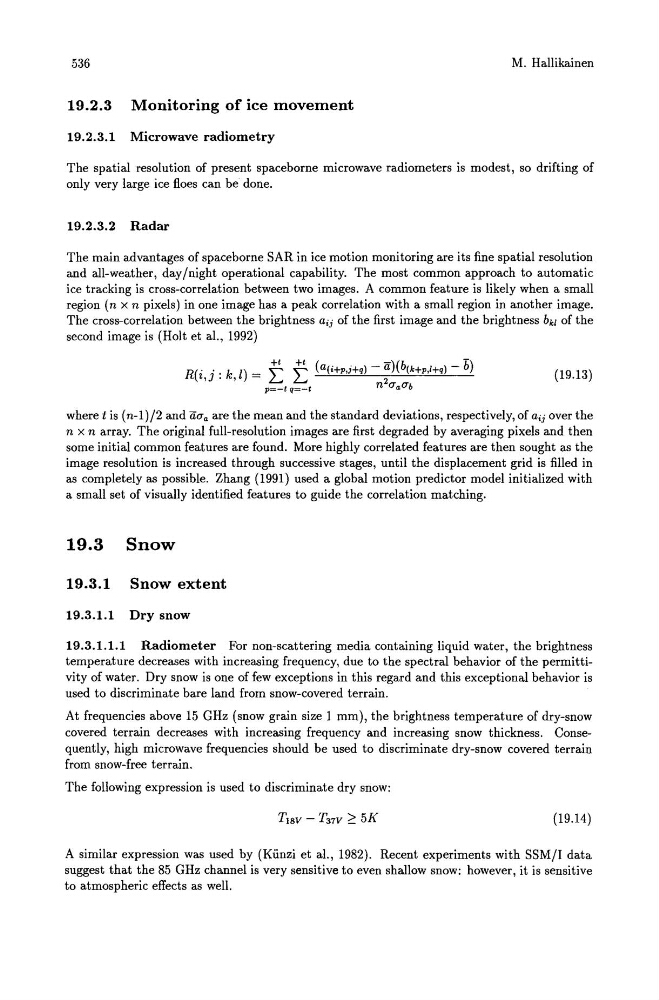
The cross-correlation between the brightness aij of the first image and the brightness bk1 of the
second image is (Holt et al., 1992)
(19.13)
where t is (n-1)/2 and aUa are the mean and the standard deviations, respectively, of aij over the
n x n array. The original full-resolution images are first degraded by averaging pixels and then
some initial common features are found. More highly correlated features are then sought as the
image resolution is increased through successive stages, until the displacement grid is filled in
as completely as possible. Zhang (1991) used a global motion predictor model initialized with
a small set of visually identified features to guide the correlation matching.
19.3 Snow
19.3.1 Snow extent
19.3.1.1 Dry snow
19.3.1.1.1 Radiometer For non-scattering media containing liquid water, the brightness
temperature decreases with increasing frequency, due to the spectral behavior of the permittivity of water. Dry snow is one of few exceptions in this regard and this exceptional behavior is
used to discriminate bare land from snow-covered terrain.
At frequencies above 15 GHz (snow grain size 1 mm), the brightness temperature of dry-snow
covered terrain decreases with increasing frequency and increasing snow thickness. Consequently, high microwave frequencies should be used to discriminate dry-snow covered terrain
from snow-free terrain.
The following expression is used to discriminate dry snow:
(19.14)
A similar expression was used by (Kiinzi et al., 1982). Recent experiments with SSM/I data
suggest that the 85 GHz channel is very sensitive to even shallow snow: however, it is sensitive
to atmospheric effects as well.