

Retrieval of Sea Ice and Snow Parameters ...
533
-6
-10
I j I~ i I~I I II II
- CD IId lI I I I I I I II
"0
- -14L..
(J)
-
- as -180
(J)
.:.::.
~
0
as
1 ~
I
CD -22
-26
I
•
19
21
23
25
27
Incidenceangle (degrees)
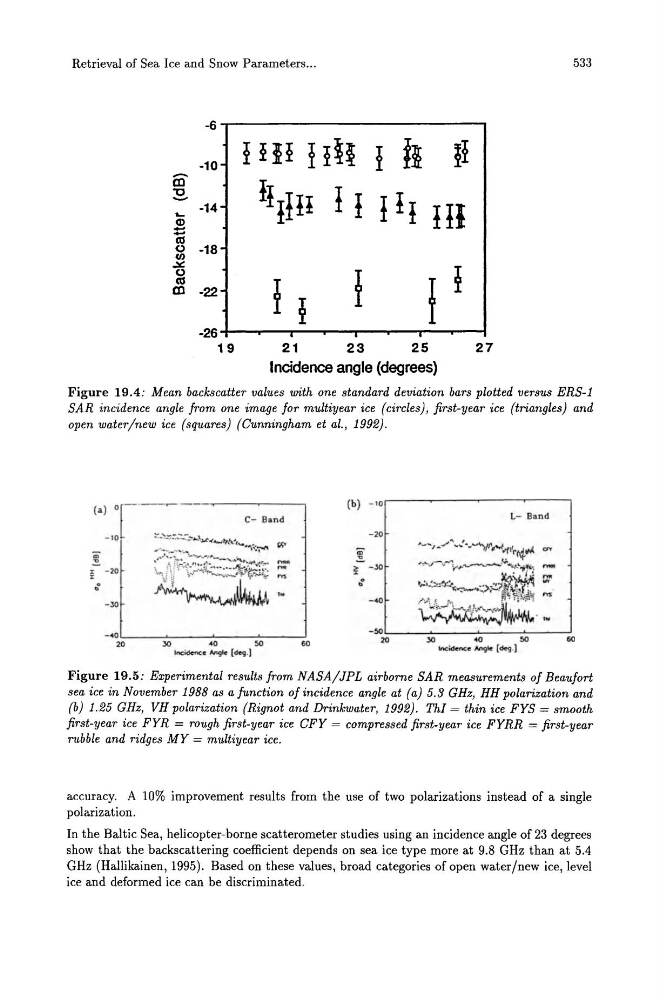
Figure 19.4: Mean backscatter values with one standard deviation bars plotted versus ERS-1
SAR incidence angle from one image for multiyear ice (circles), first-year ice (triangles) and
open water/new ice (squares) (Cunningham et al., 1992).
-.O L _ _ ~ _ _ ~ _ _ ~ _ _ ---.J
ro
30
~
~
W
k>e~. ""'lie lde
m
..,
-20
~- -30
.:
L- Band
- ~ L _ _ ~ _ _ ____ ~ _ _ ---.J
ro
30
~
~
W
Inc ....... MgIe Id«l-J
Figure 19.5: Experimental results from NASA/JPL airborne SAR measurements of Beaufort
sea ice in November 1988 as a function of incidence angle at (a) 5.3 GHz, HH polarization and
(b) 1.25 GHz, VH polarization (Rignot and Drinkwater, 1992). ThI = thin ice FYS = smooth
first-year ice FYR = rough first-year ice CFY = compressed first-year ice FYRR = first-year
rubble and ridges MY = multiyear ice.
accuracy. A 10% improvement results from the use of two polarizations instead of a single
polarization.
In the Baltic Sea, helicopter-borne scatterometer studies using an incidence angle of 23 degrees
show that the backscattering coefficient depends on sea ice type more at 9.8 GHz than at 5.4
GHz (Hallikainen, 1995). Based on these values, broad categories of open water/new ice, level
ice and deformed ice can be discriminated.