

Physical Basis for Microwave Remote Sensing ...
521
Test SUe Sodankyla
Test Site Sodankyla
20,------- --------,
g
-.,
g
-t
-20
~
-.I
E
0,-00g
E
(!
- .. (!
i
.."
CIoar-CUO
i
!
--- ~
F..-mI2nd
. .
;;
----0
f
~
""""'
t
-ti
u
~"Gttr
-eo
...... ., ......... : 41 ...
-100
, '00 I...J... _ _ _ ----.JL-_ _ _ -'---_ _ _ - - l..l
Foil
M1cI-Wln\ef
St>
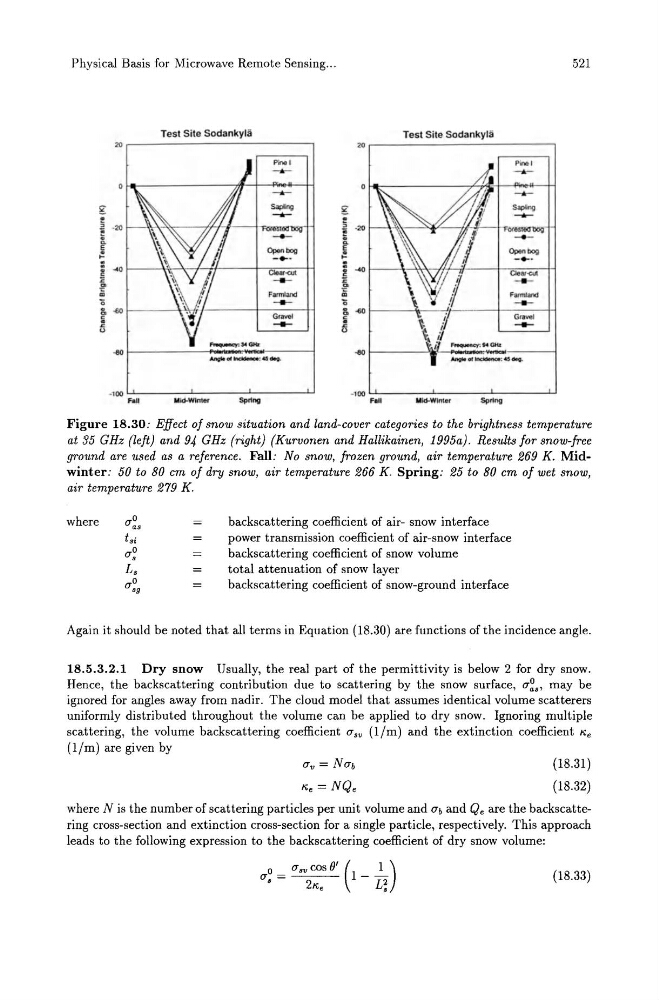
at 35 GHz (left) and 94 GHz (right) (Kurvonen and Hallikainen, 1995a). Results for snow-free
ground are used as a reference. Fall: No snow, frozen ground, air temperature 269 K. Midwinter: 50 to 80 cm of dry snow, air temperature 266 K. Spring: 25 to 80 cm of wet snow,
air temperature 279 K.
where
backscattering coefficient of air- snow interface
power transmission coefficient of air-snow interface
backscattering coefficient of snow volume
total attenuation of snow layer
backscattering coefficient of snow-ground interface
Again it should be noted that all terms in Equation (18.30) are functions of the incidence angle.
18.5.3.2.1 Dry snow Usually, the real part of the permittivity is below 2 for dry snow.
Hence, the backscattering contribution due to scattering by the snow surface, u~., may be
ignored for angles away from nadir. The cloud model that assumes identical volume scatterers
uniformly distributed throughout the volume can be applied to dry snow. Ignoring multiple
scattering, the volume backscattering coefficient U sv (11m) and the extinction coefficient K.e
(11m) are given by
K.e = NQe
(18.31 )
(18.32)
where N is the number of scattering particles per unit volume and Ub and Qe are the backscattering cross-section and extinction cross-section for a single particle, respectively. This approach
leads to the following expression to the backscattering coefficient of dry snow volume:
u~ = u sv2:s 0' (1 _ ~~)
(18.33)