

522
M. Hallikainen
In Equation (18.33) 8' is the propagation direction in snow. If the backscattering contribution
from the snow surface can be neglected, 17? should be expected to be insensitive to the surface
roughness. It has been shown that this is the case (Stiles and Ulaby, 1980).
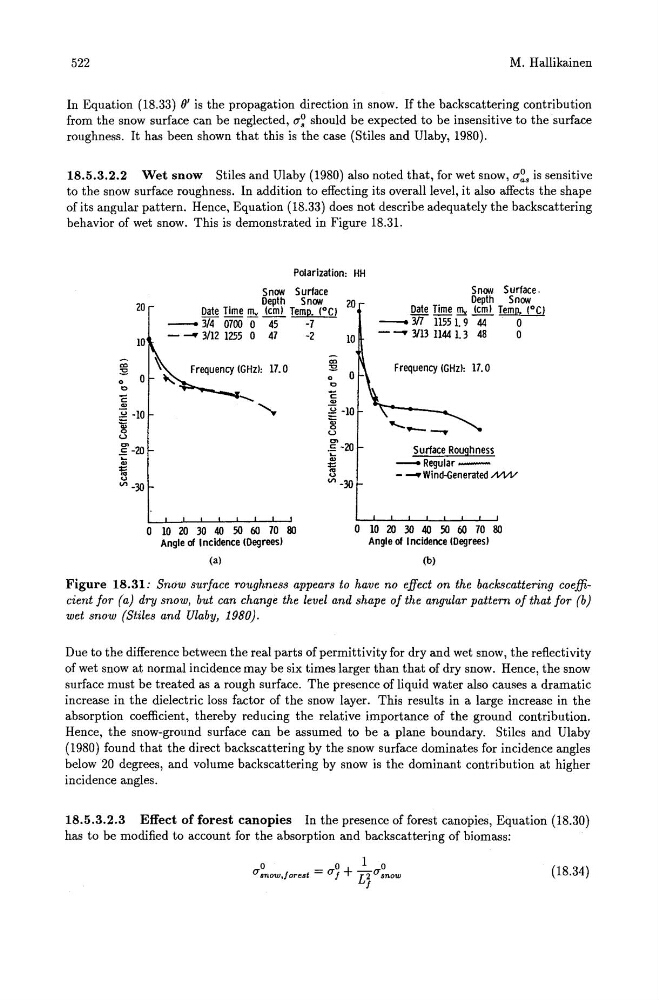
18.5.3.2.2 Wet snow Stiles and Ulaby (1980) also noted that, for wet snow, l7~s is sensitive
to the snow surface roughness. In addition to effecting its overall level, it also affects the shape
of its angular pattern. Hence, Equation (18.33) does not describe adequately the backscattering
behavior of wet snow. This is demonstrated in Figure 18.31.
20
10
Polarization: HH
Snow Surface
Depth Snow
20
Date Time!& (em) Temp. (OC)
-
3/4 0700 0 45
-7
- - 3/12 1255 0 47
-2
10
<0
<0
~
:
0
~
Frequency (GHz): 17.0
:g
° ., o
.,
c
'"
~-1O
~
'-'
g' -20
;:
'"
~ V'l_3O
c .,
~-10
~
'-'
~-20
.,
~
. .
~-3O
Snow Surface.
Depth Snow
Date Time !& J£!!!!. Temp. (0C)
-
3/7 1155 1. 9 44
0
- - 3/13 1144 1.3 48
0
Frequency (GHz): 17.0
Surface Roughness
-Regular- _ Wind-Generated /VL-1/
010203040 5060 7080
Angle of Incidence (Degrees)
01020304050607080
Angle of Incidence (Degrees)
(a)
(h)
Figure 18.31: Snow surface roughness appears to have no effect on the backscattering coefficient for (a) dry snow, but can change the level and shape of the angular pattern of that for (b)
wet snow (Stiles and Ulaby, 1980).
Due to the difference between the real parts of permittivity for dry and wet snow, the reflectivity
of wet snow at normal incidence may be six times larger than that of dry snow. Hence, the snow
surface must be treated as a rough surface. The presence of liquid water also causes a dramatic
increase in the dielectric loss factor of the snow layer. This results in a large increase in the
absorption coefficient, thereby reducing the relative importance of the ground contribution.
Hence, the snow-ground surface can be assumed to be a plane boundary. Stiles and Ulaby
(1980) found that the direct backscattering by the snow surface dominates for incidence angles
below 20 degrees, and volume backscattering by snow is the dominant contribution at higher
incidence angles.
18.5.3.2.3 Effect offorest canopies In the presence of forest canopies, Equation (18.30)
has to be modified to account for the absorption and backscattering of biomass:
o
0
1 0
(J'snow,!orest = CT j + L20'snow
f
(18.34)